

OXYGEN AS A NUCLEOPHILE: HEMIACETALS, HEMIKETALS, ACETALS AND KETALS
225
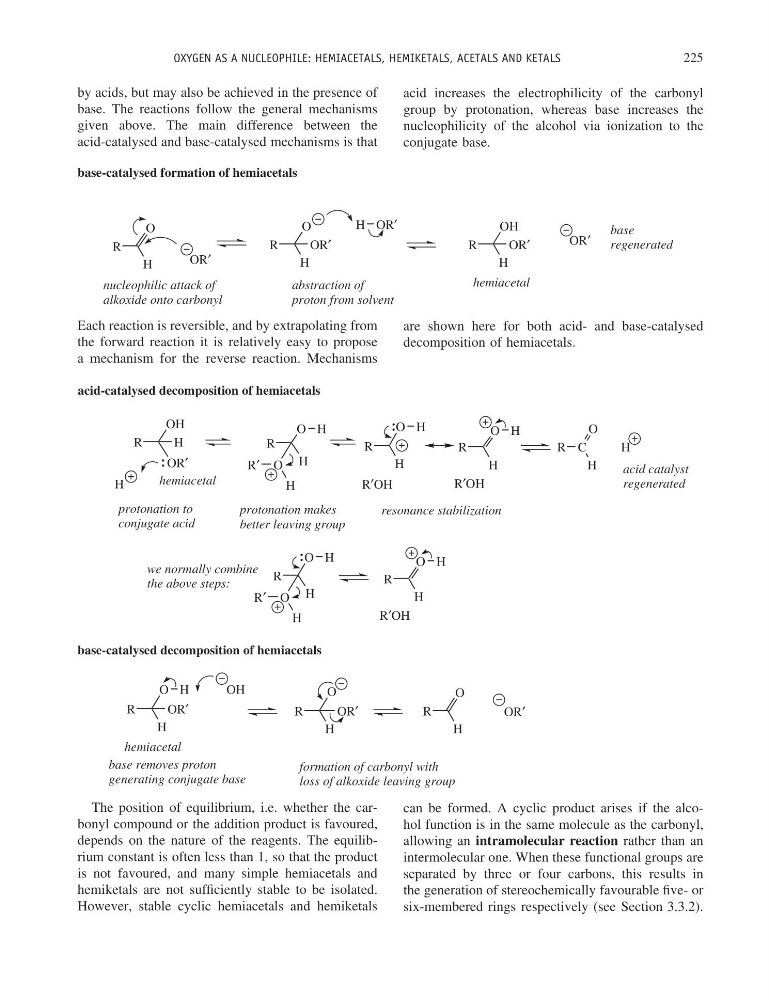
by acids, but may also be achieved in the presence of
base. The reactions follow the general mechanisms
given above. The main difference between the
acid-catalysed and base-catalysed mechanisms is that
acid increases the electrophilicity of the carbonyl
group by protonation, whereas base increases the
nucleophilicity of the alcohol via ionization to the
conjugate base.
R
O
H
R
O
H
OR′
H OR′
R
OH
H
OR′
hemiacetal
OR′
base-catalysed formation of hemiacetals
abstraction of
proton from solvent
nucleophilic attack of
alkoxide onto carbonyl
base
regenerated
OR′
Each reaction is reversible, and by extrapolating from
the forward reaction it is relatively easy to propose
a mechanism for the reverse reaction. Mechanisms
are shown here for both acid- and base-catalysed
decomposition of hemiacetals.
acid catalyst
regenerated
acid-catalysed decomposition of hemiacetals
R
OR′
OH
hemiacetal
R
O
H
H
O
R′
H
R
O
H
H
R′OH
R C
O
H
protonation to
conjugate acid
protonation makes
better leaving group
R
O
H
H
R′OH
R
O
H
H
O
R′
H
resonance stabilization
R
O
H
H
R′OH
we normally combine
the above steps:
H
H
H
base-catalysed decomposition of hemiacetals
R
O
H
OR′
hemiacetal
H
OH
R
O
H
OR′
R
O
H
OR′
base removes proton
generating conjugate base
formation of carbonyl with
loss of alkoxide leaving group
The position of equilibrium, i.e. whether the carbonyl compound or the addition product is favoured,
depends on the nature of the reagents. The equilibrium constant is often less than 1, so that the product
is not favoured, and many simple hemiacetals and
hemiketals are not sufficiently stable to be isolated.
However, stable cyclic hemiacetals and hemiketals
can be formed. A cyclic product arises if the alcohol function is in the same molecule as the carbonyl,
allowing an intramolecular reaction rather than an
intermolecular one. When these functional groups are
separated by three or four carbons, this results in
the generation of stereochemically favourable five- or
six-membered rings respectively (see Section 3.3.2).
225
by acids, but may also be achieved in the presence of
base. The reactions follow the general mechanisms
given above. The main difference between the
acid-catalysed and base-catalysed mechanisms is that
acid increases the electrophilicity of the carbonyl
group by protonation, whereas base increases the
nucleophilicity of the alcohol via ionization to the
conjugate base.
R
O
H
R
O
H
OR′
H OR′
R
OH
H
OR′
hemiacetal
OR′
base-catalysed formation of hemiacetals
abstraction of
proton from solvent
nucleophilic attack of
alkoxide onto carbonyl
base
regenerated
OR′
Each reaction is reversible, and by extrapolating from
the forward reaction it is relatively easy to propose
a mechanism for the reverse reaction. Mechanisms
are shown here for both acid- and base-catalysed
decomposition of hemiacetals.
acid catalyst
regenerated
acid-catalysed decomposition of hemiacetals
R
OR′
OH
hemiacetal
R
O
H
H
O
R′
H
R
O
H
H
R′OH
R C
O
H
protonation to
conjugate acid
protonation makes
better leaving group
R
O
H
H
R′OH
R
O
H
H
O
R′
H
resonance stabilization
R
O
H
H
R′OH
we normally combine
the above steps:
H
H
H
base-catalysed decomposition of hemiacetals
R
O
H
OR′
hemiacetal
H
OH
R
O
H
OR′
R
O
H
OR′
base removes proton
generating conjugate base
formation of carbonyl with
loss of alkoxide leaving group
The position of equilibrium, i.e. whether the carbonyl compound or the addition product is favoured,
depends on the nature of the reagents. The equilibrium constant is often less than 1, so that the product
is not favoured, and many simple hemiacetals and
hemiketals are not sufficiently stable to be isolated.
However, stable cyclic hemiacetals and hemiketals
can be formed. A cyclic product arises if the alcohol function is in the same molecule as the carbonyl,
allowing an intramolecular reaction rather than an
intermolecular one. When these functional groups are
separated by three or four carbons, this results in
the generation of stereochemically favourable five- or
six-membered rings respectively (see Section 3.3.2).