

224
NUCLEOPHILIC REACTIONS OF CARBONYL GROUPS
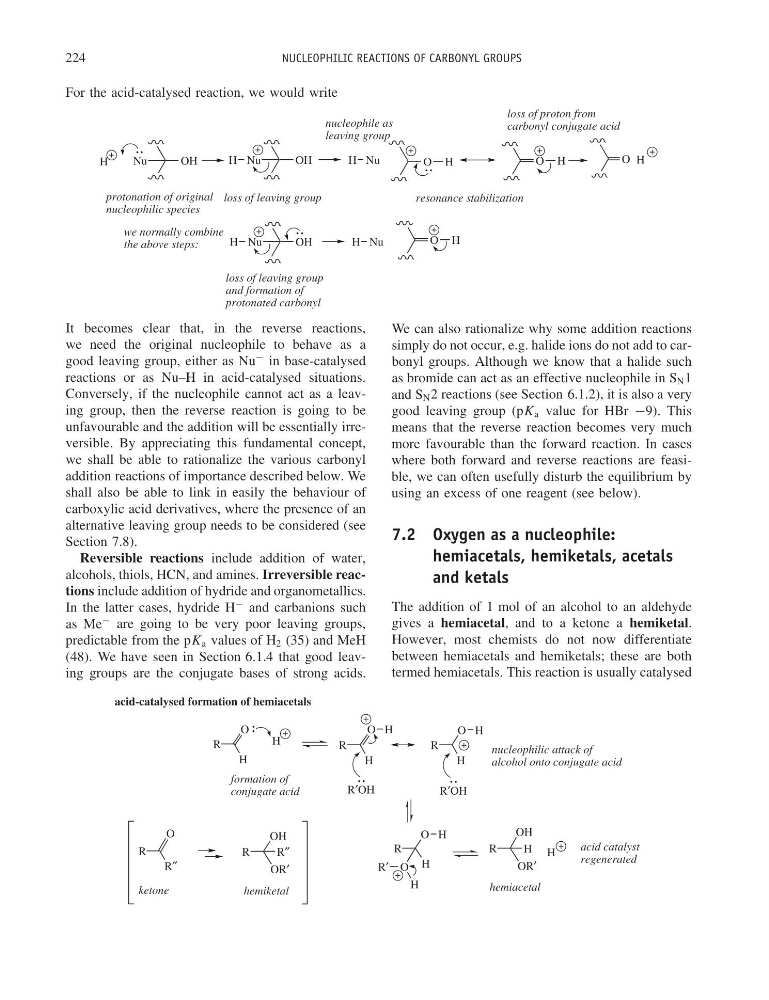
For the acid-catalysed reaction, we would write
Nu
OH
Nu
OH
H
O H
H Nu
O
protonation of original
nucleophilic species
loss of leaving group
loss of proton from
carbonyl conjugate acid
nucleophile as
leaving group
resonance stabilization
O H
Nu
OH
H
loss of leaving group
and formation of
protonated carbonyl
we normally combine
the above steps:
H Nu
O H
H
H
It becomes clear that, in the reverse reactions,
we need the original nucleophile to behave as a
good leaving group, either as Nu
− in base-catalysed
reactions or as Nu–H in acid-catalysed situations.
Conversely, if the nucleophile cannot act as a leaving group, then the reverse reaction is going to be
unfavourable and the addition will be essentially irreversible. By appreciating this fundamental concept,
we shall be able to rationalize the various carbonyl
addition reactions of importance described below. We
shall also be able to link in easily the behaviour of
carboxylic acid derivatives, where the presence of an
alternative leaving group needs to be considered (see
Section 7.8).
Reversible reactions include addition of water,
alcohols, thiols, HCN, and amines. Irreversible reactions include addition of hydride and organometallics.
In the latter cases, hydride H
− and carbanions such
as Me
− are going to be very poor leaving groups,
predictable from the pK a values of H 2 (35) and MeH
(48). We have seen in Section 6.1.4 that good leaving groups are the conjugate bases of strong acids.
We can also rationalize why some addition reactions
simply do not occur, e.g. halide ions do not add to carbonyl groups. Although we know that a halide such
as bromide can act as an effective nucleophile in S N 1
and S N 2 reactions (see Section 6.1.2), it is also a very
good leaving group (pK a value for HBr −9). This
means that the reverse reaction becomes very much
more favourable than the forward reaction. In cases
where both forward and reverse reactions are feasible, we can often usefully disturb the equilibrium by
using an excess of one reagent (see below).
7.2 Oxygen as a nucleophile:
hemiacetals, hemiketals, acetals
and ketals
The addition of 1 mol of an alcohol to an aldehyde
gives a hemiacetal, and to a ketone a hemiketal.
However, most chemists do not now differentiate
between hemiacetals and hemiketals; these are both
termed hemiacetals. This reaction is usually catalysed
R
O
H
R
O
H
H
R
O
H
H
R
O
H
H
O
R′
H
R
OR′
OH
R
OR′
OH
R″
R
O
R″
R′OH
ketone
R′OH
nucleophilic attack of
alcohol onto conjugate acid
hemiacetal
hemiketal
formation of
conjugate acid
acid catalyst
regenerated
acid-catalysed formation of hemiacetals
H
H
H
NUCLEOPHILIC REACTIONS OF CARBONYL GROUPS
For the acid-catalysed reaction, we would write
Nu
OH
Nu
OH
H
O H
H Nu
O
protonation of original
nucleophilic species
loss of leaving group
loss of proton from
carbonyl conjugate acid
nucleophile as
leaving group
resonance stabilization
O H
Nu
OH
H
loss of leaving group
and formation of
protonated carbonyl
we normally combine
the above steps:
H Nu
O H
H
H
It becomes clear that, in the reverse reactions,
we need the original nucleophile to behave as a
good leaving group, either as Nu
− in base-catalysed
reactions or as Nu–H in acid-catalysed situations.
Conversely, if the nucleophile cannot act as a leaving group, then the reverse reaction is going to be
unfavourable and the addition will be essentially irreversible. By appreciating this fundamental concept,
we shall be able to rationalize the various carbonyl
addition reactions of importance described below. We
shall also be able to link in easily the behaviour of
carboxylic acid derivatives, where the presence of an
alternative leaving group needs to be considered (see
Section 7.8).
Reversible reactions include addition of water,
alcohols, thiols, HCN, and amines. Irreversible reactions include addition of hydride and organometallics.
In the latter cases, hydride H
− and carbanions such
as Me
− are going to be very poor leaving groups,
predictable from the pK a values of H 2 (35) and MeH
(48). We have seen in Section 6.1.4 that good leaving groups are the conjugate bases of strong acids.
We can also rationalize why some addition reactions
simply do not occur, e.g. halide ions do not add to carbonyl groups. Although we know that a halide such
as bromide can act as an effective nucleophile in S N 1
and S N 2 reactions (see Section 6.1.2), it is also a very
good leaving group (pK a value for HBr −9). This
means that the reverse reaction becomes very much
more favourable than the forward reaction. In cases
where both forward and reverse reactions are feasible, we can often usefully disturb the equilibrium by
using an excess of one reagent (see below).
7.2 Oxygen as a nucleophile:
hemiacetals, hemiketals, acetals
and ketals
The addition of 1 mol of an alcohol to an aldehyde
gives a hemiacetal, and to a ketone a hemiketal.
However, most chemists do not now differentiate
between hemiacetals and hemiketals; these are both
termed hemiacetals. This reaction is usually catalysed
R
O
H
R
O
H
H
R
O
H
H
R
O
H
H
O
R′
H
R
OR′
OH
R
OR′
OH
R″
R
O
R″
R′OH
ketone
R′OH
nucleophilic attack of
alcohol onto conjugate acid
hemiacetal
hemiketal
formation of
conjugate acid
acid catalyst
regenerated
acid-catalysed formation of hemiacetals
H
H
H