

NUCLEOPHILIC ADDITION TO CARBONYL GROUPS: ALDEHYDES AND KETONES
223
C O
H 3 C
H 3 C
C O
H
H 3 C
d+ d–
d+ d–
the aldehyde carbon is more
electrophilic than the ketone carbon
O
H
d+ d–
O
H
O
H
etc.
aromatic compounds are less reactive;
the aromatic ring delocalizes positive
charge away from carbonyl carbon
aldehydes are more
reactive than ketones
aromatic aldehydes are less
reactive than aliphatic aldehydes
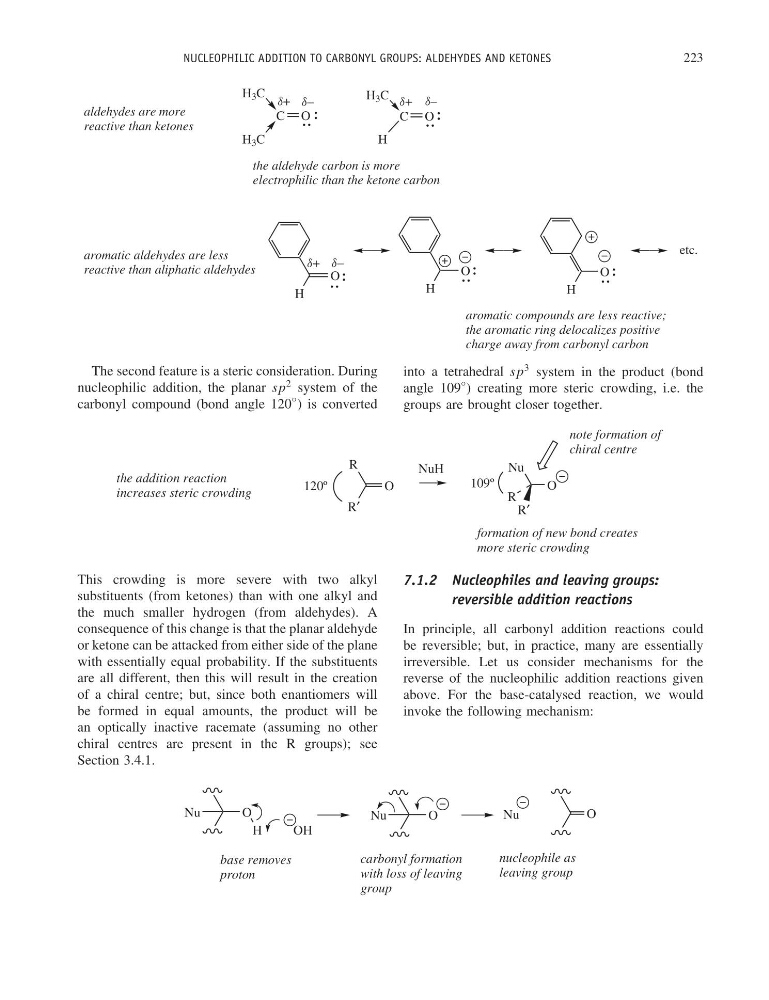
The second feature is a steric consideration. During
nucleophilic addition, the planar sp
2 system of the
carbonyl compound (bond angle 120
◦ ) is converted
into a tetrahedral sp
3 system in the product (bond
angle 109
◦ ) creating more steric crowding, i.e. the
groups are brought closer together.
O
R′
Nu
R
formation of new bond creates
more steric crowding
note formation of
chiral centre
O
R′
R
120º
109º
NuH
the addition reaction
increases steric crowding
This crowding is more severe with two alkyl
substituents (from ketones) than with one alkyl and
the much smaller hydrogen (from aldehydes). A
consequence of this change is that the planar aldehyde
or ketone can be attacked from either side of the plane
with essentially equal probability. If the substituents
are all different, then this will result in the creation
of a chiral centre; but, since both enantiomers will
be formed in equal amounts, the product will be
an optically inactive racemate (assuming no other
chiral centres are present in the R groups); see
Section 3.4.1.
7.1.2 Nucleophiles and leaving groups:
reversible addition reactions
In principle, all carbonyl addition reactions could
be reversible; but, in practice, many are essentially
irreversible. Let us consider mechanisms for the
reverse of the nucleophilic addition reactions given
above. For the base-catalysed reaction, we would
invoke the following mechanism:
Nu
O
H
OH
Nu
O
O
Nu
base removes
proton
carbonyl formation
with loss of leaving
group
nucleophile as
leaving group
223
C O
H 3 C
H 3 C
C O
H
H 3 C
d+ d–
d+ d–
the aldehyde carbon is more
electrophilic than the ketone carbon
O
H
d+ d–
O
H
O
H
etc.
aromatic compounds are less reactive;
the aromatic ring delocalizes positive
charge away from carbonyl carbon
aldehydes are more
reactive than ketones
aromatic aldehydes are less
reactive than aliphatic aldehydes
The second feature is a steric consideration. During
nucleophilic addition, the planar sp
2 system of the
carbonyl compound (bond angle 120
◦ ) is converted
into a tetrahedral sp
3 system in the product (bond
angle 109
◦ ) creating more steric crowding, i.e. the
groups are brought closer together.
O
R′
Nu
R
formation of new bond creates
more steric crowding
note formation of
chiral centre
O
R′
R
120º
109º
NuH
the addition reaction
increases steric crowding
This crowding is more severe with two alkyl
substituents (from ketones) than with one alkyl and
the much smaller hydrogen (from aldehydes). A
consequence of this change is that the planar aldehyde
or ketone can be attacked from either side of the plane
with essentially equal probability. If the substituents
are all different, then this will result in the creation
of a chiral centre; but, since both enantiomers will
be formed in equal amounts, the product will be
an optically inactive racemate (assuming no other
chiral centres are present in the R groups); see
Section 3.4.1.
7.1.2 Nucleophiles and leaving groups:
reversible addition reactions
In principle, all carbonyl addition reactions could
be reversible; but, in practice, many are essentially
irreversible. Let us consider mechanisms for the
reverse of the nucleophilic addition reactions given
above. For the base-catalysed reaction, we would
invoke the following mechanism:
Nu
O
H
OH
Nu
O
O
Nu
base removes
proton
carbonyl formation
with loss of leaving
group
nucleophile as
leaving group