

220
NUCLEOPHILIC REACTIONS: NUCLEOPHILIC SUBSTITUTION
Box 6.12 (continued)
O
H
H
H
H
HO
H
H
HO
squalene oxide
squalene
protosteryl cation
lanosterol
sequence of concerted
1,2-hydride and 1,2-methyl shifts
loss of proton
gives alkene
series of
electrophilic
cyclizations
H
HO
carbocation formation by protonation
and ring opening of epoxide
cytochrome P-450
dependent oxidation
cholesterol
H
H
H
H
HO
protosteryl cation
H
H
H
HO
H
H
HO
H
H
H
H
H
HO
H
H
H
H
HO
H
H
H
HO
H
H
hydride
shift
methyl
shift
hydride
shift
methyl
shift
proton
loss
lanosterol
see below for further
details
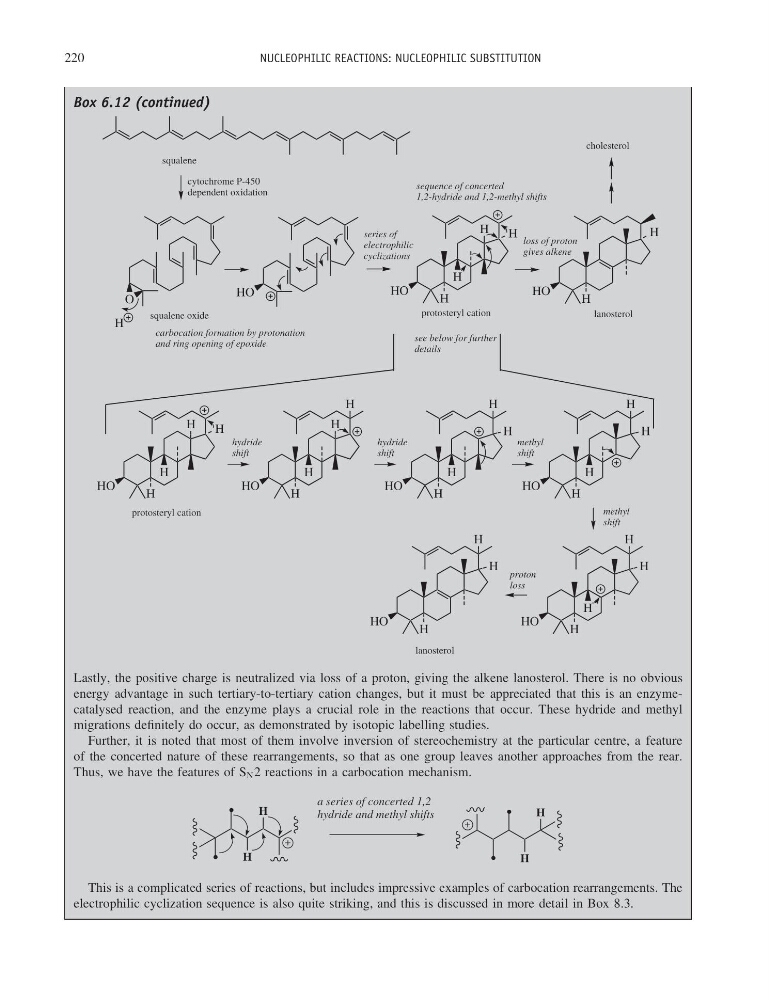
Lastly, the positive charge is neutralized via loss of a proton, giving the alkene lanosterol. There is no obvious
energy advantage in such tertiary-to-tertiary cation changes, but it must be appreciated that this is an enzymecatalysed reaction, and the enzyme plays a crucial role in the reactions that occur. These hydride and methyl
migrations definitely do occur, as demonstrated by isotopic labelling studies.
Further, it is noted that most of them involve inversion of stereochemistry at the particular centre, a feature
of the concerted nature of these rearrangements, so that as one group leaves another approaches from the rear.
Thus, we have the features of S N 2 reactions in a carbocation mechanism.
H
H
H
H
a series of concerted 1,2
hydride and methyl shifts
•
•
•
•
This is a complicated series of reactions, but includes impressive examples of carbocation rearrangements. The
electrophilic cyclization sequence is also quite striking, and this is discussed in more detail in Box 8.3.
NUCLEOPHILIC REACTIONS: NUCLEOPHILIC SUBSTITUTION
Box 6.12 (continued)
O
H
H
H
H
HO
H
H
HO
squalene oxide
squalene
protosteryl cation
lanosterol
sequence of concerted
1,2-hydride and 1,2-methyl shifts
loss of proton
gives alkene
series of
electrophilic
cyclizations
H
HO
carbocation formation by protonation
and ring opening of epoxide
cytochrome P-450
dependent oxidation
cholesterol
H
H
H
H
HO
protosteryl cation
H
H
H
HO
H
H
HO
H
H
H
H
H
HO
H
H
H
H
HO
H
H
H
HO
H
H
hydride
shift
methyl
shift
hydride
shift
methyl
shift
proton
loss
lanosterol
see below for further
details
Lastly, the positive charge is neutralized via loss of a proton, giving the alkene lanosterol. There is no obvious
energy advantage in such tertiary-to-tertiary cation changes, but it must be appreciated that this is an enzymecatalysed reaction, and the enzyme plays a crucial role in the reactions that occur. These hydride and methyl
migrations definitely do occur, as demonstrated by isotopic labelling studies.
Further, it is noted that most of them involve inversion of stereochemistry at the particular centre, a feature
of the concerted nature of these rearrangements, so that as one group leaves another approaches from the rear.
Thus, we have the features of S N 2 reactions in a carbocation mechanism.
H
H
H
H
a series of concerted 1,2
hydride and methyl shifts
•
•
•
•
This is a complicated series of reactions, but includes impressive examples of carbocation rearrangements. The
electrophilic cyclization sequence is also quite striking, and this is discussed in more detail in Box 8.3.