

COMPETING REACTIONS: ELIMINATIONS AND REARRANGEMENTS
219
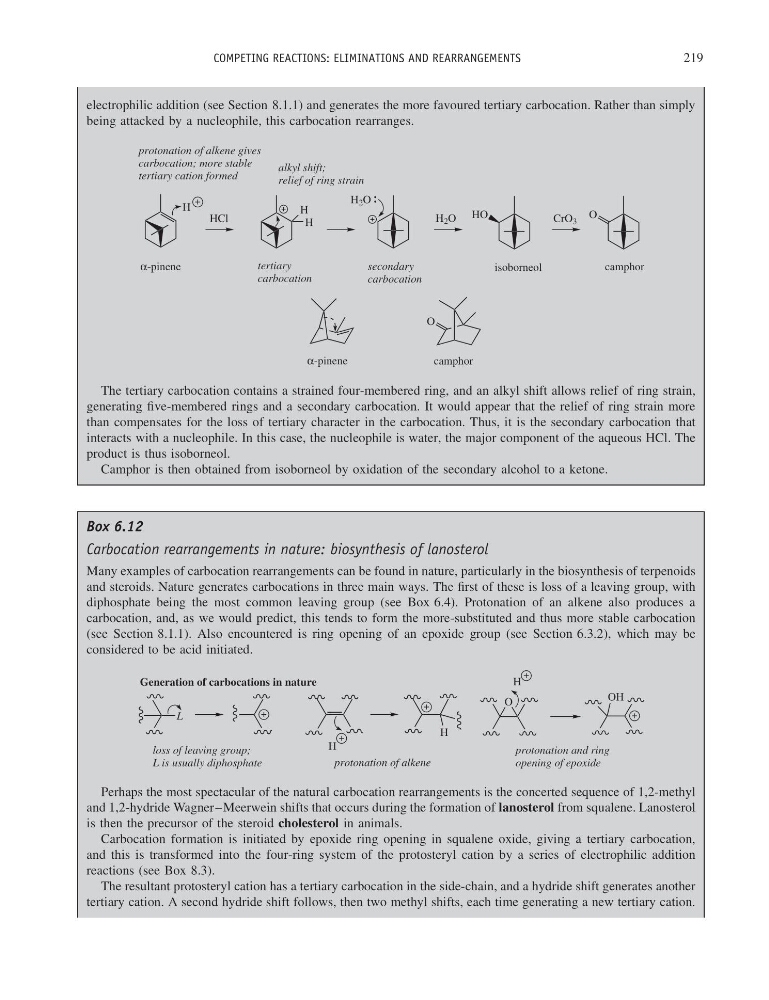
electrophilic addition (see Section 8.1.1) and generates the more favoured tertiary carbocation. Rather than simply
being attacked by a nucleophile, this carbocation rearranges.
H
H
tertiary
carbocation
α-pinene
HO
protonation of alkene gives
carbocation; more stable
tertiary cation formed
secondary
carbocation
alkyl shift;
relief of ring strain
O
isoborneol
camphor
O
H
α-pinene
camphor
HCl
H 2 O
CrO 3
H 2 O
The tertiary carbocation contains a strained four-membered ring, and an alkyl shift allows relief of ring strain,
generating five-membered rings and a secondary carbocation. It would appear that the relief of ring strain more
than compensates for the loss of tertiary character in the carbocation. Thus, it is the secondary carbocation that
interacts with a nucleophile. In this case, the nucleophile is water, the major component of the aqueous HCl. The
product is thus isoborneol.
Camphor is then obtained from isoborneol by oxidation of the secondary alcohol to a ketone.
Box 6.12
Carbocation rearrangements in nature: biosynthesis of lanosterol
Many examples of carbocation rearrangements can be found in nature, particularly in the biosynthesis of terpenoids
and steroids. Nature generates carbocations in three main ways. The first of these is loss of a leaving group, with
diphosphate being the most common leaving group (see Box 6.4). Protonation of an alkene also produces a
carbocation, and, as we would predict, this tends to form the more-substituted and thus more stable carbocation
(see Section 8.1.1). Also encountered is ring opening of an epoxide group (see Section 6.3.2), which may be
considered to be acid initiated.
L
H
O
OH
Generation of carbocations in nature
loss of leaving group;
L is usually diphosphate
protonation of alkene
protonation and ring
opening of epoxide
H
H
Perhaps the most spectacular of the natural carbocation rearrangements is the concerted sequence of 1,2-methyl
and 1,2-hydride Wagner–Meerwein shifts that occurs during the formation of lanosterol from squalene. Lanosterol
is then the precursor of the steroid cholesterol in animals.
Carbocation formation is initiated by epoxide ring opening in squalene oxide, giving a tertiary carbocation,
and this is transformed into the four-ring system of the protosteryl cation by a series of electrophilic addition
reactions (see Box 8.3).
The resultant protosteryl cation has a tertiary carbocation in the side-chain, and a hydride shift generates another
tertiary cation. A second hydride shift follows, then two methyl shifts, each time generating a new tertiary cation.
219
electrophilic addition (see Section 8.1.1) and generates the more favoured tertiary carbocation. Rather than simply
being attacked by a nucleophile, this carbocation rearranges.
H
H
tertiary
carbocation
α-pinene
HO
protonation of alkene gives
carbocation; more stable
tertiary cation formed
secondary
carbocation
alkyl shift;
relief of ring strain
O
isoborneol
camphor
O
H
α-pinene
camphor
HCl
H 2 O
CrO 3
H 2 O
The tertiary carbocation contains a strained four-membered ring, and an alkyl shift allows relief of ring strain,
generating five-membered rings and a secondary carbocation. It would appear that the relief of ring strain more
than compensates for the loss of tertiary character in the carbocation. Thus, it is the secondary carbocation that
interacts with a nucleophile. In this case, the nucleophile is water, the major component of the aqueous HCl. The
product is thus isoborneol.
Camphor is then obtained from isoborneol by oxidation of the secondary alcohol to a ketone.
Box 6.12
Carbocation rearrangements in nature: biosynthesis of lanosterol
Many examples of carbocation rearrangements can be found in nature, particularly in the biosynthesis of terpenoids
and steroids. Nature generates carbocations in three main ways. The first of these is loss of a leaving group, with
diphosphate being the most common leaving group (see Box 6.4). Protonation of an alkene also produces a
carbocation, and, as we would predict, this tends to form the more-substituted and thus more stable carbocation
(see Section 8.1.1). Also encountered is ring opening of an epoxide group (see Section 6.3.2), which may be
considered to be acid initiated.
L
H
O
OH
Generation of carbocations in nature
loss of leaving group;
L is usually diphosphate
protonation of alkene
protonation and ring
opening of epoxide
H
H
Perhaps the most spectacular of the natural carbocation rearrangements is the concerted sequence of 1,2-methyl
and 1,2-hydride Wagner–Meerwein shifts that occurs during the formation of lanosterol from squalene. Lanosterol
is then the precursor of the steroid cholesterol in animals.
Carbocation formation is initiated by epoxide ring opening in squalene oxide, giving a tertiary carbocation,
and this is transformed into the four-ring system of the protosteryl cation by a series of electrophilic addition
reactions (see Box 8.3).
The resultant protosteryl cation has a tertiary carbocation in the side-chain, and a hydride shift generates another
tertiary cation. A second hydride shift follows, then two methyl shifts, each time generating a new tertiary cation.