

218
NUCLEOPHILIC REACTIONS: NUCLEOPHILIC SUBSTITUTION
H
H 3 C
H 3 C
HCl
H
H 3 C
CH 3
H 3 C
H
H 3 C
CH 3
H 3 C
H
(50%)
CH 3
H 3 C
H
H
CH 3
Cl
H
CH 3
Cl
H
H 3 C
H
CH 3
(50%)
hydride migration
produces tertiary
carbocation
3-methylbut-1-ene
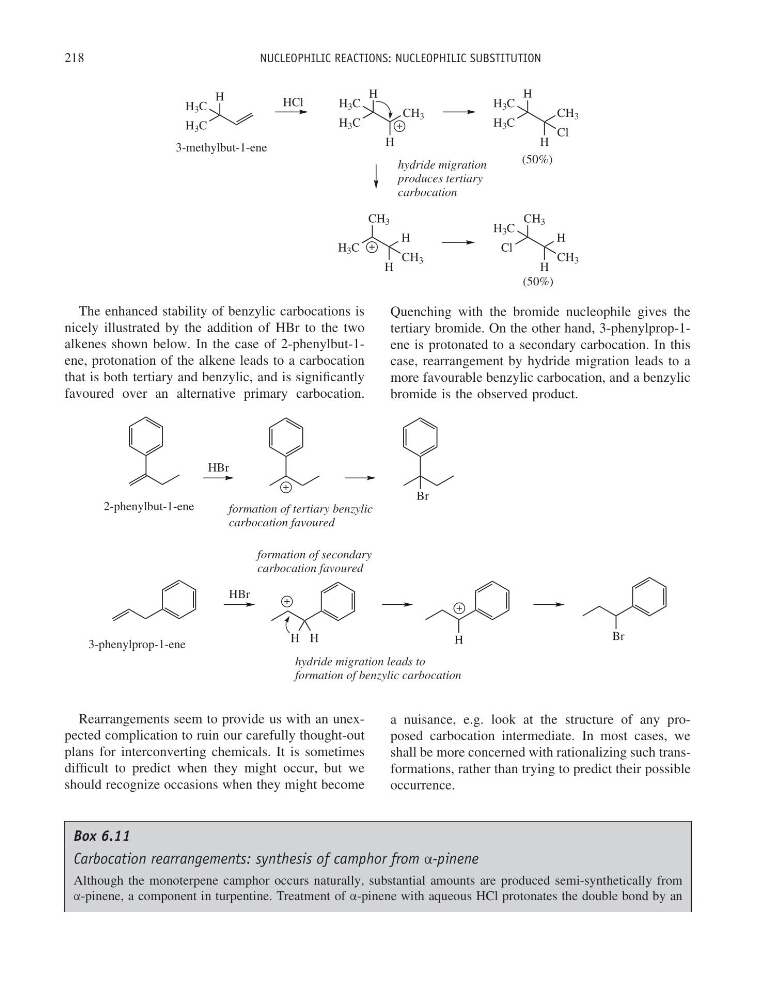
The enhanced stability of benzylic carbocations is
nicely illustrated by the addition of HBr to the two
alkenes shown below. In the case of 2-phenylbut-1ene, protonation of the alkene leads to a carbocation
that is both tertiary and benzylic, and is significantly
favoured over an alternative primary carbocation.
Quenching with the bromide nucleophile gives the
tertiary bromide. On the other hand, 3-phenylprop-1ene is protonated to a secondary carbocation. In this
case, rearrangement by hydride migration leads to a
more favourable benzylic carbocation, and a benzylic
bromide is the observed product.
HBr
Br
2-phenylbut-1-ene
HBr
3-phenylprop-1-ene
H
H
H
Br
formation of tertiary benzylic
carbocation favoured
formation of secondary
carbocation favoured
hydride migration leads to
formation of benzylic carbocation
Rearrangements seem to provide us with an unexpected complication to ruin our carefully thought-out
plans for interconverting chemicals. It is sometimes
difficult to predict when they might occur, but we
should recognize occasions when they might become
a nuisance, e.g. look at the structure of any proposed carbocation intermediate. In most cases, we
shall be more concerned with rationalizing such transformations, rather than trying to predict their possible
occurrence.
Box 6.11
Carbocation rearrangements: synthesis of camphor from α-pinene
Although the monoterpene camphor occurs naturally, substantial amounts are produced semi-synthetically from
α-pinene, a component in turpentine. Treatment of α-pinene with aqueous HCl protonates the double bond by an
NUCLEOPHILIC REACTIONS: NUCLEOPHILIC SUBSTITUTION
H
H 3 C
H 3 C
HCl
H
H 3 C
CH 3
H 3 C
H
H 3 C
CH 3
H 3 C
H
(50%)
CH 3
H 3 C
H
H
CH 3
Cl
H
CH 3
Cl
H
H 3 C
H
CH 3
(50%)
hydride migration
produces tertiary
carbocation
3-methylbut-1-ene
The enhanced stability of benzylic carbocations is
nicely illustrated by the addition of HBr to the two
alkenes shown below. In the case of 2-phenylbut-1ene, protonation of the alkene leads to a carbocation
that is both tertiary and benzylic, and is significantly
favoured over an alternative primary carbocation.
Quenching with the bromide nucleophile gives the
tertiary bromide. On the other hand, 3-phenylprop-1ene is protonated to a secondary carbocation. In this
case, rearrangement by hydride migration leads to a
more favourable benzylic carbocation, and a benzylic
bromide is the observed product.
HBr
Br
2-phenylbut-1-ene
HBr
3-phenylprop-1-ene
H
H
H
Br
formation of tertiary benzylic
carbocation favoured
formation of secondary
carbocation favoured
hydride migration leads to
formation of benzylic carbocation
Rearrangements seem to provide us with an unexpected complication to ruin our carefully thought-out
plans for interconverting chemicals. It is sometimes
difficult to predict when they might occur, but we
should recognize occasions when they might become
a nuisance, e.g. look at the structure of any proposed carbocation intermediate. In most cases, we
shall be more concerned with rationalizing such transformations, rather than trying to predict their possible
occurrence.
Box 6.11
Carbocation rearrangements: synthesis of camphor from α-pinene
Although the monoterpene camphor occurs naturally, substantial amounts are produced semi-synthetically from
α-pinene, a component in turpentine. Treatment of α-pinene with aqueous HCl protonates the double bond by an