

COMPETING REACTIONS: ELIMINATIONS AND REARRANGEMENTS
217
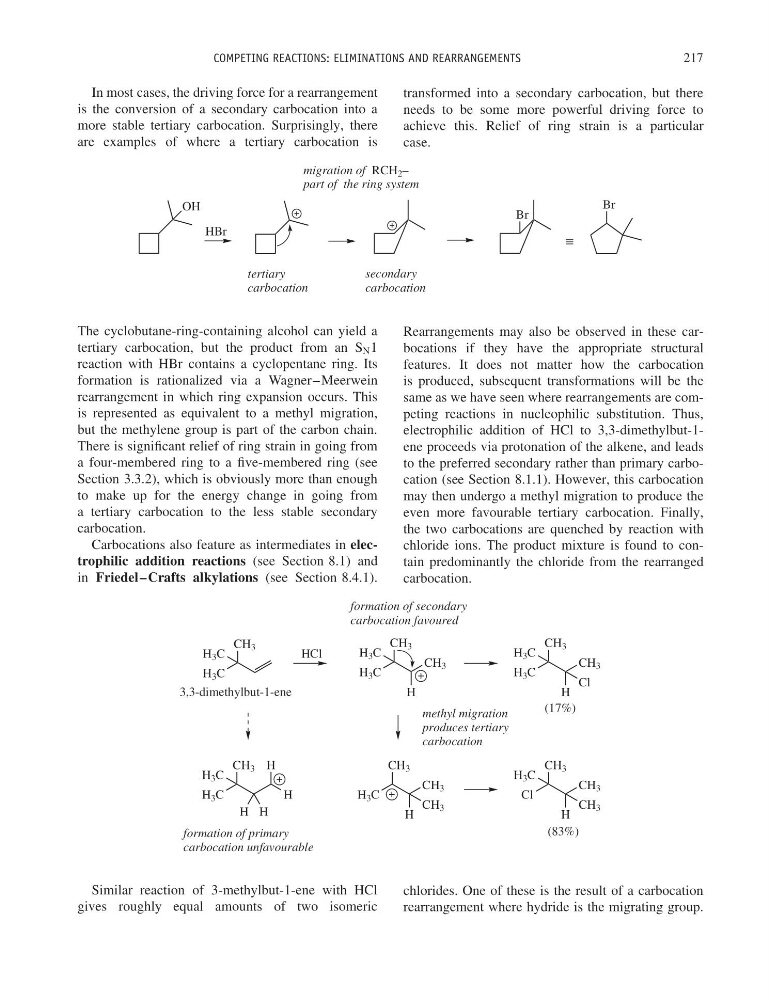
In most cases, the driving force for a rearrangement
is the conversion of a secondary carbocation into a
more stable tertiary carbocation. Surprisingly, there
are examples of where a tertiary carbocation is
transformed into a secondary carbocation, but there
needs to be some more powerful driving force to
achieve this. Relief of ring strain is a particular
case.
OH
Br
tertiary
carbocation
Br
secondary
carbocation
≡
migration of RCH 2 –
part of the ring system
HBr
The cyclobutane-ring-containing alcohol can yield a
tertiary carbocation, but the product from an S N 1
reaction with HBr contains a cyclopentane ring. Its
formation is rationalized via a Wagner–Meerwein
rearrangement in which ring expansion occurs. This
is represented as equivalent to a methyl migration,
but the methylene group is part of the carbon chain.
There is significant relief of ring strain in going from
a four-membered ring to a five-membered ring (see
Section 3.3.2), which is obviously more than enough
to make up for the energy change in going from
a tertiary carbocation to the less stable secondary
carbocation.
Carbocations also feature as intermediates in electrophilic addition reactions (see Section 8.1) and
in Friedel–Crafts alkylations (see Section 8.4.1).
Rearrangements may also be observed in these carbocations if they have the appropriate structural
features. It does not matter how the carbocation
is produced, subsequent transformations will be the
same as we have seen where rearrangements are competing reactions in nucleophilic substitution. Thus,
electrophilic addition of HCl to 3,3-dimethylbut-1ene proceeds via protonation of the alkene, and leads
to the preferred secondary rather than primary carbocation (see Section 8.1.1). However, this carbocation
may then undergo a methyl migration to produce the
even more favourable tertiary carbocation. Finally,
the two carbocations are quenched by reaction with
chloride ions. The product mixture is found to contain predominantly the chloride from the rearranged
carbocation.
CH 3
H 3 C
H 3 C
HCl
CH 3
H 3 C
CH 3
H 3 C
CH 3
H 3 C
CH 3
H 3 C
H
(17%)
CH 3
H 3 C
CH 3
H
CH 3
Cl
H
CH 3
Cl
CH 3
H 3 C
H
CH 3
(83%)
CH 3
H 3 C
H 3 C
H H
H
H
formation of primary
carbocation unfavourable
formation of secondary
carbocation favoured
methyl migration
produces tertiary
carbocation
3,3-dimethylbut-1-ene
Similar reaction of 3-methylbut-1-ene with HCl
gives roughly equal amounts of two isomeric
chlorides. One of these is the result of a carbocation
rearrangement where hydride is the migrating group.
217
In most cases, the driving force for a rearrangement
is the conversion of a secondary carbocation into a
more stable tertiary carbocation. Surprisingly, there
are examples of where a tertiary carbocation is
transformed into a secondary carbocation, but there
needs to be some more powerful driving force to
achieve this. Relief of ring strain is a particular
case.
OH
Br
tertiary
carbocation
Br
secondary
carbocation
≡
migration of RCH 2 –
part of the ring system
HBr
The cyclobutane-ring-containing alcohol can yield a
tertiary carbocation, but the product from an S N 1
reaction with HBr contains a cyclopentane ring. Its
formation is rationalized via a Wagner–Meerwein
rearrangement in which ring expansion occurs. This
is represented as equivalent to a methyl migration,
but the methylene group is part of the carbon chain.
There is significant relief of ring strain in going from
a four-membered ring to a five-membered ring (see
Section 3.3.2), which is obviously more than enough
to make up for the energy change in going from
a tertiary carbocation to the less stable secondary
carbocation.
Carbocations also feature as intermediates in electrophilic addition reactions (see Section 8.1) and
in Friedel–Crafts alkylations (see Section 8.4.1).
Rearrangements may also be observed in these carbocations if they have the appropriate structural
features. It does not matter how the carbocation
is produced, subsequent transformations will be the
same as we have seen where rearrangements are competing reactions in nucleophilic substitution. Thus,
electrophilic addition of HCl to 3,3-dimethylbut-1ene proceeds via protonation of the alkene, and leads
to the preferred secondary rather than primary carbocation (see Section 8.1.1). However, this carbocation
may then undergo a methyl migration to produce the
even more favourable tertiary carbocation. Finally,
the two carbocations are quenched by reaction with
chloride ions. The product mixture is found to contain predominantly the chloride from the rearranged
carbocation.
CH 3
H 3 C
H 3 C
HCl
CH 3
H 3 C
CH 3
H 3 C
CH 3
H 3 C
CH 3
H 3 C
H
(17%)
CH 3
H 3 C
CH 3
H
CH 3
Cl
H
CH 3
Cl
CH 3
H 3 C
H
CH 3
(83%)
CH 3
H 3 C
H 3 C
H H
H
H
formation of primary
carbocation unfavourable
formation of secondary
carbocation favoured
methyl migration
produces tertiary
carbocation
3,3-dimethylbut-1-ene
Similar reaction of 3-methylbut-1-ene with HCl
gives roughly equal amounts of two isomeric
chlorides. One of these is the result of a carbocation
rearrangement where hydride is the migrating group.