

216
NUCLEOPHILIC REACTIONS: NUCLEOPHILIC SUBSTITUTION
carbocations, which are already stabilized by the
maximum number of alkyl groups, and where
any rearrangement would tend to produce only a
less stable secondary carbocation. Wagner–Meerwein
rearrangements are not restricted to methyl migrations, and we may also see transfer of hydrogen with
an electron pair, i.e. a hydride migration.
secondary carbocation
more stable
tertiary carbocation
migration of H atom with
electron pair (hydride);
methyl migration would
merely produce another
secondary carbocation
secondary carbocation
secondary carbocation
methyl
migration
OH
CH 3
H
CH 3
H 3 C
H
H
CH 3
H
CH 3
H 3 C
H
CH 3
H 3 C
CH 3
H
H
CH 3
H 3 C
CH 3
H
Br
H
CH 3
H
CH 3
H 3 C
H
CH 3
H
CH 3
CH 3
hydride migration
nucleophile does
not attack carbon
carrying leaving
group
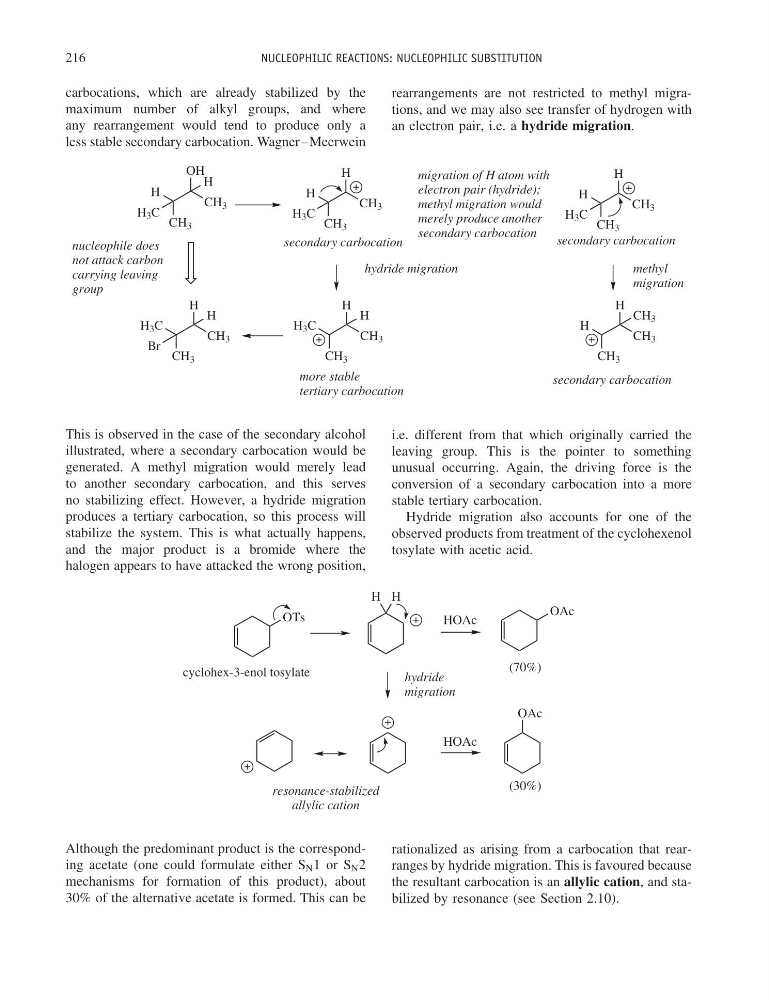
This is observed in the case of the secondary alcohol
illustrated, where a secondary carbocation would be
generated. A methyl migration would merely lead
to another secondary carbocation, and this serves
no stabilizing effect. However, a hydride migration
produces a tertiary carbocation, so this process will
stabilize the system. This is what actually happens,
and the major product is a bromide where the
halogen appears to have attacked the wrong position,
i.e. different from that which originally carried the
leaving group. This is the pointer to something
unusual occurring. Again, the driving force is the
conversion of a secondary carbocation into a more
stable tertiary carbocation.
Hydride migration also accounts for one of the
observed products from treatment of the cyclohexenol
tosylate with acetic acid.
OTs
HOAc
H
H
OAc
OAc
resonance-stabilized
allylic cation
(70%)
(30%)
hydride
migration
cyclohex-3-enol tosylate
HOAc
Although the predominant product is the corresponding acetate (one could formulate either S N 1 or S N 2
mechanisms for formation of this product), about
30% of the alternative acetate is formed. This can be
rationalized as arising from a carbocation that rearranges by hydride migration. This is favoured because
the resultant carbocation is an allylic cation, and stabilized by resonance (see Section 2.10).
NUCLEOPHILIC REACTIONS: NUCLEOPHILIC SUBSTITUTION
carbocations, which are already stabilized by the
maximum number of alkyl groups, and where
any rearrangement would tend to produce only a
less stable secondary carbocation. Wagner–Meerwein
rearrangements are not restricted to methyl migrations, and we may also see transfer of hydrogen with
an electron pair, i.e. a hydride migration.
secondary carbocation
more stable
tertiary carbocation
migration of H atom with
electron pair (hydride);
methyl migration would
merely produce another
secondary carbocation
secondary carbocation
secondary carbocation
methyl
migration
OH
CH 3
H
CH 3
H 3 C
H
H
CH 3
H
CH 3
H 3 C
H
CH 3
H 3 C
CH 3
H
H
CH 3
H 3 C
CH 3
H
Br
H
CH 3
H
CH 3
H 3 C
H
CH 3
H
CH 3
CH 3
hydride migration
nucleophile does
not attack carbon
carrying leaving
group
This is observed in the case of the secondary alcohol
illustrated, where a secondary carbocation would be
generated. A methyl migration would merely lead
to another secondary carbocation, and this serves
no stabilizing effect. However, a hydride migration
produces a tertiary carbocation, so this process will
stabilize the system. This is what actually happens,
and the major product is a bromide where the
halogen appears to have attacked the wrong position,
i.e. different from that which originally carried the
leaving group. This is the pointer to something
unusual occurring. Again, the driving force is the
conversion of a secondary carbocation into a more
stable tertiary carbocation.
Hydride migration also accounts for one of the
observed products from treatment of the cyclohexenol
tosylate with acetic acid.
OTs
HOAc
H
H
OAc
OAc
resonance-stabilized
allylic cation
(70%)
(30%)
hydride
migration
cyclohex-3-enol tosylate
HOAc
Although the predominant product is the corresponding acetate (one could formulate either S N 1 or S N 2
mechanisms for formation of this product), about
30% of the alternative acetate is formed. This can be
rationalized as arising from a carbocation that rearranges by hydride migration. This is favoured because
the resultant carbocation is an allylic cation, and stabilized by resonance (see Section 2.10).