

COMPETING REACTIONS: ELIMINATIONS AND REARRANGEMENTS
215
The most common examples of rearrangements
involve an electron-deficient atom, and pre-eminent
amongst these are carbocations. Since carbocations
are a feature of the S N 1 and E1 mechanisms, it
follows that rearrangements can be side-reactions
of these types of transformation. The driving force
in carbocation rearrangements is to form a more
stable carbocation.
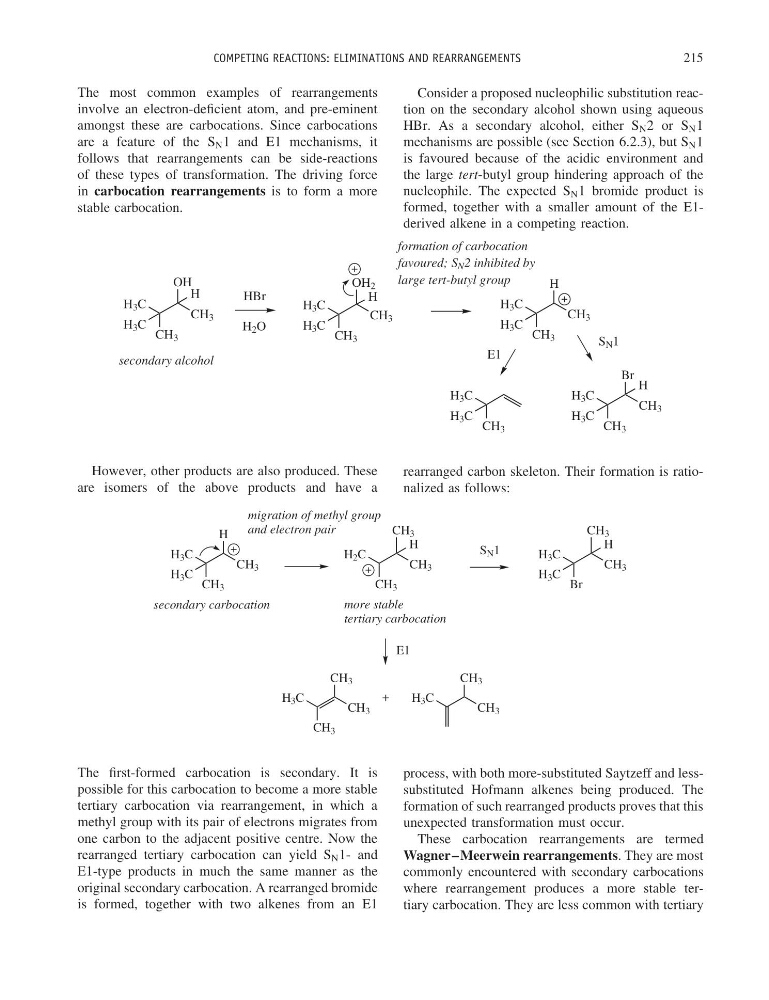
Consider a proposed nucleophilic substitution reaction on the secondary alcohol shown using aqueous
HBr. As a secondary alcohol, either S N 2 or S N 1
mechanisms are possible (see Section 6.2.3), but S N 1
is favoured because of the acidic environment and
the large tert-butyl group hindering approach of the
nucleophile. The expected S N 1 bromide product is
formed, together with a smaller amount of the E1derived alkene in a competing reaction.
HBr
H 2 O
E1
S N 1
secondary alcohol
formation of carbocation
favoured; S N 2 inhibited by
large tert-butyl group
OH
CH 3
H 3 C
CH 3
H 3 C
OH 2
CH 3
H 3 C
CH 3
H 3 C
CH 3
H 3 C
CH 3
H 3 C
H
H
H
H 3 C
CH 3
H 3 C
CH 3
H 3 C
CH 3
H 3 C
Br
H
However, other products are also produced. These
are isomers of the above products and have a
rearranged carbon skeleton. Their formation is rationalized as follows:
secondary carbocation
more stable
tertiary carbocation
migration of methyl group
and electron pair
S N 1
+
E1
CH 3
H 3 C
CH 3
H 3 C
H
CH 3
H 2 C
CH 3
CH 3
H
CH 3
H 3 C
Br
H
H 3 C
CH 3
H 3 C
CH 3
CH 3
H 3 C
CH 3
CH 3
CH 3
The first-formed carbocation is secondary. It is
possible for this carbocation to become a more stable
tertiary carbocation via rearrangement, in which a
methyl group with its pair of electrons migrates from
one carbon to the adjacent positive centre. Now the
rearranged tertiary carbocation can yield S N 1- and
E1-type products in much the same manner as the
original secondary carbocation. A rearranged bromide
is formed, together with two alkenes from an E1
process, with both more-substituted Saytzeff and lesssubstituted Hofmann alkenes being produced. The
formation of such rearranged products proves that this
unexpected transformation must occur.
These carbocation rearrangements are termed
Wagner–Meerwein rearrangements. They are most
commonly encountered with secondary carbocations
where rearrangement produces a more stable tertiary carbocation. They are less common with tertiary
215
The most common examples of rearrangements
involve an electron-deficient atom, and pre-eminent
amongst these are carbocations. Since carbocations
are a feature of the S N 1 and E1 mechanisms, it
follows that rearrangements can be side-reactions
of these types of transformation. The driving force
in carbocation rearrangements is to form a more
stable carbocation.
Consider a proposed nucleophilic substitution reaction on the secondary alcohol shown using aqueous
HBr. As a secondary alcohol, either S N 2 or S N 1
mechanisms are possible (see Section 6.2.3), but S N 1
is favoured because of the acidic environment and
the large tert-butyl group hindering approach of the
nucleophile. The expected S N 1 bromide product is
formed, together with a smaller amount of the E1derived alkene in a competing reaction.
HBr
H 2 O
E1
S N 1
secondary alcohol
formation of carbocation
favoured; S N 2 inhibited by
large tert-butyl group
OH
CH 3
H 3 C
CH 3
H 3 C
OH 2
CH 3
H 3 C
CH 3
H 3 C
CH 3
H 3 C
CH 3
H 3 C
H
H
H
H 3 C
CH 3
H 3 C
CH 3
H 3 C
CH 3
H 3 C
Br
H
However, other products are also produced. These
are isomers of the above products and have a
rearranged carbon skeleton. Their formation is rationalized as follows:
secondary carbocation
more stable
tertiary carbocation
migration of methyl group
and electron pair
S N 1
+
E1
CH 3
H 3 C
CH 3
H 3 C
H
CH 3
H 2 C
CH 3
CH 3
H
CH 3
H 3 C
Br
H
H 3 C
CH 3
H 3 C
CH 3
CH 3
H 3 C
CH 3
CH 3
CH 3
The first-formed carbocation is secondary. It is
possible for this carbocation to become a more stable
tertiary carbocation via rearrangement, in which a
methyl group with its pair of electrons migrates from
one carbon to the adjacent positive centre. Now the
rearranged tertiary carbocation can yield S N 1- and
E1-type products in much the same manner as the
original secondary carbocation. A rearranged bromide
is formed, together with two alkenes from an E1
process, with both more-substituted Saytzeff and lesssubstituted Hofmann alkenes being produced. The
formation of such rearranged products proves that this
unexpected transformation must occur.
These carbocation rearrangements are termed
Wagner–Meerwein rearrangements. They are most
commonly encountered with secondary carbocations
where rearrangement produces a more stable tertiary carbocation. They are less common with tertiary