

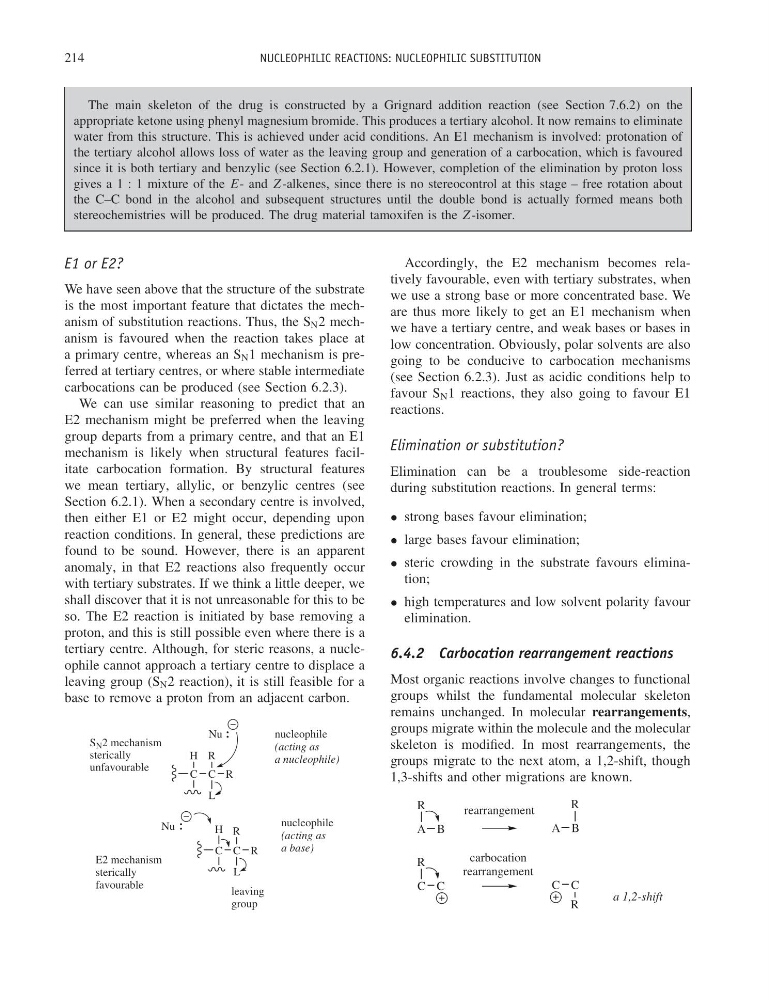
214
NUCLEOPHILIC REACTIONS: NUCLEOPHILIC SUBSTITUTION
The main skeleton of the drug is constructed by a Grignard addition reaction (see Section 7.6.2) on the
appropriate ketone using phenyl magnesium bromide. This produces a tertiary alcohol. It now remains to eliminate
water from this structure. This is achieved under acid conditions. An E1 mechanism is involved: protonation of
the tertiary alcohol allows loss of water as the leaving group and generation of a carbocation, which is favoured
since it is both tertiary and benzylic (see Section 6.2.1). However, completion of the elimination by proton loss
gives a 1 : 1 mixture of the E- and Z-alkenes, since there is no stereocontrol at this stage – free rotation about
the C–C bond in the alcohol and subsequent structures until the double bond is actually formed means both
stereochemistries will be produced. The drug material tamoxifen is the Z-isomer.
E1 or E2?
We have seen above that the structure of the substrate
is the most important feature that dictates the mechanism of substitution reactions. Thus, the S N 2 mechanism is favoured when the reaction takes place at
a primary centre, whereas an S N 1 mechanism is preferred at tertiary centres, or where stable intermediate
carbocations can be produced (see Section 6.2.3).
We can use similar reasoning to predict that an
E2 mechanism might be preferred when the leaving
group departs from a primary centre, and that an E1
mechanism is likely when structural features facilitate carbocation formation. By structural features
we mean tertiary, allylic, or benzylic centres (see
Section 6.2.1). When a secondary centre is involved,
then either E1 or E2 might occur, depending upon
reaction conditions. In general, these predictions are
found to be sound. However, there is an apparent
anomaly, in that E2 reactions also frequently occur
with tertiary substrates. If we think a little deeper, we
shall discover that it is not unreasonable for this to be
so. The E2 reaction is initiated by base removing a
proton, and this is still possible even where there is a
tertiary centre. Although, for steric reasons, a nucleophile cannot approach a tertiary centre to displace a
leaving group (S N 2 reaction), it is still feasible for a
base to remove a proton from an adjacent carbon.
C
H
C
R
R
L
Nu
S N 2 mechanism
sterically
unfavourable
nucleophile
(acting as
a nucleophile)
C
H
C
R
R
nucleophile
(acting as
a base)
leaving
group
Nu
L
E2 mechanism
sterically
favourable
Accordingly, the E2 mechanism becomes relatively favourable, even with tertiary substrates, when
we use a strong base or more concentrated base. We
are thus more likely to get an E1 mechanism when
we have a tertiary centre, and weak bases or bases in
low concentration. Obviously, polar solvents are also
going to be conducive to carbocation mechanisms
(see Section 6.2.3). Just as acidic conditions help to
favour S N 1 reactions, they also going to favour E1
reactions.
Elimination or substitution?
Elimination can be a troublesome side-reaction
during substitution reactions. In general terms:
• strong bases favour elimination;
• large bases favour elimination;
• steric crowding in the substrate favours elimination;
• high temperatures and low solvent polarity favour
elimination.
6.4.2 Carbocation rearrangement reactions
Most organic reactions involve changes to functional
groups whilst the fundamental molecular skeleton
remains unchanged. In molecular rearrangements,
groups migrate within the molecule and the molecular
skeleton is modified. In most rearrangements, the
groups migrate to the next atom, a 1,2-shift, though
1,3-shifts and other migrations are known.
A B
R
rearrangement
B
A
R
C C
R
carbocation
rearrangement
C
C
a 1,2-shift
R
NUCLEOPHILIC REACTIONS: NUCLEOPHILIC SUBSTITUTION
The main skeleton of the drug is constructed by a Grignard addition reaction (see Section 7.6.2) on the
appropriate ketone using phenyl magnesium bromide. This produces a tertiary alcohol. It now remains to eliminate
water from this structure. This is achieved under acid conditions. An E1 mechanism is involved: protonation of
the tertiary alcohol allows loss of water as the leaving group and generation of a carbocation, which is favoured
since it is both tertiary and benzylic (see Section 6.2.1). However, completion of the elimination by proton loss
gives a 1 : 1 mixture of the E- and Z-alkenes, since there is no stereocontrol at this stage – free rotation about
the C–C bond in the alcohol and subsequent structures until the double bond is actually formed means both
stereochemistries will be produced. The drug material tamoxifen is the Z-isomer.
E1 or E2?
We have seen above that the structure of the substrate
is the most important feature that dictates the mechanism of substitution reactions. Thus, the S N 2 mechanism is favoured when the reaction takes place at
a primary centre, whereas an S N 1 mechanism is preferred at tertiary centres, or where stable intermediate
carbocations can be produced (see Section 6.2.3).
We can use similar reasoning to predict that an
E2 mechanism might be preferred when the leaving
group departs from a primary centre, and that an E1
mechanism is likely when structural features facilitate carbocation formation. By structural features
we mean tertiary, allylic, or benzylic centres (see
Section 6.2.1). When a secondary centre is involved,
then either E1 or E2 might occur, depending upon
reaction conditions. In general, these predictions are
found to be sound. However, there is an apparent
anomaly, in that E2 reactions also frequently occur
with tertiary substrates. If we think a little deeper, we
shall discover that it is not unreasonable for this to be
so. The E2 reaction is initiated by base removing a
proton, and this is still possible even where there is a
tertiary centre. Although, for steric reasons, a nucleophile cannot approach a tertiary centre to displace a
leaving group (S N 2 reaction), it is still feasible for a
base to remove a proton from an adjacent carbon.
C
H
C
R
R
L
Nu
S N 2 mechanism
sterically
unfavourable
nucleophile
(acting as
a nucleophile)
C
H
C
R
R
nucleophile
(acting as
a base)
leaving
group
Nu
L
E2 mechanism
sterically
favourable
Accordingly, the E2 mechanism becomes relatively favourable, even with tertiary substrates, when
we use a strong base or more concentrated base. We
are thus more likely to get an E1 mechanism when
we have a tertiary centre, and weak bases or bases in
low concentration. Obviously, polar solvents are also
going to be conducive to carbocation mechanisms
(see Section 6.2.3). Just as acidic conditions help to
favour S N 1 reactions, they also going to favour E1
reactions.
Elimination or substitution?
Elimination can be a troublesome side-reaction
during substitution reactions. In general terms:
• strong bases favour elimination;
• large bases favour elimination;
• steric crowding in the substrate favours elimination;
• high temperatures and low solvent polarity favour
elimination.
6.4.2 Carbocation rearrangement reactions
Most organic reactions involve changes to functional
groups whilst the fundamental molecular skeleton
remains unchanged. In molecular rearrangements,
groups migrate within the molecule and the molecular
skeleton is modified. In most rearrangements, the
groups migrate to the next atom, a 1,2-shift, though
1,3-shifts and other migrations are known.
A B
R
rearrangement
B
A
R
C C
R
carbocation
rearrangement
C
C
a 1,2-shift
R