

COMPETING REACTIONS: ELIMINATIONS AND REARRANGEMENTS
213
H
R´
R
H
R
R´
R´
R
R
R´
p orbital should
be parallel to
C−H bond
alternative stereochemistries may result
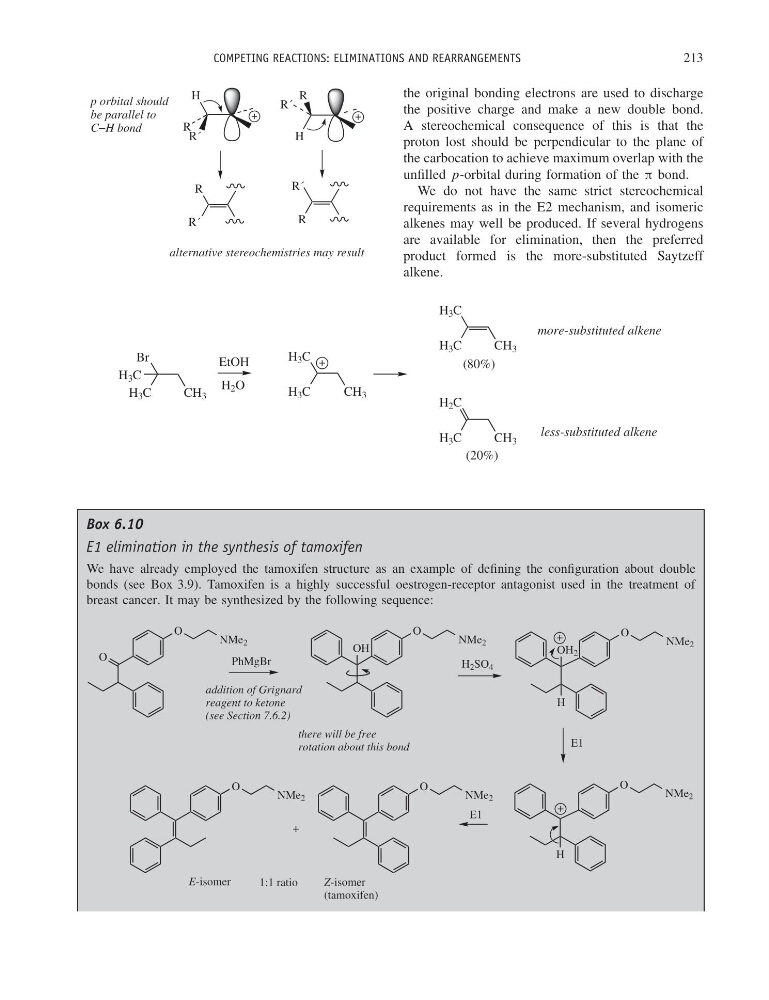
the original bonding electrons are used to discharge
the positive charge and make a new double bond.
A stereochemical consequence of this is that the
proton lost should be perpendicular to the plane of
the carbocation to achieve maximum overlap with the
unfilled p-orbital during formation of the π bond.
We do not have the same strict stereochemical
requirements as in the E2 mechanism, and isomeric
alkenes may well be produced. If several hydrogens
are available for elimination, then the preferred
product formed is the more-substituted Saytzeff
alkene.
H 3 C
Br
CH 3
H 3 C
EtOH
H 2 O
H 3 C
H 3 C
CH 3
H 3 C
H 3 C
CH 3
H 3 C
H 2 C
CH 3
(80%)
(20%)
more-substituted alkene
less-substituted alkene
Box 6.10
E1 elimination in the synthesis of tamoxifen
We have already employed the tamoxifen structure as an example of defining the configuration about double
bonds (see Box 3.9). Tamoxifen is a highly successful oestrogen-receptor antagonist used in the treatment of
breast cancer. It may be synthesized by the following sequence:
O
NMe 2
Z-isomer
(tamoxifen)
O
NMe 2
O
O
NMe 2
PhMgBr
OH
addition of Grignard
reagent to ketone
(see Section 7.6.2)
H 2 SO 4
O
NMe 2
OH 2
H
O
NMe 2
H
O
NMe 2
E-isomer
+
1:1 ratio
E1
E1
there will be free
rotation about this bond
213
H
R´
R
H
R
R´
R´
R
R
R´
p orbital should
be parallel to
C−H bond
alternative stereochemistries may result
the original bonding electrons are used to discharge
the positive charge and make a new double bond.
A stereochemical consequence of this is that the
proton lost should be perpendicular to the plane of
the carbocation to achieve maximum overlap with the
unfilled p-orbital during formation of the π bond.
We do not have the same strict stereochemical
requirements as in the E2 mechanism, and isomeric
alkenes may well be produced. If several hydrogens
are available for elimination, then the preferred
product formed is the more-substituted Saytzeff
alkene.
H 3 C
Br
CH 3
H 3 C
EtOH
H 2 O
H 3 C
H 3 C
CH 3
H 3 C
H 3 C
CH 3
H 3 C
H 2 C
CH 3
(80%)
(20%)
more-substituted alkene
less-substituted alkene
Box 6.10
E1 elimination in the synthesis of tamoxifen
We have already employed the tamoxifen structure as an example of defining the configuration about double
bonds (see Box 3.9). Tamoxifen is a highly successful oestrogen-receptor antagonist used in the treatment of
breast cancer. It may be synthesized by the following sequence:
O
NMe 2
Z-isomer
(tamoxifen)
O
NMe 2
O
O
NMe 2
PhMgBr
OH
addition of Grignard
reagent to ketone
(see Section 7.6.2)
H 2 SO 4
O
NMe 2
OH 2
H
O
NMe 2
H
O
NMe 2
E-isomer
+
1:1 ratio
E1
E1
there will be free
rotation about this bond