

212
NUCLEOPHILIC REACTIONS: NUCLEOPHILIC SUBSTITUTION
Box 6.9 (continued)
Me 3 N
O
O
NMe 3
O
O
Me 3 N
O
O
MeO
N
MeO
OMe
OMe
O
O
O
O
OMe
N
OMe
MeO
OMe
Me
Me
N
O
O
Me H
suxamethonium
atracurium
(mixture of stereoisomers)
acetylcholine
elimination favoured
by electron-withdrawing
carbonyl group
NH
O
O
Me
The E1 reaction: unimolecular elimination
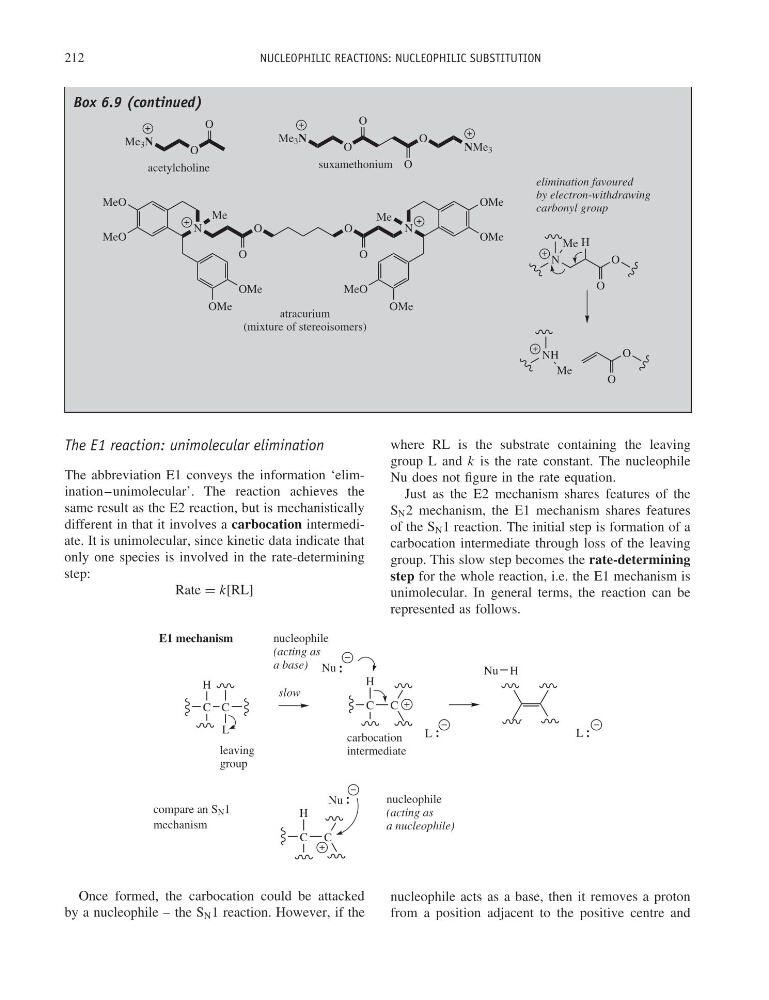
The abbreviation E1 conveys the information ‘elimination–unimolecular’. The reaction achieves the
same result as the E2 reaction, but is mechanistically
different in that it involves a carbocation intermediate. It is unimolecular, since kinetic data indicate that
only one species is involved in the rate-determining
step:
Rate = k[RL]
where RL is the substrate containing the leaving
group L and k is the rate constant. The nucleophile
Nu does not figure in the rate equation.
Just as the E2 mechanism shares features of the
S N 2 mechanism, the E1 mechanism shares features
of the S N 1 reaction. The initial step is formation of a
carbocation intermediate through loss of the leaving
group. This slow step becomes the rate-determining
step for the whole reaction, i.e. the E1 mechanism is
unimolecular. In general terms, the reaction can be
represented as follows.
C
H
C
nucleophile
(acting as
a base)
leaving
group
Nu
L
L
C
H
C
L
slow
carbocation
intermediate
Nu
compare an S N 1
mechanism
nucleophile
(acting as
a nucleophile)
C
H
C
Nu H
E1 mechanism
Once formed, the carbocation could be attacked
by a nucleophile – the S N 1 reaction. However, if the
nucleophile acts as a base, then it removes a proton
from a position adjacent to the positive centre and
NUCLEOPHILIC REACTIONS: NUCLEOPHILIC SUBSTITUTION
Box 6.9 (continued)
Me 3 N
O
O
NMe 3
O
O
Me 3 N
O
O
MeO
N
MeO
OMe
OMe
O
O
O
O
OMe
N
OMe
MeO
OMe
Me
Me
N
O
O
Me H
suxamethonium
atracurium
(mixture of stereoisomers)
acetylcholine
elimination favoured
by electron-withdrawing
carbonyl group
NH
O
O
Me
The E1 reaction: unimolecular elimination
The abbreviation E1 conveys the information ‘elimination–unimolecular’. The reaction achieves the
same result as the E2 reaction, but is mechanistically
different in that it involves a carbocation intermediate. It is unimolecular, since kinetic data indicate that
only one species is involved in the rate-determining
step:
Rate = k[RL]
where RL is the substrate containing the leaving
group L and k is the rate constant. The nucleophile
Nu does not figure in the rate equation.
Just as the E2 mechanism shares features of the
S N 2 mechanism, the E1 mechanism shares features
of the S N 1 reaction. The initial step is formation of a
carbocation intermediate through loss of the leaving
group. This slow step becomes the rate-determining
step for the whole reaction, i.e. the E1 mechanism is
unimolecular. In general terms, the reaction can be
represented as follows.
C
H
C
nucleophile
(acting as
a base)
leaving
group
Nu
L
L
C
H
C
L
slow
carbocation
intermediate
Nu
compare an S N 1
mechanism
nucleophile
(acting as
a nucleophile)
C
H
C
Nu H
E1 mechanism
Once formed, the carbocation could be attacked
by a nucleophile – the S N 1 reaction. However, if the
nucleophile acts as a base, then it removes a proton
from a position adjacent to the positive centre and