

COMPETING REACTIONS: ELIMINATIONS AND REARRANGEMENTS
211
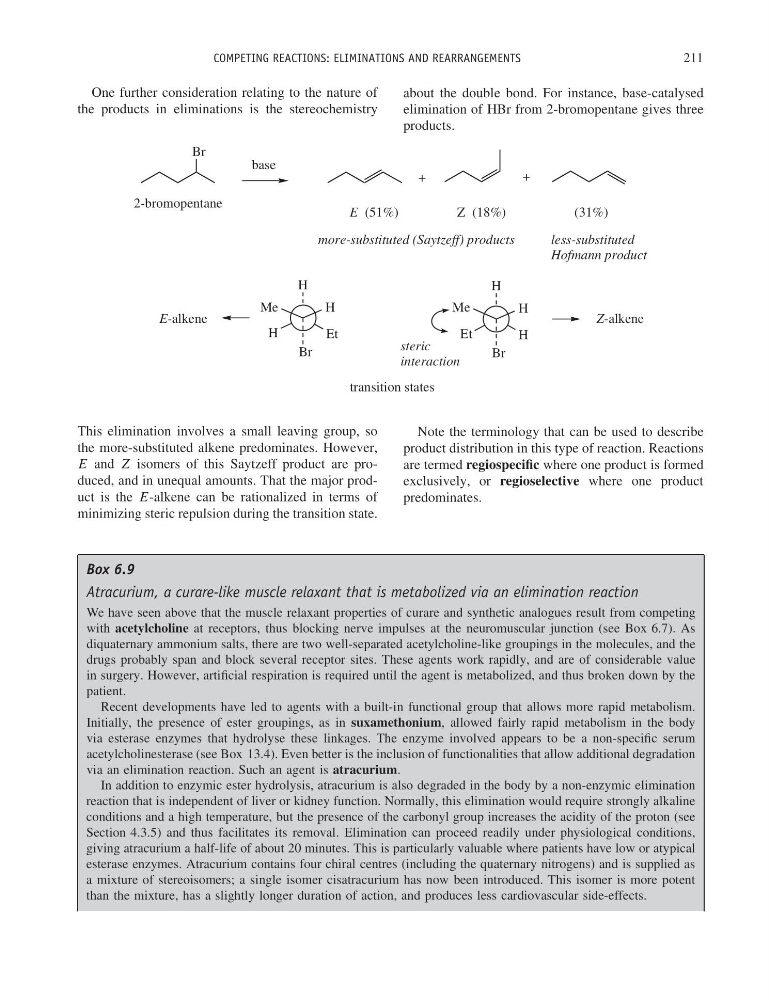
One further consideration relating to the nature of
the products in eliminations is the stereochemistry
about the double bond. For instance, base-catalysed
elimination of HBr from 2-bromopentane gives three
products.
Br
base
+
+
E (51%)
Z (18%)
(31%)
more-substituted (Saytzeff) products
less-substituted
Hofmann product
H
H
Et
H
Br
Me
H
Et
H
H
Br
Me
transition states
steric
interaction
Z-alkene
E-alkene
2-bromopentane
This elimination involves a small leaving group, so
the more-substituted alkene predominates. However,
E and Z isomers of this Saytzeff product are produced, and in unequal amounts. That the major product is the E-alkene can be rationalized in terms of
minimizing steric repulsion during the transition state.
Note the terminology that can be used to describe
product distribution in this type of reaction. Reactions
are termed regiospecific where one product is formed
exclusively, or regioselective where one product
predominates.
Box 6.9
Atracurium, a curare-like muscle relaxant that is metabolized via an elimination reaction
We have seen above that the muscle relaxant properties of curare and synthetic analogues result from competing
with acetylcholine at receptors, thus blocking nerve impulses at the neuromuscular junction (see Box 6.7). As
diquaternary ammonium salts, there are two well-separated acetylcholine-like groupings in the molecules, and the
drugs probably span and block several receptor sites. These agents work rapidly, and are of considerable value
in surgery. However, artificial respiration is required until the agent is metabolized, and thus broken down by the
patient.
Recent developments have led to agents with a built-in functional group that allows more rapid metabolism.
Initially, the presence of ester groupings, as in suxamethonium, allowed fairly rapid metabolism in the body
via esterase enzymes that hydrolyse these linkages. The enzyme involved appears to be a non-specific serum
acetylcholinesterase (see Box 13.4). Even better is the inclusion of functionalities that allow additional degradation
via an elimination reaction. Such an agent is atracurium.
In addition to enzymic ester hydrolysis, atracurium is also degraded in the body by a non-enzymic elimination
reaction that is independent of liver or kidney function. Normally, this elimination would require strongly alkaline
conditions and a high temperature, but the presence of the carbonyl group increases the acidity of the proton (see
Section 4.3.5) and thus facilitates its removal. Elimination can proceed readily under physiological conditions,
giving atracurium a half-life of about 20 minutes. This is particularly valuable where patients have low or atypical
esterase enzymes. Atracurium contains four chiral centres (including the quaternary nitrogens) and is supplied as
a mixture of stereoisomers; a single isomer cisatracurium has now been introduced. This isomer is more potent
than the mixture, has a slightly longer duration of action, and produces less cardiovascular side-effects.
211
One further consideration relating to the nature of
the products in eliminations is the stereochemistry
about the double bond. For instance, base-catalysed
elimination of HBr from 2-bromopentane gives three
products.
Br
base
+
+
E (51%)
Z (18%)
(31%)
more-substituted (Saytzeff) products
less-substituted
Hofmann product
H
H
Et
H
Br
Me
H
Et
H
H
Br
Me
transition states
steric
interaction
Z-alkene
E-alkene
2-bromopentane
This elimination involves a small leaving group, so
the more-substituted alkene predominates. However,
E and Z isomers of this Saytzeff product are produced, and in unequal amounts. That the major product is the E-alkene can be rationalized in terms of
minimizing steric repulsion during the transition state.
Note the terminology that can be used to describe
product distribution in this type of reaction. Reactions
are termed regiospecific where one product is formed
exclusively, or regioselective where one product
predominates.
Box 6.9
Atracurium, a curare-like muscle relaxant that is metabolized via an elimination reaction
We have seen above that the muscle relaxant properties of curare and synthetic analogues result from competing
with acetylcholine at receptors, thus blocking nerve impulses at the neuromuscular junction (see Box 6.7). As
diquaternary ammonium salts, there are two well-separated acetylcholine-like groupings in the molecules, and the
drugs probably span and block several receptor sites. These agents work rapidly, and are of considerable value
in surgery. However, artificial respiration is required until the agent is metabolized, and thus broken down by the
patient.
Recent developments have led to agents with a built-in functional group that allows more rapid metabolism.
Initially, the presence of ester groupings, as in suxamethonium, allowed fairly rapid metabolism in the body
via esterase enzymes that hydrolyse these linkages. The enzyme involved appears to be a non-specific serum
acetylcholinesterase (see Box 13.4). Even better is the inclusion of functionalities that allow additional degradation
via an elimination reaction. Such an agent is atracurium.
In addition to enzymic ester hydrolysis, atracurium is also degraded in the body by a non-enzymic elimination
reaction that is independent of liver or kidney function. Normally, this elimination would require strongly alkaline
conditions and a high temperature, but the presence of the carbonyl group increases the acidity of the proton (see
Section 4.3.5) and thus facilitates its removal. Elimination can proceed readily under physiological conditions,
giving atracurium a half-life of about 20 minutes. This is particularly valuable where patients have low or atypical
esterase enzymes. Atracurium contains four chiral centres (including the quaternary nitrogens) and is supplied as
a mixture of stereoisomers; a single isomer cisatracurium has now been introduced. This isomer is more potent
than the mixture, has a slightly longer duration of action, and produces less cardiovascular side-effects.