

210
NUCLEOPHILIC REACTIONS: NUCLEOPHILIC SUBSTITUTION
The stabilizing effect of alkyl groups appears to
involve overlap of σ C–H (or C–C) orbitals with the π
system of the alkene, rather as we have seen with carbocations (see Section 6.2.1). The more alkyl groups
attached, the more stabilization the alkene derives.
overlap from σ bond
with π system
H
H
H
H
H
H
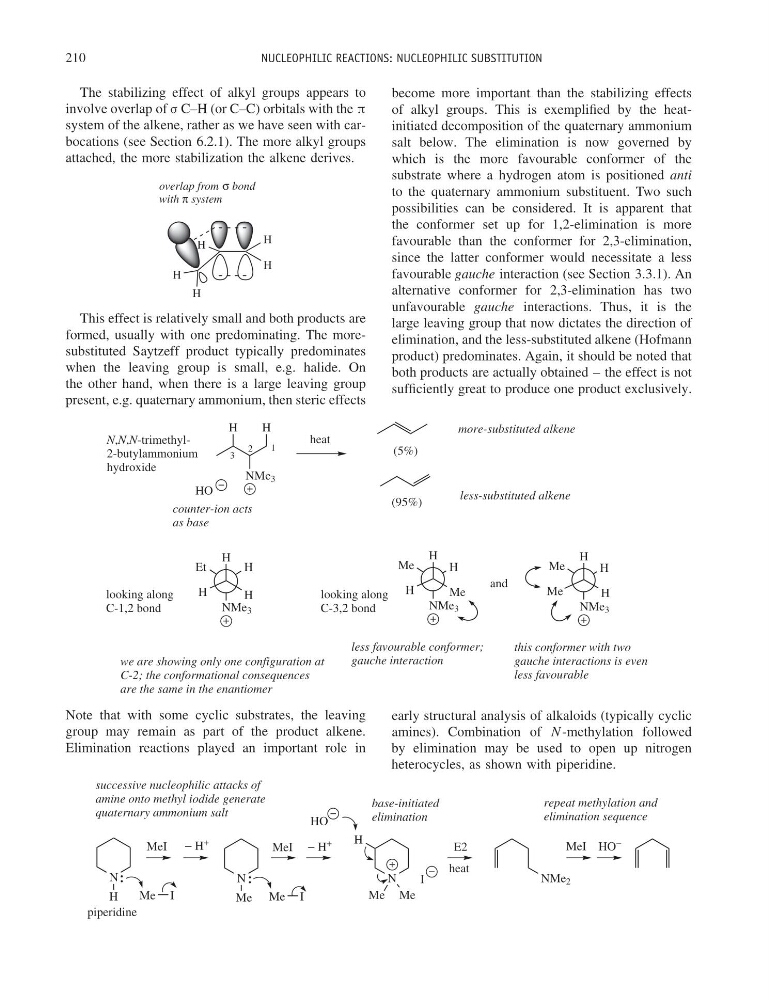
This effect is relatively small and both products are
formed, usually with one predominating. The moresubstituted Saytzeff product typically predominates
when the leaving group is small, e.g. halide. On
the other hand, when there is a large leaving group
present, e.g. quaternary ammonium, then steric effects
become more important than the stabilizing effects
of alkyl groups. This is exemplified by the heatinitiated decomposition of the quaternary ammonium
salt below. The elimination is now governed by
which is the more favourable conformer of the
substrate where a hydrogen atom is positioned anti
to the quaternary ammonium substituent. Two such
possibilities can be considered. It is apparent that
the conformer set up for 1,2-elimination is more
favourable than the conformer for 2,3-elimination,
since the latter conformer would necessitate a less
favourable gauche interaction (see Section 3.3.1). An
alternative conformer for 2,3-elimination has two
unfavourable gauche interactions. Thus, it is the
large leaving group that now dictates the direction of
elimination, and the less-substituted alkene (Hofmann
product) predominates. Again, it should be noted that
both products are actually obtained – the effect is not
sufficiently great to produce one product exclusively.
NMe 3
H
H
heat
(5%)
(95%)
more-substituted alkene
less-substituted alkene
HO
counter-ion acts
as base
H
NMe 3
Et
H
H
H
H
NMe 3
Me
H
H
Me
1
2
3
looking along
C-1,2 bond
looking along
C-3,2 bond
less favourable conformer;
gauche interaction
N,N,N-trimethyl2-butylammonium
hydroxide
and
we are showing only one configuration at
C-2; the conformational consequences
are the same in the enantiomer
H
NMe 3
Me
Me
H
H
this conformer with two
gauche interactions is even
less favourable
Note that with some cyclic substrates, the leaving
group may remain as part of the product alkene.
Elimination reactions played an important role in
early structural analysis of alkaloids (typically cyclic
amines). Combination of N -methylation followed
by elimination may be used to open up nitrogen
heterocycles, as shown with piperidine.
N
N
Me Me
NMe 2
Me I
N
− H +
Me
H
− H +
Me I
H
HO
E2
successive nucleophilic attacks of
amine onto methyl iodide generate
quaternary ammonium salt
base-initiated
elimination
I
MeI
HO −
repeat methylation and
elimination sequence
piperidine
MeI
MeI
heat
NUCLEOPHILIC REACTIONS: NUCLEOPHILIC SUBSTITUTION
The stabilizing effect of alkyl groups appears to
involve overlap of σ C–H (or C–C) orbitals with the π
system of the alkene, rather as we have seen with carbocations (see Section 6.2.1). The more alkyl groups
attached, the more stabilization the alkene derives.
overlap from σ bond
with π system
H
H
H
H
H
H
This effect is relatively small and both products are
formed, usually with one predominating. The moresubstituted Saytzeff product typically predominates
when the leaving group is small, e.g. halide. On
the other hand, when there is a large leaving group
present, e.g. quaternary ammonium, then steric effects
become more important than the stabilizing effects
of alkyl groups. This is exemplified by the heatinitiated decomposition of the quaternary ammonium
salt below. The elimination is now governed by
which is the more favourable conformer of the
substrate where a hydrogen atom is positioned anti
to the quaternary ammonium substituent. Two such
possibilities can be considered. It is apparent that
the conformer set up for 1,2-elimination is more
favourable than the conformer for 2,3-elimination,
since the latter conformer would necessitate a less
favourable gauche interaction (see Section 3.3.1). An
alternative conformer for 2,3-elimination has two
unfavourable gauche interactions. Thus, it is the
large leaving group that now dictates the direction of
elimination, and the less-substituted alkene (Hofmann
product) predominates. Again, it should be noted that
both products are actually obtained – the effect is not
sufficiently great to produce one product exclusively.
NMe 3
H
H
heat
(5%)
(95%)
more-substituted alkene
less-substituted alkene
HO
counter-ion acts
as base
H
NMe 3
Et
H
H
H
H
NMe 3
Me
H
H
Me
1
2
3
looking along
C-1,2 bond
looking along
C-3,2 bond
less favourable conformer;
gauche interaction
N,N,N-trimethyl2-butylammonium
hydroxide
and
we are showing only one configuration at
C-2; the conformational consequences
are the same in the enantiomer
H
NMe 3
Me
Me
H
H
this conformer with two
gauche interactions is even
less favourable
Note that with some cyclic substrates, the leaving
group may remain as part of the product alkene.
Elimination reactions played an important role in
early structural analysis of alkaloids (typically cyclic
amines). Combination of N -methylation followed
by elimination may be used to open up nitrogen
heterocycles, as shown with piperidine.
N
N
Me Me
NMe 2
Me I
N
− H +
Me
H
− H +
Me I
H
HO
E2
successive nucleophilic attacks of
amine onto methyl iodide generate
quaternary ammonium salt
base-initiated
elimination
I
MeI
HO −
repeat methylation and
elimination sequence
piperidine
MeI
MeI
heat