

7
Nucleophilic reactions of carbonyl
groups
7.1 Nucleophilic addition to carbonyl
groups: aldehydes and ketones
The carbon–oxygen double bond C=O is termed
a carbonyl group, and represents one of the most
important reactive functional groups in chemistry and
biochemistry. Since oxygen is more electronegative
than carbon, the electrons in the double bond are not
shared equally and the carbon–oxygen bond is polarized, with the oxygen atom attracting more of the
electron density (see Section 2.7). This polarization
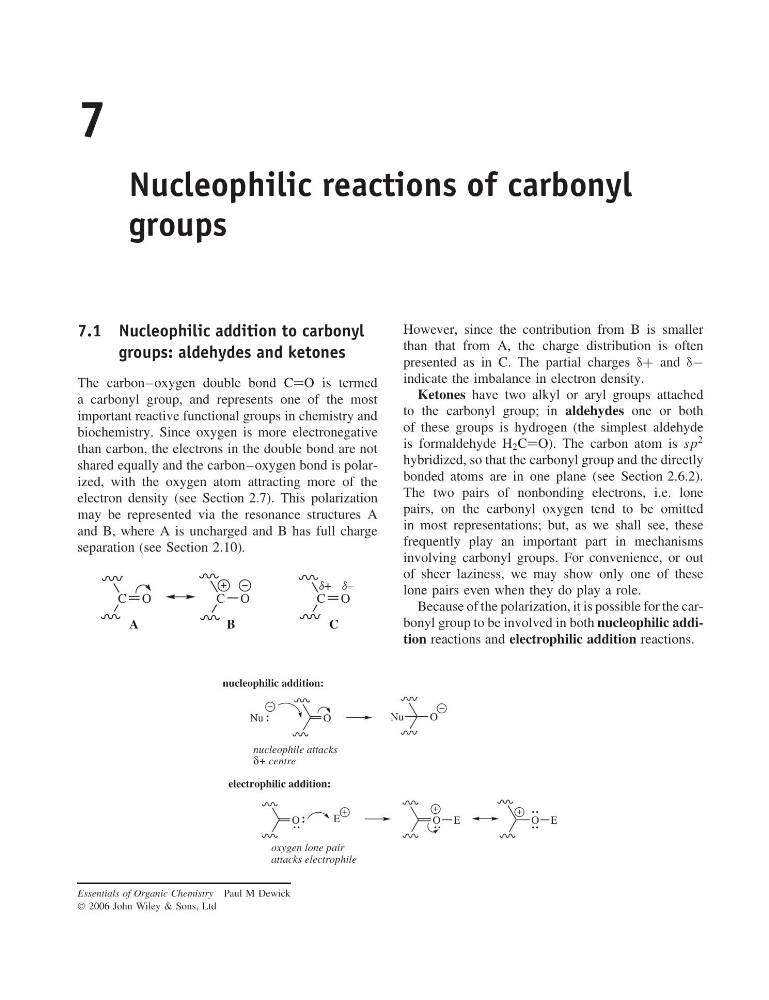
may be represented via the resonance structures A
and B, where A is uncharged and B has full charge
separation (see Section 2.10).
C O
C O
C O
d+ d–
A
B
C
However, since the contribution from B is smaller
than that from A, the charge distribution is often
presented as in C. The partial charges δ+ and δ−
indicate the imbalance in electron density.
Ketones have two alkyl or aryl groups attached
to the carbonyl group; in aldehydes one or both
of these groups is hydrogen (the simplest aldehyde
is formaldehyde H 2 C=O). The carbon atom is sp
2
hybridized, so that the carbonyl group and the directly
bonded atoms are in one plane (see Section 2.6.2).
The two pairs of nonbonding electrons, i.e. lone
pairs, on the carbonyl oxygen tend to be omitted
in most representations; but, as we shall see, these
frequently play an important part in mechanisms
involving carbonyl groups. For convenience, or out
of sheer laziness, we may show only one of these
lone pairs even when they do play a role.
Because of the polarization, it is possible for the carbonyl group to be involved in both nucleophilic addition reactions and electrophilic addition reactions.
O
Nu
nucleophilic addition:
nucleophile attacks
δ+ centre
O
Nu
O
O E
O E
E
electrophilic addition:
oxygen lone pair
attacks electrophile
Essentials of Organic Chemistry Paul M Dewick
2006 John Wiley & Sons, Ltd
Nucleophilic reactions of carbonyl
groups
7.1 Nucleophilic addition to carbonyl
groups: aldehydes and ketones
The carbon–oxygen double bond C=O is termed
a carbonyl group, and represents one of the most
important reactive functional groups in chemistry and
biochemistry. Since oxygen is more electronegative
than carbon, the electrons in the double bond are not
shared equally and the carbon–oxygen bond is polarized, with the oxygen atom attracting more of the
electron density (see Section 2.7). This polarization
may be represented via the resonance structures A
and B, where A is uncharged and B has full charge
separation (see Section 2.10).
C O
C O
C O
d+ d–
A
B
C
However, since the contribution from B is smaller
than that from A, the charge distribution is often
presented as in C. The partial charges δ+ and δ−
indicate the imbalance in electron density.
Ketones have two alkyl or aryl groups attached
to the carbonyl group; in aldehydes one or both
of these groups is hydrogen (the simplest aldehyde
is formaldehyde H 2 C=O). The carbon atom is sp
2
hybridized, so that the carbonyl group and the directly
bonded atoms are in one plane (see Section 2.6.2).
The two pairs of nonbonding electrons, i.e. lone
pairs, on the carbonyl oxygen tend to be omitted
in most representations; but, as we shall see, these
frequently play an important part in mechanisms
involving carbonyl groups. For convenience, or out
of sheer laziness, we may show only one of these
lone pairs even when they do play a role.
Because of the polarization, it is possible for the carbonyl group to be involved in both nucleophilic addition reactions and electrophilic addition reactions.
O
Nu
nucleophilic addition:
nucleophile attacks
δ+ centre
O
Nu
O
O E
O E
E
electrophilic addition:
oxygen lone pair
attacks electrophile
Essentials of Organic Chemistry Paul M Dewick
2006 John Wiley & Sons, Ltd