

206
NUCLEOPHILIC REACTIONS: NUCLEOPHILIC SUBSTITUTION
O
H
OH
H
S N 2 reaction on epoxide
with ring opening
note that the nucleophile
preferentially attacks the
less-hindered carbon
LiAlH 4 H
+
H
Al
H
H
H
H OH
AlH 3
Li
LiOH
H 2
lithium aluminium hydride
reacts violently with water!
as ethyl acetate (see Section 7.5). Note that LAH
is a powerful reducing agent and will attack many
other functional groups, especially carbonyl groups
(see Section 7.11).
An analogous series of reactions is involved when
sodium borohydride is used as the reducing agent.
Sodium borohydride is considerably less reactive than
LAH, and reactions proceed much more slowly. This
reagent may be used in alcoholic or even aqueous
solution, so there are no particular hazards associated
with its use.
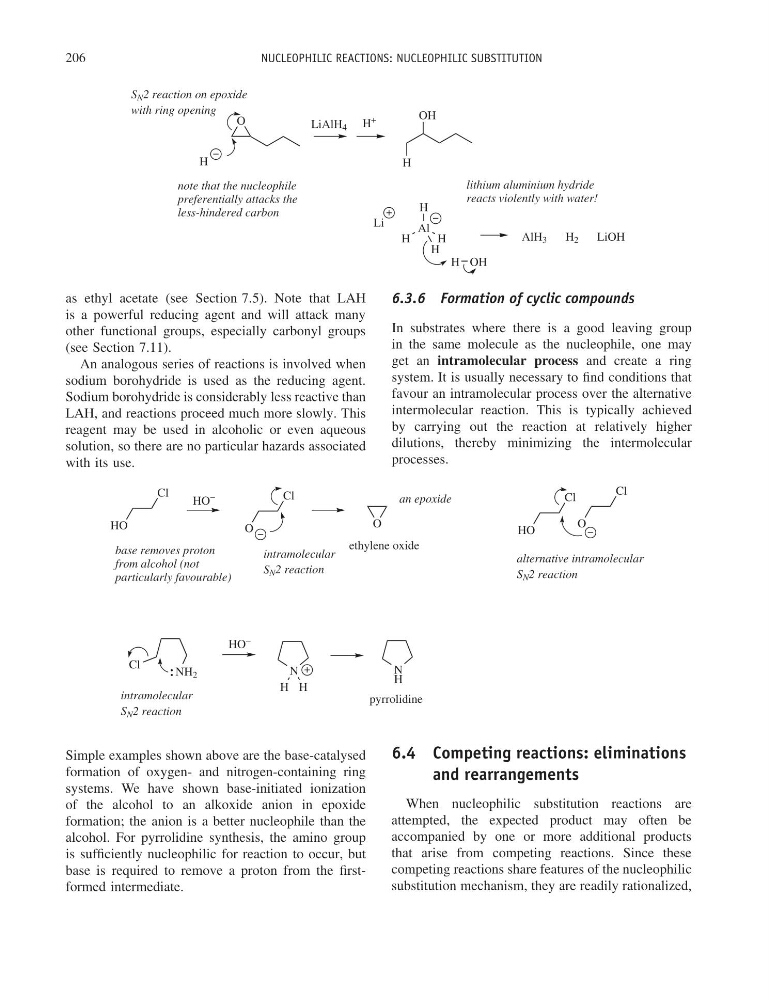
6.3.6 Formation of cyclic compounds
In substrates where there is a good leaving group
in the same molecule as the nucleophile, one may
get an intramolecular process and create a ring
system. It is usually necessary to find conditions that
favour an intramolecular process over the alternative
intermolecular reaction. This is typically achieved
by carrying out the reaction at relatively higher
dilutions, thereby minimizing the intermolecular
processes.
Cl
HO
HO
−
Cl
O
O
ethylene oxide
base removes proton
from alcohol (not
particularly favourable)
intramolecular
S N 2 reaction
an epoxide
NH 2
Cl
intramolecular
S N 2 reaction
N
H
pyrrolidine
alternative intramolecular
S N 2 reaction
Cl
O
Cl
HO
HO −
N
H H
Simple examples shown above are the base-catalysed
formation of oxygen- and nitrogen-containing ring
systems. We have shown base-initiated ionization
of the alcohol to an alkoxide anion in epoxide
formation; the anion is a better nucleophile than the
alcohol. For pyrrolidine synthesis, the amino group
is sufficiently nucleophilic for reaction to occur, but
base is required to remove a proton from the firstformed intermediate.
6.4 Competing reactions: eliminations
and rearrangements
When nucleophilic substitution reactions are
attempted, the expected product may often be
accompanied by one or more additional products
that arise from competing reactions. Since these
competing reactions share features of the nucleophilic
substitution mechanism, they are readily rationalized,
NUCLEOPHILIC REACTIONS: NUCLEOPHILIC SUBSTITUTION
O
H
OH
H
S N 2 reaction on epoxide
with ring opening
note that the nucleophile
preferentially attacks the
less-hindered carbon
LiAlH 4 H
+
H
Al
H
H
H
H OH
AlH 3
Li
LiOH
H 2
lithium aluminium hydride
reacts violently with water!
as ethyl acetate (see Section 7.5). Note that LAH
is a powerful reducing agent and will attack many
other functional groups, especially carbonyl groups
(see Section 7.11).
An analogous series of reactions is involved when
sodium borohydride is used as the reducing agent.
Sodium borohydride is considerably less reactive than
LAH, and reactions proceed much more slowly. This
reagent may be used in alcoholic or even aqueous
solution, so there are no particular hazards associated
with its use.
6.3.6 Formation of cyclic compounds
In substrates where there is a good leaving group
in the same molecule as the nucleophile, one may
get an intramolecular process and create a ring
system. It is usually necessary to find conditions that
favour an intramolecular process over the alternative
intermolecular reaction. This is typically achieved
by carrying out the reaction at relatively higher
dilutions, thereby minimizing the intermolecular
processes.
Cl
HO
HO
−
Cl
O
O
ethylene oxide
base removes proton
from alcohol (not
particularly favourable)
intramolecular
S N 2 reaction
an epoxide
NH 2
Cl
intramolecular
S N 2 reaction
N
H
pyrrolidine
alternative intramolecular
S N 2 reaction
Cl
O
Cl
HO
HO −
N
H H
Simple examples shown above are the base-catalysed
formation of oxygen- and nitrogen-containing ring
systems. We have shown base-initiated ionization
of the alcohol to an alkoxide anion in epoxide
formation; the anion is a better nucleophile than the
alcohol. For pyrrolidine synthesis, the amino group
is sufficiently nucleophilic for reaction to occur, but
base is required to remove a proton from the firstformed intermediate.
6.4 Competing reactions: eliminations
and rearrangements
When nucleophilic substitution reactions are
attempted, the expected product may often be
accompanied by one or more additional products
that arise from competing reactions. Since these
competing reactions share features of the nucleophilic
substitution mechanism, they are readily rationalized,