

COMPETING REACTIONS: ELIMINATIONS AND REARRANGEMENTS
207
and it is possible to devise conditions to minimize or
maximize the formation of such products. The most
common alternative reactions are eliminations and
rearrangements, which we shall consider in turn.
6.4.1 Elimination reactions
The E2 reaction: bimolecular elimination
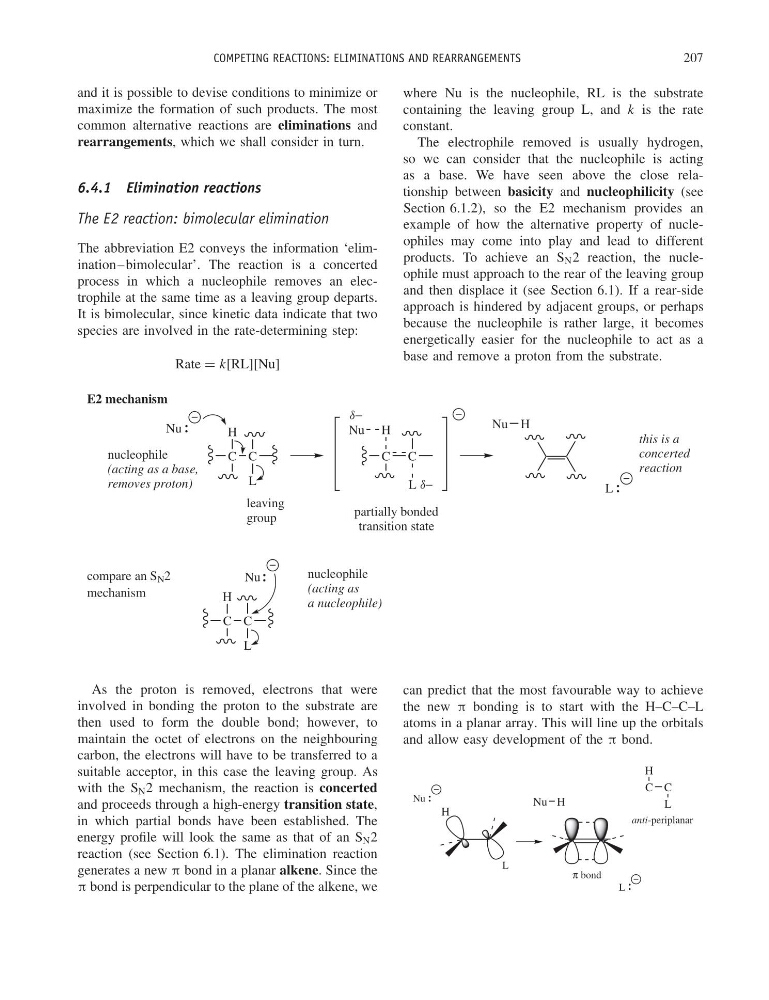
The abbreviation E2 conveys the information ‘elimination–bimolecular’. The reaction is a concerted
process in which a nucleophile removes an electrophile at the same time as a leaving group departs.
It is bimolecular, since kinetic data indicate that two
species are involved in the rate-determining step:
Rate = k[RL][Nu]
where Nu is the nucleophile, RL is the substrate
containing the leaving group L, and k is the rate
constant.
The electrophile removed is usually hydrogen,
so we can consider that the nucleophile is acting
as a base. We have seen above the close relationship between basicity and nucleophilicity (see
Section 6.1.2), so the E2 mechanism provides an
example of how the alternative property of nucleophiles may come into play and lead to different
products. To achieve an S N 2 reaction, the nucleophile must approach to the rear of the leaving group
and then displace it (see Section 6.1). If a rear-side
approach is hindered by adjacent groups, or perhaps
because the nucleophile is rather large, it becomes
energetically easier for the nucleophile to act as a
base and remove a proton from the substrate.
C
H
C
nucleophile
(acting as a base,
removes proton)
leaving
group
this is a
concerted
reaction
Nu
L
L
C
H
C
L
Nu
E2 mechanism
compare an S N 2
mechanism
C
H
C
L
Nu
d−
d−
partially bonded
transition state
nucleophile
(acting as
a nucleophile)
Nu H
As the proton is removed, electrons that were
involved in bonding the proton to the substrate are
then used to form the double bond; however, to
maintain the octet of electrons on the neighbouring
carbon, the electrons will have to be transferred to a
suitable acceptor, in this case the leaving group. As
with the S N 2 mechanism, the reaction is concerted
and proceeds through a high-energy transition state,
in which partial bonds have been established. The
energy profile will look the same as that of an S N 2
reaction (see Section 6.1). The elimination reaction
generates a new π bond in a planar alkene. Since the
π bond is perpendicular to the plane of the alkene, we
can predict that the most favourable way to achieve
the new π bonding is to start with the H–C–C–L
atoms in a planar array. This will line up the orbitals
and allow easy development of the π bond.
H
L
Nu
L
C C
anti-periplanar
Nu H
H
L
π bond
207
and it is possible to devise conditions to minimize or
maximize the formation of such products. The most
common alternative reactions are eliminations and
rearrangements, which we shall consider in turn.
6.4.1 Elimination reactions
The E2 reaction: bimolecular elimination
The abbreviation E2 conveys the information ‘elimination–bimolecular’. The reaction is a concerted
process in which a nucleophile removes an electrophile at the same time as a leaving group departs.
It is bimolecular, since kinetic data indicate that two
species are involved in the rate-determining step:
Rate = k[RL][Nu]
where Nu is the nucleophile, RL is the substrate
containing the leaving group L, and k is the rate
constant.
The electrophile removed is usually hydrogen,
so we can consider that the nucleophile is acting
as a base. We have seen above the close relationship between basicity and nucleophilicity (see
Section 6.1.2), so the E2 mechanism provides an
example of how the alternative property of nucleophiles may come into play and lead to different
products. To achieve an S N 2 reaction, the nucleophile must approach to the rear of the leaving group
and then displace it (see Section 6.1). If a rear-side
approach is hindered by adjacent groups, or perhaps
because the nucleophile is rather large, it becomes
energetically easier for the nucleophile to act as a
base and remove a proton from the substrate.
C
H
C
nucleophile
(acting as a base,
removes proton)
leaving
group
this is a
concerted
reaction
Nu
L
L
C
H
C
L
Nu
E2 mechanism
compare an S N 2
mechanism
C
H
C
L
Nu
d−
d−
partially bonded
transition state
nucleophile
(acting as
a nucleophile)
Nu H
As the proton is removed, electrons that were
involved in bonding the proton to the substrate are
then used to form the double bond; however, to
maintain the octet of electrons on the neighbouring
carbon, the electrons will have to be transferred to a
suitable acceptor, in this case the leaving group. As
with the S N 2 mechanism, the reaction is concerted
and proceeds through a high-energy transition state,
in which partial bonds have been established. The
energy profile will look the same as that of an S N 2
reaction (see Section 6.1). The elimination reaction
generates a new π bond in a planar alkene. Since the
π bond is perpendicular to the plane of the alkene, we
can predict that the most favourable way to achieve
the new π bonding is to start with the H–C–C–L
atoms in a planar array. This will line up the orbitals
and allow easy development of the π bond.
H
L
Nu
L
C C
anti-periplanar
Nu H
H
L
π bond