

NUCLEOPHILIC SUBSTITUTION REACTIONS
205
In the example shown, reaction of a Grignard
reagent with the epoxide electrophile ethylene oxide
proceeds as expected, and after acidification results
in formation of an alcohol that is two carbons longer
than the original nucleophile.
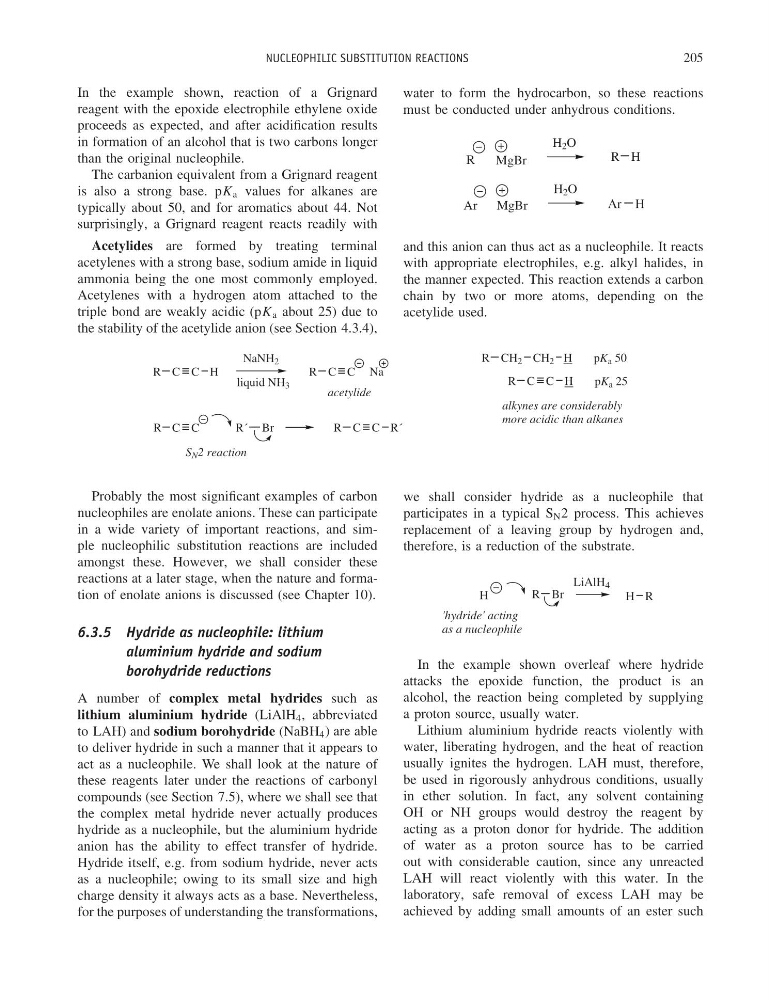
The carbanion equivalent from a Grignard reagent
is also a strong base. pK a values for alkanes are
typically about 50, and for aromatics about 44. Not
surprisingly, a Grignard reagent reacts readily with
water to form the hydrocarbon, so these reactions
must be conducted under anhydrous conditions.
Ar
H 2 O
R H
Ar H
H 2 O
R
MgBr
MgBr
Acetylides are formed by treating terminal
acetylenes with a strong base, sodium amide in liquid
ammonia being the one most commonly employed.
Acetylenes with a hydrogen atom attached to the
triple bond are weakly acidic (pK a about 25) due to
the stability of the acetylide anion (see Section 4.3.4),
and this anion can thus act as a nucleophile. It reacts
with appropriate electrophiles, e.g. alkyl halides, in
the manner expected. This reaction extends a carbon
chain by two or more atoms, depending on the
acetylide used.
C C
R
H
C C
R
liquid NH 3
acetylide
C C
R
R´ Br
R C C R´
C C
R
H
R CH 2 CH 2 H
pK a 50
pK a 25
alkynes are considerably
more acidic than alkanes
S N 2 reaction
Na
NaNH 2
Probably the most significant examples of carbon
nucleophiles are enolate anions. These can participate
in a wide variety of important reactions, and simple nucleophilic substitution reactions are included
amongst these. However, we shall consider these
reactions at a later stage, when the nature and formation of enolate anions is discussed (see Chapter 10).
6.3.5 Hydride as nucleophile: lithium
aluminium hydride and sodium
borohydride reductions
A number of complex metal hydrides such as
lithium aluminium hydride (LiAlH 4 , abbreviated
to LAH) and sodium borohydride (NaBH 4 ) are able
to deliver hydride in such a manner that it appears to
act as a nucleophile. We shall look at the nature of
these reagents later under the reactions of carbonyl
compounds (see Section 7.5), where we shall see that
the complex metal hydride never actually produces
hydride as a nucleophile, but the aluminium hydride
anion has the ability to effect transfer of hydride.
Hydride itself, e.g. from sodium hydride, never acts
as a nucleophile; owing to its small size and high
charge density it always acts as a base. Nevertheless,
for the purposes of understanding the transformations,
we shall consider hydride as a nucleophile that
participates in a typical S N 2 process. This achieves
replacement of a leaving group by hydrogen and,
therefore, is a reduction of the substrate.
R Br
H
H R
LiAlH 4
'hydride' acting
as a nucleophile
In the example shown overleaf where hydride
attacks the epoxide function, the product is an
alcohol, the reaction being completed by supplying
a proton source, usually water.
Lithium aluminium hydride reacts violently with
water, liberating hydrogen, and the heat of reaction
usually ignites the hydrogen. LAH must, therefore,
be used in rigorously anhydrous conditions, usually
in ether solution. In fact, any solvent containing
OH or NH groups would destroy the reagent by
acting as a proton donor for hydride. The addition
of water as a proton source has to be carried
out with considerable caution, since any unreacted
LAH will react violently with this water. In the
laboratory, safe removal of excess LAH may be
achieved by adding small amounts of an ester such
205
In the example shown, reaction of a Grignard
reagent with the epoxide electrophile ethylene oxide
proceeds as expected, and after acidification results
in formation of an alcohol that is two carbons longer
than the original nucleophile.
The carbanion equivalent from a Grignard reagent
is also a strong base. pK a values for alkanes are
typically about 50, and for aromatics about 44. Not
surprisingly, a Grignard reagent reacts readily with
water to form the hydrocarbon, so these reactions
must be conducted under anhydrous conditions.
Ar
H 2 O
R H
Ar H
H 2 O
R
MgBr
MgBr
Acetylides are formed by treating terminal
acetylenes with a strong base, sodium amide in liquid
ammonia being the one most commonly employed.
Acetylenes with a hydrogen atom attached to the
triple bond are weakly acidic (pK a about 25) due to
the stability of the acetylide anion (see Section 4.3.4),
and this anion can thus act as a nucleophile. It reacts
with appropriate electrophiles, e.g. alkyl halides, in
the manner expected. This reaction extends a carbon
chain by two or more atoms, depending on the
acetylide used.
C C
R
H
C C
R
liquid NH 3
acetylide
C C
R
R´ Br
R C C R´
C C
R
H
R CH 2 CH 2 H
pK a 50
pK a 25
alkynes are considerably
more acidic than alkanes
S N 2 reaction
Na
NaNH 2
Probably the most significant examples of carbon
nucleophiles are enolate anions. These can participate
in a wide variety of important reactions, and simple nucleophilic substitution reactions are included
amongst these. However, we shall consider these
reactions at a later stage, when the nature and formation of enolate anions is discussed (see Chapter 10).
6.3.5 Hydride as nucleophile: lithium
aluminium hydride and sodium
borohydride reductions
A number of complex metal hydrides such as
lithium aluminium hydride (LiAlH 4 , abbreviated
to LAH) and sodium borohydride (NaBH 4 ) are able
to deliver hydride in such a manner that it appears to
act as a nucleophile. We shall look at the nature of
these reagents later under the reactions of carbonyl
compounds (see Section 7.5), where we shall see that
the complex metal hydride never actually produces
hydride as a nucleophile, but the aluminium hydride
anion has the ability to effect transfer of hydride.
Hydride itself, e.g. from sodium hydride, never acts
as a nucleophile; owing to its small size and high
charge density it always acts as a base. Nevertheless,
for the purposes of understanding the transformations,
we shall consider hydride as a nucleophile that
participates in a typical S N 2 process. This achieves
replacement of a leaving group by hydrogen and,
therefore, is a reduction of the substrate.
R Br
H
H R
LiAlH 4
'hydride' acting
as a nucleophile
In the example shown overleaf where hydride
attacks the epoxide function, the product is an
alcohol, the reaction being completed by supplying
a proton source, usually water.
Lithium aluminium hydride reacts violently with
water, liberating hydrogen, and the heat of reaction
usually ignites the hydrogen. LAH must, therefore,
be used in rigorously anhydrous conditions, usually
in ether solution. In fact, any solvent containing
OH or NH groups would destroy the reagent by
acting as a proton donor for hydride. The addition
of water as a proton source has to be carried
out with considerable caution, since any unreacted
LAH will react violently with this water. In the
laboratory, safe removal of excess LAH may be
achieved by adding small amounts of an ester such