

204
NUCLEOPHILIC REACTIONS: NUCLEOPHILIC SUBSTITUTION
6.3.4 Carbon as a nucleophile: nitriles,
Grignard reagents, acetylides
Nucleophilic substitution reactions employing carbon
as a nucleophile are important in synthetic chemistry
in that they create a new C–C bond. A carbon nucleophile, of course, must be in the form of anionic
carbon, or its equivalent. One of the simplest sources
of anionic carbon is the cyanide anion. HCN is a
weak acid (pK a 9.1) and forms a series of stable
salts. Sodium and potassium cyanides are convenient
sources of cyanide, which in many reactions behaves
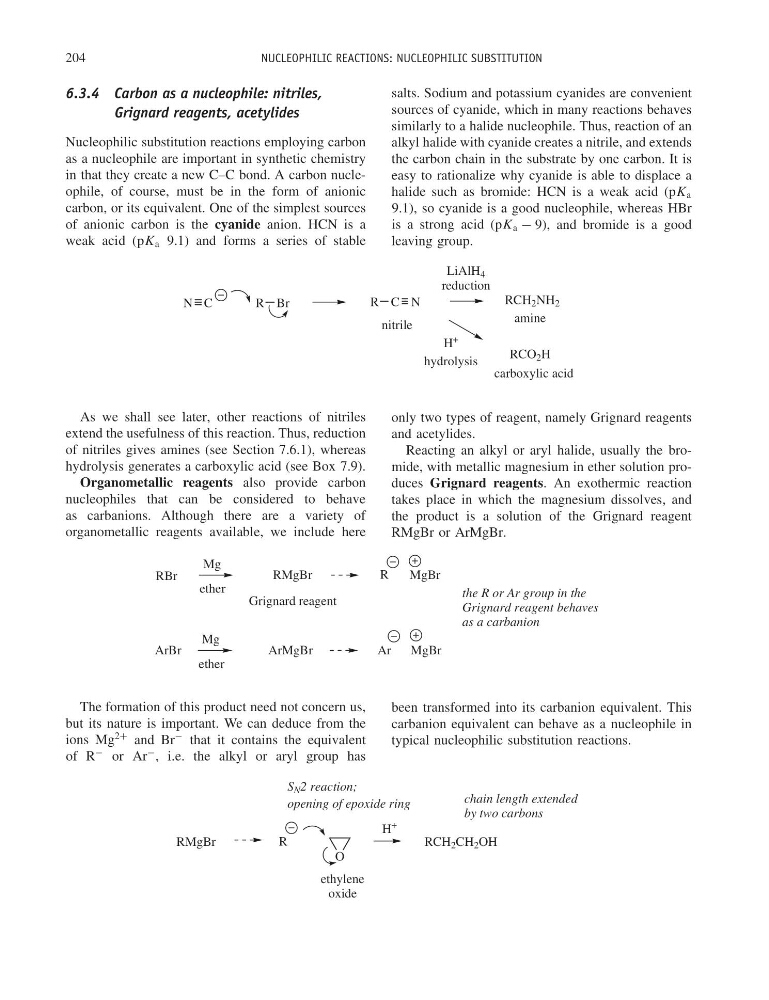
similarly to a halide nucleophile. Thus, reaction of an
alkyl halide with cyanide creates a nitrile, and extends
the carbon chain in the substrate by one carbon. It is
easy to rationalize why cyanide is able to displace a
halide such as bromide: HCN is a weak acid (pK a
9.1), so cyanide is a good nucleophile, whereas HBr
is a strong acid (pK a − 9), and bromide is a good
leaving group.
N C
R Br
R C N
nitrile
RCH 2 NH 2
amine
RCO 2 H
carboxylic acid
LiAlH 4
reduction
H
+
hydrolysis
As we shall see later, other reactions of nitriles
extend the usefulness of this reaction. Thus, reduction
of nitriles gives amines (see Section 7.6.1), whereas
hydrolysis generates a carboxylic acid (see Box 7.9).
Organometallic reagents also provide carbon
nucleophiles that can be considered to behave
as carbanions. Although there are a variety of
organometallic reagents available, we include here
only two types of reagent, namely Grignard reagents
and acetylides.
Reacting an alkyl or aryl halide, usually the bromide, with metallic magnesium in ether solution produces Grignard reagents. An exothermic reaction
takes place in which the magnesium dissolves, and
the product is a solution of the Grignard reagent
RMgBr or ArMgBr.
ether
Grignard reagent
the R or Ar group in the
Grignard reagent behaves
as a carbanion
Mg
RBr
ether
Mg
ArBr
ArMgBr
Ar
RMgBr
R
MgBr
MgBr
The formation of this product need not concern us,
but its nature is important. We can deduce from the
ions Mg
2+ and Br
− that it contains the equivalent
of R
− or Ar
− , i.e. the alkyl or aryl group has
been transformed into its carbanion equivalent. This
carbanion equivalent can behave as a nucleophile in
typical nucleophilic substitution reactions.
O
ethylene
oxide
H +
RCH 2 CH 2 OH
S N 2 reaction;
opening of epoxide ring
chain length extended
by two carbons
RMgBr
R
NUCLEOPHILIC REACTIONS: NUCLEOPHILIC SUBSTITUTION
6.3.4 Carbon as a nucleophile: nitriles,
Grignard reagents, acetylides
Nucleophilic substitution reactions employing carbon
as a nucleophile are important in synthetic chemistry
in that they create a new C–C bond. A carbon nucleophile, of course, must be in the form of anionic
carbon, or its equivalent. One of the simplest sources
of anionic carbon is the cyanide anion. HCN is a
weak acid (pK a 9.1) and forms a series of stable
salts. Sodium and potassium cyanides are convenient
sources of cyanide, which in many reactions behaves
similarly to a halide nucleophile. Thus, reaction of an
alkyl halide with cyanide creates a nitrile, and extends
the carbon chain in the substrate by one carbon. It is
easy to rationalize why cyanide is able to displace a
halide such as bromide: HCN is a weak acid (pK a
9.1), so cyanide is a good nucleophile, whereas HBr
is a strong acid (pK a − 9), and bromide is a good
leaving group.
N C
R Br
R C N
nitrile
RCH 2 NH 2
amine
RCO 2 H
carboxylic acid
LiAlH 4
reduction
H
+
hydrolysis
As we shall see later, other reactions of nitriles
extend the usefulness of this reaction. Thus, reduction
of nitriles gives amines (see Section 7.6.1), whereas
hydrolysis generates a carboxylic acid (see Box 7.9).
Organometallic reagents also provide carbon
nucleophiles that can be considered to behave
as carbanions. Although there are a variety of
organometallic reagents available, we include here
only two types of reagent, namely Grignard reagents
and acetylides.
Reacting an alkyl or aryl halide, usually the bromide, with metallic magnesium in ether solution produces Grignard reagents. An exothermic reaction
takes place in which the magnesium dissolves, and
the product is a solution of the Grignard reagent
RMgBr or ArMgBr.
ether
Grignard reagent
the R or Ar group in the
Grignard reagent behaves
as a carbanion
Mg
RBr
ether
Mg
ArBr
ArMgBr
Ar
RMgBr
R
MgBr
MgBr
The formation of this product need not concern us,
but its nature is important. We can deduce from the
ions Mg
2+ and Br
− that it contains the equivalent
of R
− or Ar
− , i.e. the alkyl or aryl group has
been transformed into its carbanion equivalent. This
carbanion equivalent can behave as a nucleophile in
typical nucleophilic substitution reactions.
O
ethylene
oxide
H +
RCH 2 CH 2 OH
S N 2 reaction;
opening of epoxide ring
chain length extended
by two carbons
RMgBr
R