

202
NUCLEOPHILIC REACTIONS: NUCLEOPHILIC SUBSTITUTION
Nevertheless, it offers a convenient route to
amino acids, both natural and unnatural, since the
amino group in amino acids is less basic (pK a
about 9.8) than a simple amine (pK a about 10.6)
and is consequently rather less nucleophilic (see
Section 4.11.3). Steric hindrance also reduces the
chance of multiple alkylations.
Br
R
NH 3 (excess)
NH 2
R
CO 2 H
CO 2 H
Box 6.7
Curare-like muscle relaxants: quaternary ammonium salts
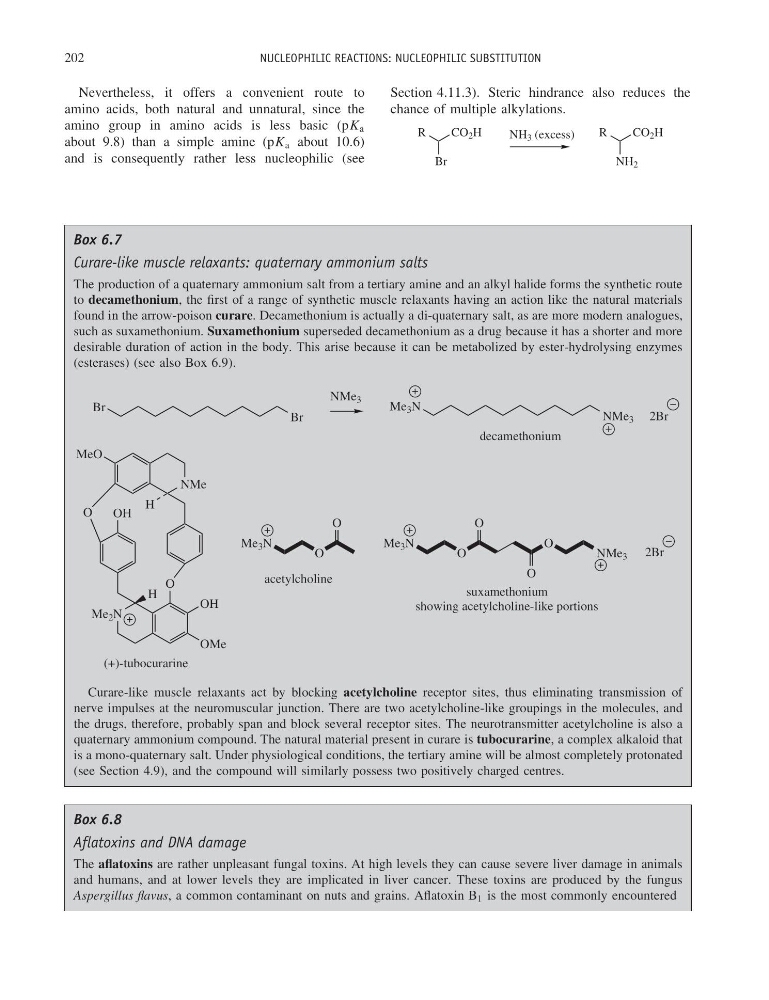
The production of a quaternary ammonium salt from a tertiary amine and an alkyl halide forms the synthetic route
to decamethonium, the first of a range of synthetic muscle relaxants having an action like the natural materials
found in the arrow-poison curare. Decamethonium is actually a di-quaternary salt, as are more modern analogues,
such as suxamethonium. Suxamethonium superseded decamethonium as a drug because it has a shorter and more
desirable duration of action in the body. This arise because it can be metabolized by ester-hydrolysing enzymes
(esterases) (see also Box 6.9).
decamethonium
Me 3 N
O
O
NMe 3
O
O
suxamethonium
showing acetylcholine-like portions
Me 3 N
O
O
acetylcholine
Br
Br
NMe 3
Me 3 N
NMe 3
O
NMe
MeO
H
Me 2 N
O
OH
OMe
H
OH
(+)-tubocurarine
2Br
2Br
Curare-like muscle relaxants act by blocking acetylcholine receptor sites, thus eliminating transmission of
nerve impulses at the neuromuscular junction. There are two acetylcholine-like groupings in the molecules, and
the drugs, therefore, probably span and block several receptor sites. The neurotransmitter acetylcholine is also a
quaternary ammonium compound. The natural material present in curare is tubocurarine, a complex alkaloid that
is a mono-quaternary salt. Under physiological conditions, the tertiary amine will be almost completely protonated
(see Section 4.9), and the compound will similarly possess two positively charged centres.
Box 6.8
Aflatoxins and DNA damage
The aflatoxins are rather unpleasant fungal toxins. At high levels they can cause severe liver damage in animals
and humans, and at lower levels they are implicated in liver cancer. These toxins are produced by the fungus
Aspergillus flavus, a common contaminant on nuts and grains. Aflatoxin B 1 is the most commonly encountered
NUCLEOPHILIC REACTIONS: NUCLEOPHILIC SUBSTITUTION
Nevertheless, it offers a convenient route to
amino acids, both natural and unnatural, since the
amino group in amino acids is less basic (pK a
about 9.8) than a simple amine (pK a about 10.6)
and is consequently rather less nucleophilic (see
Section 4.11.3). Steric hindrance also reduces the
chance of multiple alkylations.
Br
R
NH 3 (excess)
NH 2
R
CO 2 H
CO 2 H
Box 6.7
Curare-like muscle relaxants: quaternary ammonium salts
The production of a quaternary ammonium salt from a tertiary amine and an alkyl halide forms the synthetic route
to decamethonium, the first of a range of synthetic muscle relaxants having an action like the natural materials
found in the arrow-poison curare. Decamethonium is actually a di-quaternary salt, as are more modern analogues,
such as suxamethonium. Suxamethonium superseded decamethonium as a drug because it has a shorter and more
desirable duration of action in the body. This arise because it can be metabolized by ester-hydrolysing enzymes
(esterases) (see also Box 6.9).
decamethonium
Me 3 N
O
O
NMe 3
O
O
suxamethonium
showing acetylcholine-like portions
Me 3 N
O
O
acetylcholine
Br
Br
NMe 3
Me 3 N
NMe 3
O
NMe
MeO
H
Me 2 N
O
OH
OMe
H
OH
(+)-tubocurarine
2Br
2Br
Curare-like muscle relaxants act by blocking acetylcholine receptor sites, thus eliminating transmission of
nerve impulses at the neuromuscular junction. There are two acetylcholine-like groupings in the molecules, and
the drugs, therefore, probably span and block several receptor sites. The neurotransmitter acetylcholine is also a
quaternary ammonium compound. The natural material present in curare is tubocurarine, a complex alkaloid that
is a mono-quaternary salt. Under physiological conditions, the tertiary amine will be almost completely protonated
(see Section 4.9), and the compound will similarly possess two positively charged centres.
Box 6.8
Aflatoxins and DNA damage
The aflatoxins are rather unpleasant fungal toxins. At high levels they can cause severe liver damage in animals
and humans, and at lower levels they are implicated in liver cancer. These toxins are produced by the fungus
Aspergillus flavus, a common contaminant on nuts and grains. Aflatoxin B 1 is the most commonly encountered