

NUCLEOPHILIC SUBSTITUTION REACTIONS
201
Box 6.6
Glutathione as a sulfur nucleophile in the metabolism of foreign compounds
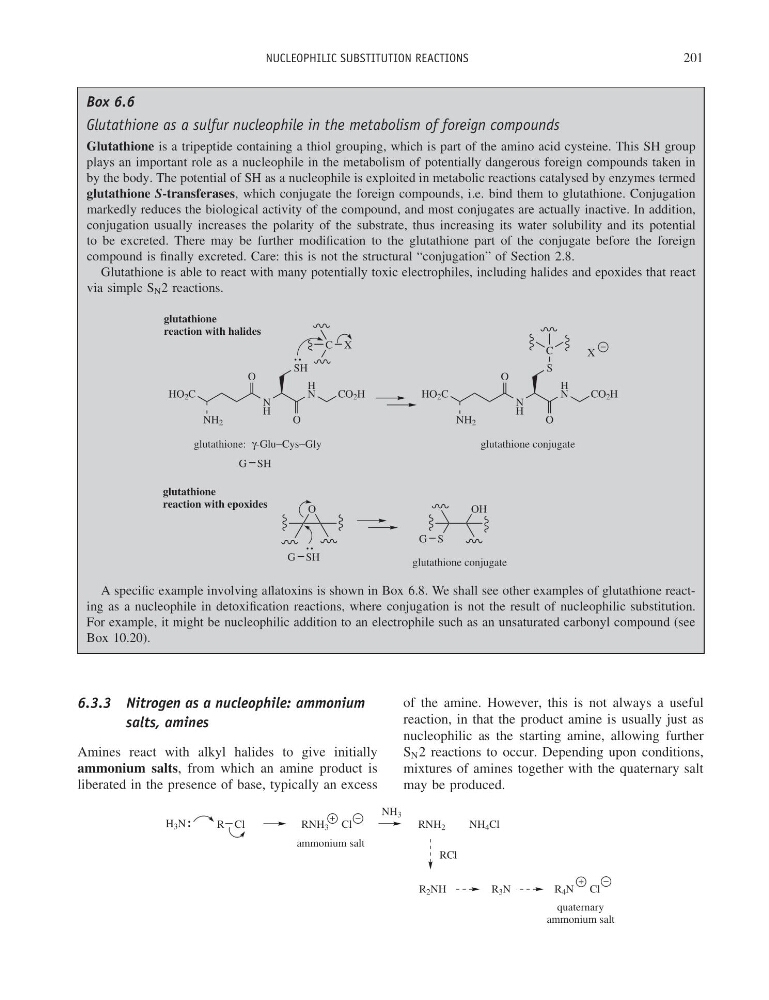
Glutathione is a tripeptide containing a thiol grouping, which is part of the amino acid cysteine. This SH group
plays an important role as a nucleophile in the metabolism of potentially dangerous foreign compounds taken in
by the body. The potential of SH as a nucleophile is exploited in metabolic reactions catalysed by enzymes termed
glutathione S-transferases, which conjugate the foreign compounds, i.e. bind them to glutathione. Conjugation
markedly reduces the biological activity of the compound, and most conjugates are actually inactive. In addition,
conjugation usually increases the polarity of the substrate, thus increasing its water solubility and its potential
to be excreted. There may be further modification to the glutathione part of the conjugate before the foreign
compound is finally excreted. Care: this is not the structural “conjugation” of Section 2.8.
Glutathione is able to react with many potentially toxic electrophiles, including halides and epoxides that react
via simple S N 2 reactions.
HO 2 C
N
H
H
N
CO 2 H
NH 2
O
SH
O
glutathione: γ-Glu−Cys−Gly
G SH
C X
HO 2 C
N
H
H
N
CO 2 H
NH 2
O
S
O
C
X
glutathione conjugate
O
OH
S
G
G SH
glutathione
reaction with halides
glutathione
reaction with epoxides
glutathione conjugate
A specific example involving aflatoxins is shown in Box 6.8. We shall see other examples of glutathione reacting as a nucleophile in detoxification reactions, where conjugation is not the result of nucleophilic substitution.
For example, it might be nucleophilic addition to an electrophile such as an unsaturated carbonyl compound (see
Box 10.20).
6.3.3 Nitrogen as a nucleophile: ammonium
salts, amines
Amines react with alkyl halides to give initially
ammonium salts, from which an amine product is
liberated in the presence of base, typically an excess
of the amine. However, this is not always a useful
reaction, in that the product amine is usually just as
nucleophilic as the starting amine, allowing further
S N 2 reactions to occur. Depending upon conditions,
mixtures of amines together with the quaternary salt
may be produced.
H 3 N
R Cl
RNH 3 Cl
RNH 2
NH 4 Cl
NH 3
RCl
R 2 NH
R 3 N
R 4 N Cl
ammonium salt
quaternary
ammonium salt
201
Box 6.6
Glutathione as a sulfur nucleophile in the metabolism of foreign compounds
Glutathione is a tripeptide containing a thiol grouping, which is part of the amino acid cysteine. This SH group
plays an important role as a nucleophile in the metabolism of potentially dangerous foreign compounds taken in
by the body. The potential of SH as a nucleophile is exploited in metabolic reactions catalysed by enzymes termed
glutathione S-transferases, which conjugate the foreign compounds, i.e. bind them to glutathione. Conjugation
markedly reduces the biological activity of the compound, and most conjugates are actually inactive. In addition,
conjugation usually increases the polarity of the substrate, thus increasing its water solubility and its potential
to be excreted. There may be further modification to the glutathione part of the conjugate before the foreign
compound is finally excreted. Care: this is not the structural “conjugation” of Section 2.8.
Glutathione is able to react with many potentially toxic electrophiles, including halides and epoxides that react
via simple S N 2 reactions.
HO 2 C
N
H
H
N
CO 2 H
NH 2
O
SH
O
glutathione: γ-Glu−Cys−Gly
G SH
C X
HO 2 C
N
H
H
N
CO 2 H
NH 2
O
S
O
C
X
glutathione conjugate
O
OH
S
G
G SH
glutathione
reaction with halides
glutathione
reaction with epoxides
glutathione conjugate
A specific example involving aflatoxins is shown in Box 6.8. We shall see other examples of glutathione reacting as a nucleophile in detoxification reactions, where conjugation is not the result of nucleophilic substitution.
For example, it might be nucleophilic addition to an electrophile such as an unsaturated carbonyl compound (see
Box 10.20).
6.3.3 Nitrogen as a nucleophile: ammonium
salts, amines
Amines react with alkyl halides to give initially
ammonium salts, from which an amine product is
liberated in the presence of base, typically an excess
of the amine. However, this is not always a useful
reaction, in that the product amine is usually just as
nucleophilic as the starting amine, allowing further
S N 2 reactions to occur. Depending upon conditions,
mixtures of amines together with the quaternary salt
may be produced.
H 3 N
R Cl
RNH 3 Cl
RNH 2
NH 4 Cl
NH 3
RCl
R 2 NH
R 3 N
R 4 N Cl
ammonium salt
quaternary
ammonium salt