

198
NUCLEOPHILIC REACTIONS: NUCLEOPHILIC SUBSTITUTION
Box 6.4 (continued)
OPP
OPP
OPP
OPP
Z
E
≡
geranyl PP
(GPP)
linalyl PP
(LPP)
neryl PP
(NPP)
resonance-stabilized allylic cation
(geranyl cation)
resonance-stabilized allylic cation
(neryl cation)
single bond in LPP
allows rotation
OPP
OPP
6.3 Nucleophilic substitution reactions
6.3.1 Halide as a nucleophile: alkyl halides
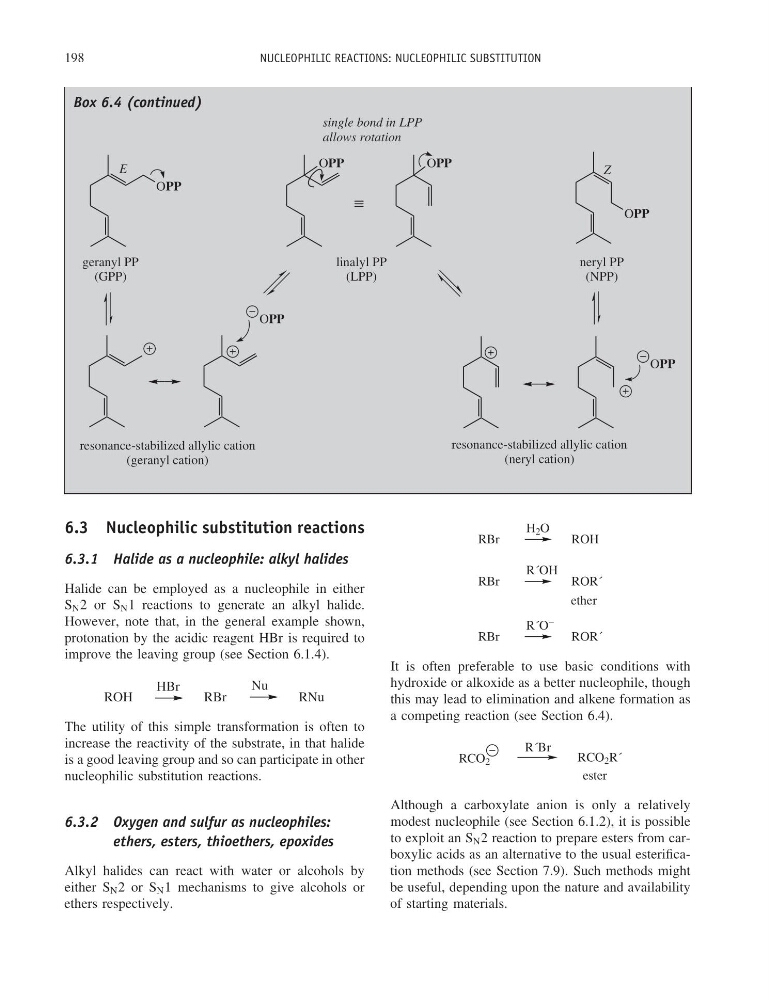
Halide can be employed as a nucleophile in either
S N 2 or S N 1 reactions to generate an alkyl halide.
However, note that, in the general example shown,
protonation by the acidic reagent HBr is required to
improve the leaving group (see Section 6.1.4).
ROH
HBr
RBr
Nu
RNu
The utility of this simple transformation is often to
increase the reactivity of the substrate, in that halide
is a good leaving group and so can participate in other
nucleophilic substitution reactions.
6.3.2 Oxygen and sulfur as nucleophiles:
ethers, esters, thioethers, epoxides
Alkyl halides can react with water or alcohols by
either S N 2 or S N 1 mechanisms to give alcohols or
ethers respectively.
RBr
H 2 O
ROH
RBr
R´OH
ROR´
ether
RBr
R´O
−
ROR´
It is often preferable to use basic conditions with
hydroxide or alkoxide as a better nucleophile, though
this may lead to elimination and alkene formation as
a competing reaction (see Section 6.4).
RCO 2
R´Br
RCO 2 R´
ester
Although a carboxylate anion is only a relatively
modest nucleophile (see Section 6.1.2), it is possible
to exploit an S N 2 reaction to prepare esters from carboxylic acids as an alternative to the usual esterification methods (see Section 7.9). Such methods might
be useful, depending upon the nature and availability
of starting materials.
NUCLEOPHILIC REACTIONS: NUCLEOPHILIC SUBSTITUTION
Box 6.4 (continued)
OPP
OPP
OPP
OPP
Z
E
≡
geranyl PP
(GPP)
linalyl PP
(LPP)
neryl PP
(NPP)
resonance-stabilized allylic cation
(geranyl cation)
resonance-stabilized allylic cation
(neryl cation)
single bond in LPP
allows rotation
OPP
OPP
6.3 Nucleophilic substitution reactions
6.3.1 Halide as a nucleophile: alkyl halides
Halide can be employed as a nucleophile in either
S N 2 or S N 1 reactions to generate an alkyl halide.
However, note that, in the general example shown,
protonation by the acidic reagent HBr is required to
improve the leaving group (see Section 6.1.4).
ROH
HBr
RBr
Nu
RNu
The utility of this simple transformation is often to
increase the reactivity of the substrate, in that halide
is a good leaving group and so can participate in other
nucleophilic substitution reactions.
6.3.2 Oxygen and sulfur as nucleophiles:
ethers, esters, thioethers, epoxides
Alkyl halides can react with water or alcohols by
either S N 2 or S N 1 mechanisms to give alcohols or
ethers respectively.
RBr
H 2 O
ROH
RBr
R´OH
ROR´
ether
RBr
R´O
−
ROR´
It is often preferable to use basic conditions with
hydroxide or alkoxide as a better nucleophile, though
this may lead to elimination and alkene formation as
a competing reaction (see Section 6.4).
RCO 2
R´Br
RCO 2 R´
ester
Although a carboxylate anion is only a relatively
modest nucleophile (see Section 6.1.2), it is possible
to exploit an S N 2 reaction to prepare esters from carboxylic acids as an alternative to the usual esterification methods (see Section 7.9). Such methods might
be useful, depending upon the nature and availability
of starting materials.