

NUCLEOPHILIC SUBSTITUTION REACTIONS
199
RBr
R´SH
RSR´
thioether
RBr
R´S −
RSR´
Sulfur nucleophiles behave similarly to oxygen
compounds. Again, the anion will be a better
nucleophile than the thiol; and since thiols are more
acidic than alcohols (see Section 4.3.2), the conjugate
bases are more easily generated.
Note also that ring-opening nucleophilic substitution reactions may be possible, and that these will
give a product with two functional groups, since the
leaving group is still attached to the original molecule
through another bond.
cyclic compound
difunctional product
H +
L
Nu
L
Nu
LH
Nu
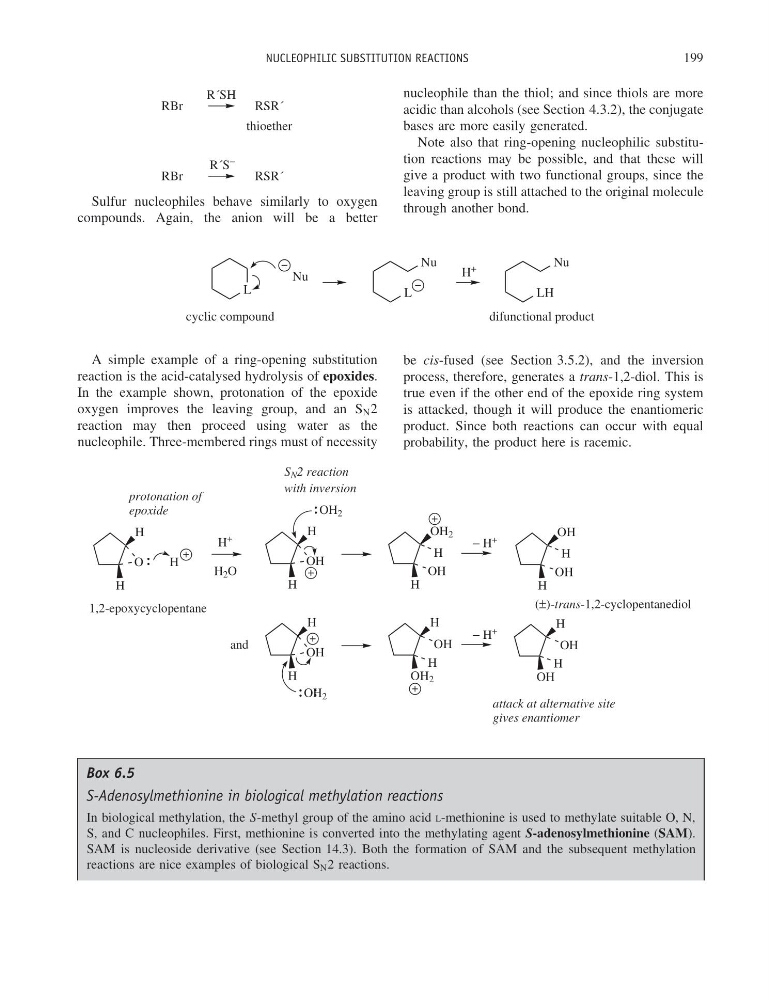
A simple example of a ring-opening substitution
reaction is the acid-catalysed hydrolysis of epoxides.
In the example shown, protonation of the epoxide
oxygen improves the leaving group, and an S N 2
reaction may then proceed using water as the
nucleophile. Three-membered rings must of necessity
be cis-fused (see Section 3.5.2), and the inversion
process, therefore, generates a trans-1,2-diol. This is
true even if the other end of the epoxide ring system
is attacked, though it will produce the enantiomeric
product. Since both reactions can occur with equal
probability, the product here is racemic.
O
H
H
H +
H
OH
H
H
H
H
OH
OH 2
− H +
H
H
OH
OH
OH
H
H
OH
OH 2
H
H
− H +
OH
OH
H
H
and
protonation of
epoxide
H 2 O
S N 2 reaction
with inversion
(±)-trans-1,2-cyclopentanediol
attack at alternative site
gives enantiomer
1,2-epoxycyclopentane
OH 2
OH 2
Box 6.5
S-Adenosylmethionine in biological methylation reactions
In biological methylation, the S-methyl group of the amino acid L-methionine is used to methylate suitable O, N,
S, and C nucleophiles. First, methionine is converted into the methylating agent S-adenosylmethionine (SAM).
SAM is nucleoside derivative (see Section 14.3). Both the formation of SAM and the subsequent methylation
reactions are nice examples of biological S N 2 reactions.
199
RBr
R´SH
RSR´
thioether
RBr
R´S −
RSR´
Sulfur nucleophiles behave similarly to oxygen
compounds. Again, the anion will be a better
nucleophile than the thiol; and since thiols are more
acidic than alcohols (see Section 4.3.2), the conjugate
bases are more easily generated.
Note also that ring-opening nucleophilic substitution reactions may be possible, and that these will
give a product with two functional groups, since the
leaving group is still attached to the original molecule
through another bond.
cyclic compound
difunctional product
H +
L
Nu
L
Nu
LH
Nu
A simple example of a ring-opening substitution
reaction is the acid-catalysed hydrolysis of epoxides.
In the example shown, protonation of the epoxide
oxygen improves the leaving group, and an S N 2
reaction may then proceed using water as the
nucleophile. Three-membered rings must of necessity
be cis-fused (see Section 3.5.2), and the inversion
process, therefore, generates a trans-1,2-diol. This is
true even if the other end of the epoxide ring system
is attacked, though it will produce the enantiomeric
product. Since both reactions can occur with equal
probability, the product here is racemic.
O
H
H
H +
H
OH
H
H
H
H
OH
OH 2
− H +
H
H
OH
OH
OH
H
H
OH
OH 2
H
H
− H +
OH
OH
H
H
and
protonation of
epoxide
H 2 O
S N 2 reaction
with inversion
(±)-trans-1,2-cyclopentanediol
attack at alternative site
gives enantiomer
1,2-epoxycyclopentane
OH 2
OH 2
Box 6.5
S-Adenosylmethionine in biological methylation reactions
In biological methylation, the S-methyl group of the amino acid L-methionine is used to methylate suitable O, N,
S, and C nucleophiles. First, methionine is converted into the methylating agent S-adenosylmethionine (SAM).
SAM is nucleoside derivative (see Section 14.3). Both the formation of SAM and the subsequent methylation
reactions are nice examples of biological S N 2 reactions.