

THE S N 1 REACTION: UNIMOLECULAR NUCLEOPHILIC SUBSTITUTION
197
PPO
R
OH
diphosphate is a
good leaving group
S N 1 reaction
resonance-stabilized
allylic carbocation
OPP (diphosphate)
dimethylallyl diphosphate
(DMAPP)
– H
+
R
OH
RO
O
P
O
O
P
O
O
O
O
O
R
O
R
H
– H +
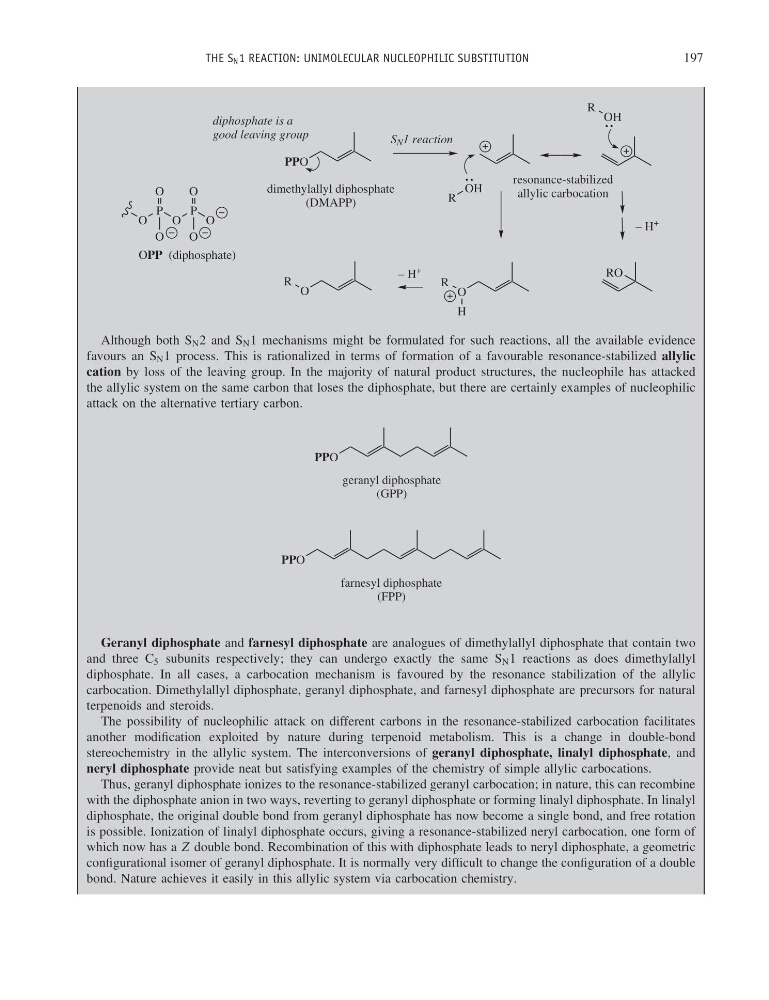
Although both S N 2 and S N 1 mechanisms might be formulated for such reactions, all the available evidence
favours an S N 1 process. This is rationalized in terms of formation of a favourable resonance-stabilized allylic
cation by loss of the leaving group. In the majority of natural product structures, the nucleophile has attacked
the allylic system on the same carbon that loses the diphosphate, but there are certainly examples of nucleophilic
attack on the alternative tertiary carbon.
PPO
geranyl diphosphate
(GPP)
PPO
farnesyl diphosphate
(FPP)
Geranyl diphosphate and farnesyl diphosphate are analogues of dimethylallyl diphosphate that contain two
and three C 5 subunits respectively; they can undergo exactly the same S N 1 reactions as does dimethylallyl
diphosphate. In all cases, a carbocation mechanism is favoured by the resonance stabilization of the allylic
carbocation. Dimethylallyl diphosphate, geranyl diphosphate, and farnesyl diphosphate are precursors for natural
terpenoids and steroids.
The possibility of nucleophilic attack on different carbons in the resonance-stabilized carbocation facilitates
another modification exploited by nature during terpenoid metabolism. This is a change in double-bond
stereochemistry in the allylic system. The interconversions of geranyl diphosphate, linalyl diphosphate, and
neryl diphosphate provide neat but satisfying examples of the chemistry of simple allylic carbocations.
Thus, geranyl diphosphate ionizes to the resonance-stabilized geranyl carbocation; in nature, this can recombine
with the diphosphate anion in two ways, reverting to geranyl diphosphate or forming linalyl diphosphate. In linalyl
diphosphate, the original double bond from geranyl diphosphate has now become a single bond, and free rotation
is possible. Ionization of linalyl diphosphate occurs, giving a resonance-stabilized neryl carbocation, one form of
which now has a Z double bond. Recombination of this with diphosphate leads to neryl diphosphate, a geometric
configurational isomer of geranyl diphosphate. It is normally very difficult to change the configuration of a double
bond. Nature achieves it easily in this allylic system via carbocation chemistry.
197
PPO
R
OH
diphosphate is a
good leaving group
S N 1 reaction
resonance-stabilized
allylic carbocation
OPP (diphosphate)
dimethylallyl diphosphate
(DMAPP)
– H
+
R
OH
RO
O
P
O
O
P
O
O
O
O
O
R
O
R
H
– H +
Although both S N 2 and S N 1 mechanisms might be formulated for such reactions, all the available evidence
favours an S N 1 process. This is rationalized in terms of formation of a favourable resonance-stabilized allylic
cation by loss of the leaving group. In the majority of natural product structures, the nucleophile has attacked
the allylic system on the same carbon that loses the diphosphate, but there are certainly examples of nucleophilic
attack on the alternative tertiary carbon.
PPO
geranyl diphosphate
(GPP)
PPO
farnesyl diphosphate
(FPP)
Geranyl diphosphate and farnesyl diphosphate are analogues of dimethylallyl diphosphate that contain two
and three C 5 subunits respectively; they can undergo exactly the same S N 1 reactions as does dimethylallyl
diphosphate. In all cases, a carbocation mechanism is favoured by the resonance stabilization of the allylic
carbocation. Dimethylallyl diphosphate, geranyl diphosphate, and farnesyl diphosphate are precursors for natural
terpenoids and steroids.
The possibility of nucleophilic attack on different carbons in the resonance-stabilized carbocation facilitates
another modification exploited by nature during terpenoid metabolism. This is a change in double-bond
stereochemistry in the allylic system. The interconversions of geranyl diphosphate, linalyl diphosphate, and
neryl diphosphate provide neat but satisfying examples of the chemistry of simple allylic carbocations.
Thus, geranyl diphosphate ionizes to the resonance-stabilized geranyl carbocation; in nature, this can recombine
with the diphosphate anion in two ways, reverting to geranyl diphosphate or forming linalyl diphosphate. In linalyl
diphosphate, the original double bond from geranyl diphosphate has now become a single bond, and free rotation
is possible. Ionization of linalyl diphosphate occurs, giving a resonance-stabilized neryl carbocation, one form of
which now has a Z double bond. Recombination of this with diphosphate leads to neryl diphosphate, a geometric
configurational isomer of geranyl diphosphate. It is normally very difficult to change the configuration of a double
bond. Nature achieves it easily in this allylic system via carbocation chemistry.