

196
NUCLEOPHILIC REACTIONS: NUCLEOPHILIC SUBSTITUTION
S N 1 reaction
R C
R
R
Cl
H 2 O
readily
R C
R
R
OH
C
R
R
Cl
slow
R C
R
R
O
H
H
relatively poor nucleophile
attacks very good electrophile
fast
R C
R
R
O
H
H
O
H
H
R C
R
R
OH
R
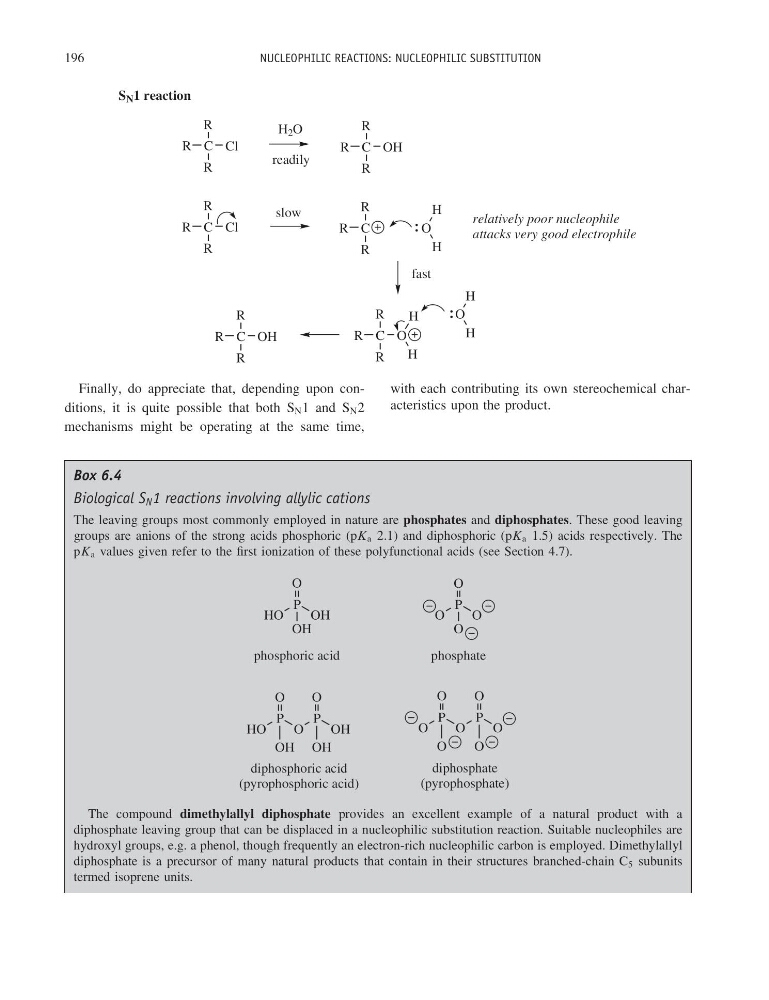
Finally, do appreciate that, depending upon conditions, it is quite possible that both S N 1 and S N 2
mechanisms might be operating at the same time,
with each contributing its own stereochemical characteristics upon the product.
Box 6.4
Biological S N 1 reactions involving allylic cations
The leaving groups most commonly employed in nature are phosphates and diphosphates. These good leaving
groups are anions of the strong acids phosphoric (pK a 2.1) and diphosphoric (pK a 1.5) acids respectively. The
pK a values given refer to the first ionization of these polyfunctional acids (see Section 4.7).
phosphate
phosphoric acid
diphosphate
(pyrophosphate)
diphosphoric acid
(pyrophosphoric acid)
O
P
HO
OH
OH
O
P
O
O
O
O
P
HO
O
P
OH
O
OH OH
O
P
O
O
P
O
O
O
O
The compound dimethylallyl diphosphate provides an excellent example of a natural product with a
diphosphate leaving group that can be displaced in a nucleophilic substitution reaction. Suitable nucleophiles are
hydroxyl groups, e.g. a phenol, though frequently an electron-rich nucleophilic carbon is employed. Dimethylallyl
diphosphate is a precursor of many natural products that contain in their structures branched-chain C 5 subunits
termed isoprene units.
NUCLEOPHILIC REACTIONS: NUCLEOPHILIC SUBSTITUTION
S N 1 reaction
R C
R
R
Cl
H 2 O
readily
R C
R
R
OH
C
R
R
Cl
slow
R C
R
R
O
H
H
relatively poor nucleophile
attacks very good electrophile
fast
R C
R
R
O
H
H
O
H
H
R C
R
R
OH
R
Finally, do appreciate that, depending upon conditions, it is quite possible that both S N 1 and S N 2
mechanisms might be operating at the same time,
with each contributing its own stereochemical characteristics upon the product.
Box 6.4
Biological S N 1 reactions involving allylic cations
The leaving groups most commonly employed in nature are phosphates and diphosphates. These good leaving
groups are anions of the strong acids phosphoric (pK a 2.1) and diphosphoric (pK a 1.5) acids respectively. The
pK a values given refer to the first ionization of these polyfunctional acids (see Section 4.7).
phosphate
phosphoric acid
diphosphate
(pyrophosphate)
diphosphoric acid
(pyrophosphoric acid)
O
P
HO
OH
OH
O
P
O
O
O
O
P
HO
O
P
OH
O
OH OH
O
P
O
O
P
O
O
O
O
The compound dimethylallyl diphosphate provides an excellent example of a natural product with a
diphosphate leaving group that can be displaced in a nucleophilic substitution reaction. Suitable nucleophiles are
hydroxyl groups, e.g. a phenol, though frequently an electron-rich nucleophilic carbon is employed. Dimethylallyl
diphosphate is a precursor of many natural products that contain in their structures branched-chain C 5 subunits
termed isoprene units.