

THE S N 1 REACTION: UNIMOLECULAR NUCLEOPHILIC SUBSTITUTION
195
6.2.2 S N 1 reactions in cyclic systems
We noted above that the inversion of configuration that accompanied S N 2 reactions was particularly
apparent in cyclic systems, and that cis derivatives
would be converted into trans products in disubstituted rings, and vice versa (see Section 6.1.5). Should
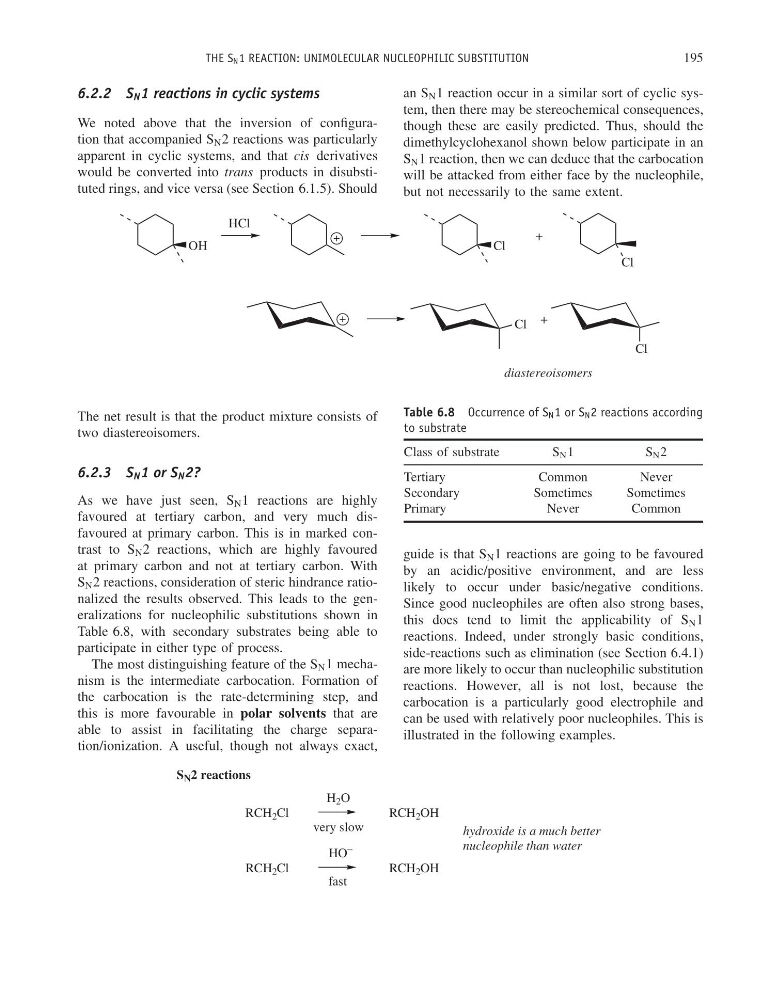
an S N 1 reaction occur in a similar sort of cyclic system, then there may be stereochemical consequences,
though these are easily predicted. Thus, should the
dimethylcyclohexanol shown below participate in an
S N 1 reaction, then we can deduce that the carbocation
will be attacked from either face by the nucleophile,
but not necessarily to the same extent.
OH
HCl
Cl
Cl
+
Cl
Cl
+
diastereoisomers
The net result is that the product mixture consists of
two diastereoisomers.
6.2.3 S N 1 or S N 2?
As we have just seen, S N 1 reactions are highly
favoured at tertiary carbon, and very much disfavoured at primary carbon. This is in marked contrast to S N 2 reactions, which are highly favoured
at primary carbon and not at tertiary carbon. With
S N 2 reactions, consideration of steric hindrance rationalized the results observed. This leads to the generalizations for nucleophilic substitutions shown in
Table 6.8, with secondary substrates being able to
participate in either type of process.
The most distinguishing feature of the S N 1 mechanism is the intermediate carbocation. Formation of
the carbocation is the rate-determining step, and
this is more favourable in polar solvents that are
able to assist in facilitating the charge separation/ionization. A useful, though not always exact,
Table 6.8 Occurrence of S N 1 or S N 2 reactions according
to substrate
Class of substrate
S N 1
S N 2
Tertiary
Common
Never
Secondary
Sometimes
Sometimes
Primary
Never
Common
guide is that S N 1 reactions are going to be favoured
by an acidic/positive environment, and are less
likely to occur under basic/negative conditions.
Since good nucleophiles are often also strong bases,
this does tend to limit the applicability of S N 1
reactions. Indeed, under strongly basic conditions,
side-reactions such as elimination (see Section 6.4.1)
are more likely to occur than nucleophilic substitution
reactions. However, all is not lost, because the
carbocation is a particularly good electrophile and
can be used with relatively poor nucleophiles. This is
illustrated in the following examples.
RCH 2 Cl
RCH 2 OH
H 2 O
very slow
S N 2 reactions
RCH 2 Cl
RCH 2 OH
HO
−
fast
hydroxide is a much better
nucleophile than water
195
6.2.2 S N 1 reactions in cyclic systems
We noted above that the inversion of configuration that accompanied S N 2 reactions was particularly
apparent in cyclic systems, and that cis derivatives
would be converted into trans products in disubstituted rings, and vice versa (see Section 6.1.5). Should
an S N 1 reaction occur in a similar sort of cyclic system, then there may be stereochemical consequences,
though these are easily predicted. Thus, should the
dimethylcyclohexanol shown below participate in an
S N 1 reaction, then we can deduce that the carbocation
will be attacked from either face by the nucleophile,
but not necessarily to the same extent.
OH
HCl
Cl
Cl
+
Cl
Cl
+
diastereoisomers
The net result is that the product mixture consists of
two diastereoisomers.
6.2.3 S N 1 or S N 2?
As we have just seen, S N 1 reactions are highly
favoured at tertiary carbon, and very much disfavoured at primary carbon. This is in marked contrast to S N 2 reactions, which are highly favoured
at primary carbon and not at tertiary carbon. With
S N 2 reactions, consideration of steric hindrance rationalized the results observed. This leads to the generalizations for nucleophilic substitutions shown in
Table 6.8, with secondary substrates being able to
participate in either type of process.
The most distinguishing feature of the S N 1 mechanism is the intermediate carbocation. Formation of
the carbocation is the rate-determining step, and
this is more favourable in polar solvents that are
able to assist in facilitating the charge separation/ionization. A useful, though not always exact,
Table 6.8 Occurrence of S N 1 or S N 2 reactions according
to substrate
Class of substrate
S N 1
S N 2
Tertiary
Common
Never
Secondary
Sometimes
Sometimes
Primary
Never
Common
guide is that S N 1 reactions are going to be favoured
by an acidic/positive environment, and are less
likely to occur under basic/negative conditions.
Since good nucleophiles are often also strong bases,
this does tend to limit the applicability of S N 1
reactions. Indeed, under strongly basic conditions,
side-reactions such as elimination (see Section 6.4.1)
are more likely to occur than nucleophilic substitution
reactions. However, all is not lost, because the
carbocation is a particularly good electrophile and
can be used with relatively poor nucleophiles. This is
illustrated in the following examples.
RCH 2 Cl
RCH 2 OH
H 2 O
very slow
S N 2 reactions
RCH 2 Cl
RCH 2 OH
HO
−
fast
hydroxide is a much better
nucleophile than water