

194
NUCLEOPHILIC REACTIONS: NUCLEOPHILIC SUBSTITUTION
H 2 C CH CH 2 Cl
H 2 C CH CH 2
H 2 C CH CH 2
resonance-stabilized
allylic cation
allyl chloride
H 2 C CH CH 2 Nu
Nu
−
S N 1
NuH 2 C CH CH 2
Nu
−
attack of nucleophile onto
either terminal carbon
Cl
Nu
Nu
S N 1
with a non-symmetrical allylic system,
two different products would be formed
Nu
−
Nu
−
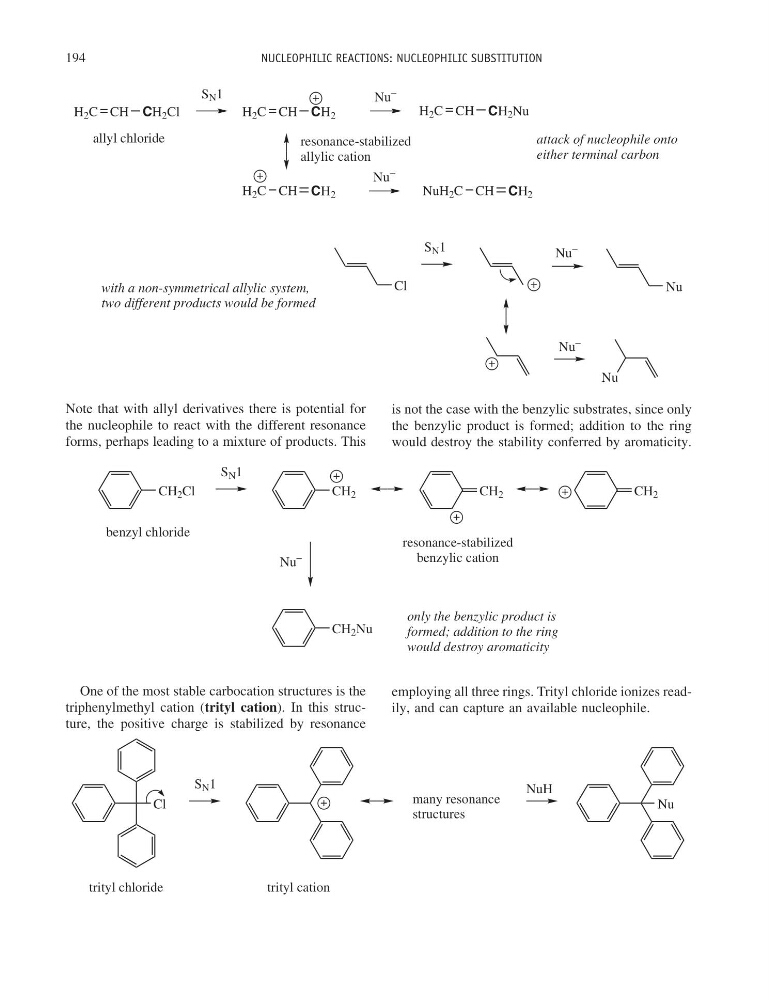
Note that with allyl derivatives there is potential for
the nucleophile to react with the different resonance
forms, perhaps leading to a mixture of products. This
is not the case with the benzylic substrates, since only
the benzylic product is formed; addition to the ring
would destroy the stability conferred by aromaticity.
CH 2 Cl
benzyl chloride
S N 1
CH 2
CH 2
CH 2
resonance-stabilized
benzylic cation
CH 2 Nu
only the benzylic product is
formed; addition to the ring
would destroy aromaticity
Nu
−
One of the most stable carbocation structures is the
triphenylmethyl cation (trityl cation). In this structure, the positive charge is stabilized by resonance
employing all three rings. Trityl chloride ionizes readily, and can capture an available nucleophile.
trityl chloride
S N 1
Cl
trityl cation
many resonance
structures
Nu
NuH
NUCLEOPHILIC REACTIONS: NUCLEOPHILIC SUBSTITUTION
H 2 C CH CH 2 Cl
H 2 C CH CH 2
H 2 C CH CH 2
resonance-stabilized
allylic cation
allyl chloride
H 2 C CH CH 2 Nu
Nu
−
S N 1
NuH 2 C CH CH 2
Nu
−
attack of nucleophile onto
either terminal carbon
Cl
Nu
Nu
S N 1
with a non-symmetrical allylic system,
two different products would be formed
Nu
−
Nu
−
Note that with allyl derivatives there is potential for
the nucleophile to react with the different resonance
forms, perhaps leading to a mixture of products. This
is not the case with the benzylic substrates, since only
the benzylic product is formed; addition to the ring
would destroy the stability conferred by aromaticity.
CH 2 Cl
benzyl chloride
S N 1
CH 2
CH 2
CH 2
resonance-stabilized
benzylic cation
CH 2 Nu
only the benzylic product is
formed; addition to the ring
would destroy aromaticity
Nu
−
One of the most stable carbocation structures is the
triphenylmethyl cation (trityl cation). In this structure, the positive charge is stabilized by resonance
employing all three rings. Trityl chloride ionizes readily, and can capture an available nucleophile.
trityl chloride
S N 1
Cl
trityl cation
many resonance
structures
Nu
NuH