

THE S N 1 REACTION: UNIMOLECULAR NUCLEOPHILIC SUBSTITUTION
193
Cl
H
Me
Ph
C
H
Ph Me
Cl
OH
H
Me
Ph
HO
H
Me
Ph
leaving group
crowds this side
of carbocation
nucleophilic
attack from this
side preferred
H 2 O
51%
49%
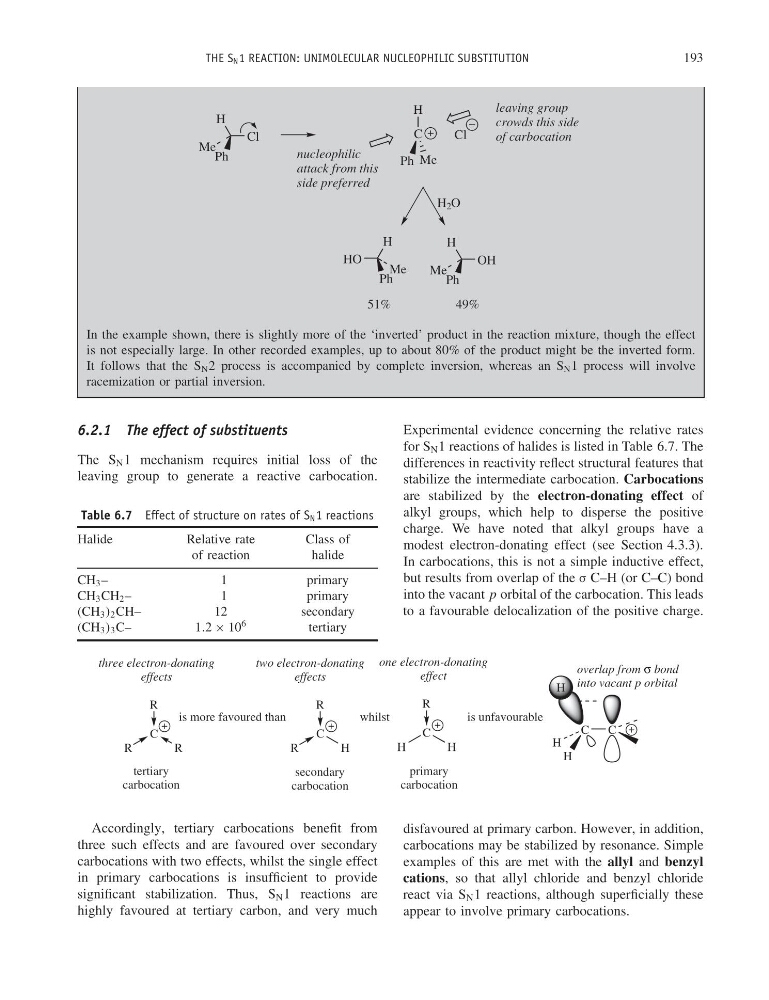
In the example shown, there is slightly more of the ‘inverted’ product in the reaction mixture, though the effect
is not especially large. In other recorded examples, up to about 80% of the product might be the inverted form.
It follows that the S N 2 process is accompanied by complete inversion, whereas an S N 1 process will involve
racemization or partial inversion.
6.2.1 The effect of substituents
The S N 1 mechanism requires initial loss of the
leaving group to generate a reactive carbocation.
Table 6.7 Effect of structure on rates of S N 1 reactions
Halide
Relative rate
of reaction
Class of
halide
CH 3 –
1
p r i m a r y
CH 3 CH 2 –
1
p r i m a r y
(CH 3 ) 2 CH–
12
secondary
(CH 3 ) 3 C–
1.2 × 10
6
tertiary
Experimental evidence concerning the relative rates
for S N 1 reactions of halides is listed in Table 6.7. The
differences in reactivity reflect structural features that
stabilize the intermediate carbocation. Carbocations
are stabilized by the electron-donating effect of
alkyl groups, which help to disperse the positive
charge. We have noted that alkyl groups have a
modest electron-donating effect (see Section 4.3.3).
In carbocations, this is not a simple inductive effect,
but results from overlap of the σ C–H (or C–C) bond
into the vacant p orbital of the carbocation. This leads
to a favourable delocalization of the positive charge.
is more favoured than
whilst
is unfavourable
tertiary
carbocation
secondary
carbocation
primary
carbocation
R
C
R
R
R
C
R
H
R
C
H
H
three electron-donating
effects
two electron-donating
effects
one electron-donating
effect
C
C
H
H
H
overlap from σ bond
into vacant p orbital
Accordingly, tertiary carbocations benefit from
three such effects and are favoured over secondary
carbocations with two effects, whilst the single effect
in primary carbocations is insufficient to provide
significant stabilization. Thus, S N 1 reactions are
highly favoured at tertiary carbon, and very much
disfavoured at primary carbon. However, in addition,
carbocations may be stabilized by resonance. Simple
examples of this are met with the allyl and benzyl
cations, so that allyl chloride and benzyl chloride
react via S N 1 reactions, although superficially these
appear to involve primary carbocations.
193
Cl
H
Me
Ph
C
H
Ph Me
Cl
OH
H
Me
Ph
HO
H
Me
Ph
leaving group
crowds this side
of carbocation
nucleophilic
attack from this
side preferred
H 2 O
51%
49%
In the example shown, there is slightly more of the ‘inverted’ product in the reaction mixture, though the effect
is not especially large. In other recorded examples, up to about 80% of the product might be the inverted form.
It follows that the S N 2 process is accompanied by complete inversion, whereas an S N 1 process will involve
racemization or partial inversion.
6.2.1 The effect of substituents
The S N 1 mechanism requires initial loss of the
leaving group to generate a reactive carbocation.
Table 6.7 Effect of structure on rates of S N 1 reactions
Halide
Relative rate
of reaction
Class of
halide
CH 3 –
1
p r i m a r y
CH 3 CH 2 –
1
p r i m a r y
(CH 3 ) 2 CH–
12
secondary
(CH 3 ) 3 C–
1.2 × 10
6
tertiary
Experimental evidence concerning the relative rates
for S N 1 reactions of halides is listed in Table 6.7. The
differences in reactivity reflect structural features that
stabilize the intermediate carbocation. Carbocations
are stabilized by the electron-donating effect of
alkyl groups, which help to disperse the positive
charge. We have noted that alkyl groups have a
modest electron-donating effect (see Section 4.3.3).
In carbocations, this is not a simple inductive effect,
but results from overlap of the σ C–H (or C–C) bond
into the vacant p orbital of the carbocation. This leads
to a favourable delocalization of the positive charge.
is more favoured than
whilst
is unfavourable
tertiary
carbocation
secondary
carbocation
primary
carbocation
R
C
R
R
R
C
R
H
R
C
H
H
three electron-donating
effects
two electron-donating
effects
one electron-donating
effect
C
C
H
H
H
overlap from σ bond
into vacant p orbital
Accordingly, tertiary carbocations benefit from
three such effects and are favoured over secondary
carbocations with two effects, whilst the single effect
in primary carbocations is insufficient to provide
significant stabilization. Thus, S N 1 reactions are
highly favoured at tertiary carbon, and very much
disfavoured at primary carbon. However, in addition,
carbocations may be stabilized by resonance. Simple
examples of this are met with the allyl and benzyl
cations, so that allyl chloride and benzyl chloride
react via S N 1 reactions, although superficially these
appear to involve primary carbocations.