

192
NUCLEOPHILIC REACTIONS: NUCLEOPHILIC SUBSTITUTION
charged or uncharged, will rapidly react. Therefore,
as the rate equation shows, the nucleophile plays
no part in controlling the overall reaction rate. We
have shown carbocation formation as reversible; it
would be if the leaving group recombined with the
carbocation. If there is an excess of an alternative
nucleophile, however, we shall get the required
product.
The carbon atom of the carbocation has only six
bonding electrons, and is a planar entity. The bonding
electrons are in sp
2 orbitals, and there is also an
unoccupied p orbital. The attacking nucleophile is
able to attack from either face of this planar species;
so, when X, Y, and Z are different, the product will
turn out to be a mixture of two possible stereoisomers.
As there is usually an equal probability of attack at
each face, the product will be a racemic mixture.
This is in marked contrast to the product from an
S N 2 reaction, where there would be inversion of
configuration and formation of a single enantiomer.
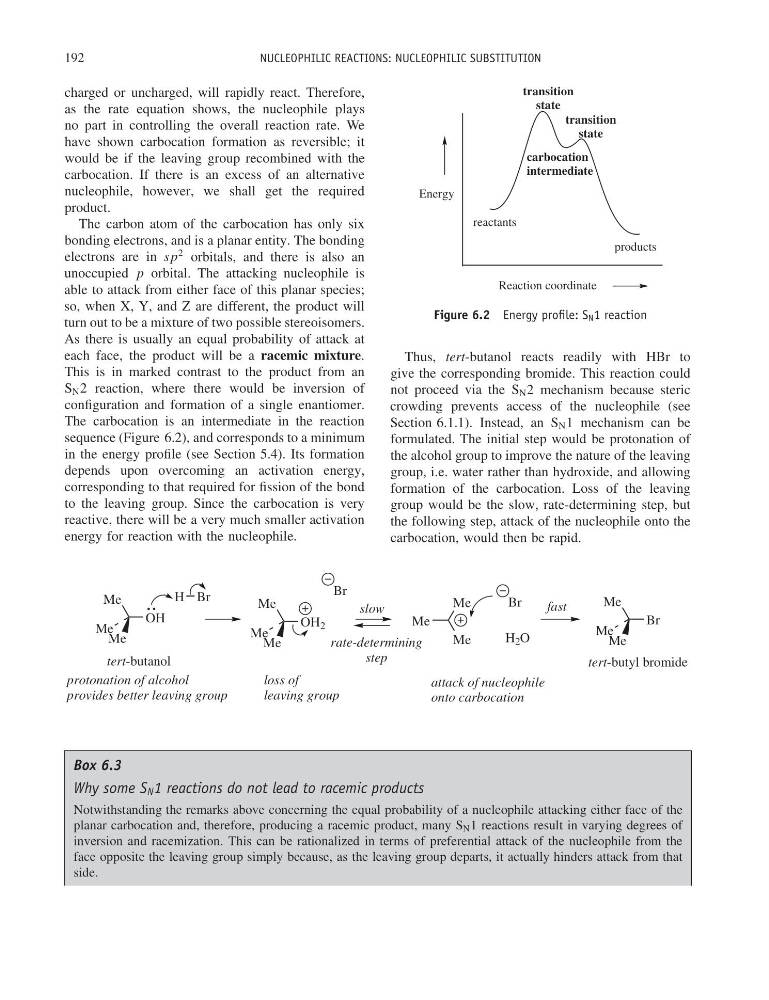
The carbocation is an intermediate in the reaction
sequence (Figure 6.2), and corresponds to a minimum
in the energy profile (see Section 5.4). Its formation
depends upon overcoming an activation energy,
corresponding to that required for fission of the bond
to the leaving group. Since the carbocation is very
reactive, there will be a very much smaller activation
energy for reaction with the nucleophile.
transition
state
Energy
Reaction coordinate
reactants
products
transition
state
carbocation
intermediate
Figure 6.2 Energy profile: S N 1 reaction
Thus, tert-butanol reacts readily with HBr to
give the corresponding bromide. This reaction could
not proceed via the S N 2 mechanism because steric
crowding prevents access of the nucleophile (see
Section 6.1.1). Instead, an S N 1 mechanism can be
formulated. The initial step would be protonation of
the alcohol group to improve the nature of the leaving
group, i.e. water rather than hydroxide, and allowing
formation of the carbocation. Loss of the leaving
group would be the slow, rate-determining step, but
the following step, attack of the nucleophile onto the
carbocation, would then be rapid.
OH
Me
Me
Me
tert-butanol
H Br
Me
Me
Me
OH 2
Me
Me
Me
slow
rate-determining
step
Br
Br
H 2 O
fast
Br
Me
Me
Me
tert-butyl bromide
protonation of alcohol
provides better leaving group
loss of
leaving group
attack of nucleophile
onto carbocation
Box 6.3
Why some S N 1 reactions do not lead to racemic products
Notwithstanding the remarks above concerning the equal probability of a nucleophile attacking either face of the
planar carbocation and, therefore, producing a racemic product, many S N 1 reactions result in varying degrees of
inversion and racemization. This can be rationalized in terms of preferential attack of the nucleophile from the
face opposite the leaving group simply because, as the leaving group departs, it actually hinders attack from that
side.
NUCLEOPHILIC REACTIONS: NUCLEOPHILIC SUBSTITUTION
charged or uncharged, will rapidly react. Therefore,
as the rate equation shows, the nucleophile plays
no part in controlling the overall reaction rate. We
have shown carbocation formation as reversible; it
would be if the leaving group recombined with the
carbocation. If there is an excess of an alternative
nucleophile, however, we shall get the required
product.
The carbon atom of the carbocation has only six
bonding electrons, and is a planar entity. The bonding
electrons are in sp
2 orbitals, and there is also an
unoccupied p orbital. The attacking nucleophile is
able to attack from either face of this planar species;
so, when X, Y, and Z are different, the product will
turn out to be a mixture of two possible stereoisomers.
As there is usually an equal probability of attack at
each face, the product will be a racemic mixture.
This is in marked contrast to the product from an
S N 2 reaction, where there would be inversion of
configuration and formation of a single enantiomer.
The carbocation is an intermediate in the reaction
sequence (Figure 6.2), and corresponds to a minimum
in the energy profile (see Section 5.4). Its formation
depends upon overcoming an activation energy,
corresponding to that required for fission of the bond
to the leaving group. Since the carbocation is very
reactive, there will be a very much smaller activation
energy for reaction with the nucleophile.
transition
state
Energy
Reaction coordinate
reactants
products
transition
state
carbocation
intermediate
Figure 6.2 Energy profile: S N 1 reaction
Thus, tert-butanol reacts readily with HBr to
give the corresponding bromide. This reaction could
not proceed via the S N 2 mechanism because steric
crowding prevents access of the nucleophile (see
Section 6.1.1). Instead, an S N 1 mechanism can be
formulated. The initial step would be protonation of
the alcohol group to improve the nature of the leaving
group, i.e. water rather than hydroxide, and allowing
formation of the carbocation. Loss of the leaving
group would be the slow, rate-determining step, but
the following step, attack of the nucleophile onto the
carbocation, would then be rapid.
OH
Me
Me
Me
tert-butanol
H Br
Me
Me
Me
OH 2
Me
Me
Me
slow
rate-determining
step
Br
Br
H 2 O
fast
Br
Me
Me
Me
tert-butyl bromide
protonation of alcohol
provides better leaving group
loss of
leaving group
attack of nucleophile
onto carbocation
Box 6.3
Why some S N 1 reactions do not lead to racemic products
Notwithstanding the remarks above concerning the equal probability of a nucleophile attacking either face of the
planar carbocation and, therefore, producing a racemic product, many S N 1 reactions result in varying degrees of
inversion and racemization. This can be rationalized in terms of preferential attack of the nucleophile from the
face opposite the leaving group simply because, as the leaving group departs, it actually hinders attack from that
side.