

THE S N 1 REACTION: UNIMOLECULAR NUCLEOPHILIC SUBSTITUTION
191
angles are the same as in an acyclic compound.
In cyclohexyl compounds, the rate of reaction is
apparently slowed by steric interactions with axial
hydrogens.
L
X
Nu
Y Z
d−
d−
transition
state
120˚
H
H
H
Nu
L
interaction with axial
hydrogens reduces rate
of S N 2 reaction
A consequence of the low rate of reaction in
S N 2 reactions is that side-reactions in cyclohexane
derivatives, especially elimination reactions (see
Section 6.4.1), may often dominate over substitution.
6.2 The S N 1 reaction: unimolecular
nucleophilic substitution
The abbreviation S N 1 conveys the information ‘substitution–nucleophilic–unimolecular’. The reaction
achieves much the same result as the S N 2 reaction, i.e.
the replacement of a leaving group by a nucleophile,
but is mechanistically different. It is unimolecular,
since kinetic data indicate that only one species is
involved in the rate-determining step:
Rate = k[RL]
where RL the substrate containing the leaving group
L and k is the rate constant. Note that the nucleophile
Nu does not figure in the rate equation.
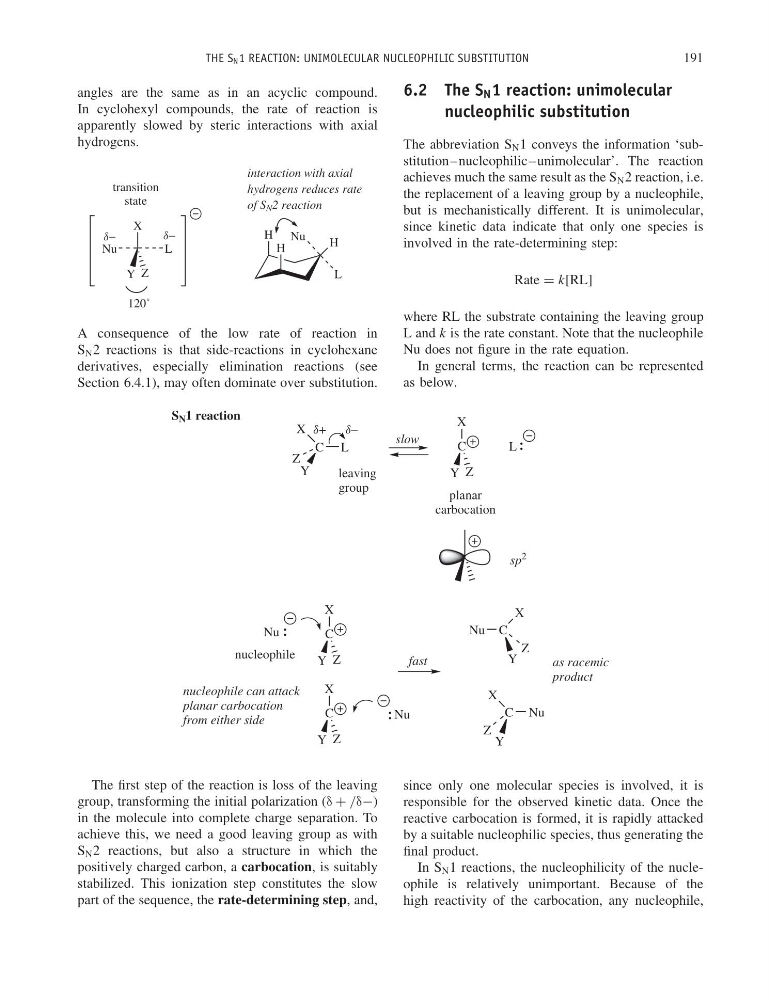
In general terms, the reaction can be represented
as below.
C
X
Y
Nu
planar
carbocation
L
slow
fast
as racemic
product
nucleophile can attack
planar carbocation
from either side
Z
X
C L
Y
Nu
nucleophile
leaving
group
Z
d+ d−
C
X
Y Z
C
X
Y Z
C
X
Y
Nu
Z
sp
2
S N 1 reaction
C
X
Y Z
Nu
The first step of the reaction is loss of the leaving
group, transforming the initial polarization (δ + /δ−)
in the molecule into complete charge separation. To
achieve this, we need a good leaving group as with
S N 2 reactions, but also a structure in which the
positively charged carbon, a carbocation, is suitably
stabilized. This ionization step constitutes the slow
part of the sequence, the rate-determining step, and,
since only one molecular species is involved, it is
responsible for the observed kinetic data. Once the
reactive carbocation is formed, it is rapidly attacked
by a suitable nucleophilic species, thus generating the
final product.
In S N 1 reactions, the nucleophilicity of the nucleophile is relatively unimportant. Because of the
high reactivity of the carbocation, any nucleophile,
191
angles are the same as in an acyclic compound.
In cyclohexyl compounds, the rate of reaction is
apparently slowed by steric interactions with axial
hydrogens.
L
X
Nu
Y Z
d−
d−
transition
state
120˚
H
H
H
Nu
L
interaction with axial
hydrogens reduces rate
of S N 2 reaction
A consequence of the low rate of reaction in
S N 2 reactions is that side-reactions in cyclohexane
derivatives, especially elimination reactions (see
Section 6.4.1), may often dominate over substitution.
6.2 The S N 1 reaction: unimolecular
nucleophilic substitution
The abbreviation S N 1 conveys the information ‘substitution–nucleophilic–unimolecular’. The reaction
achieves much the same result as the S N 2 reaction, i.e.
the replacement of a leaving group by a nucleophile,
but is mechanistically different. It is unimolecular,
since kinetic data indicate that only one species is
involved in the rate-determining step:
Rate = k[RL]
where RL the substrate containing the leaving group
L and k is the rate constant. Note that the nucleophile
Nu does not figure in the rate equation.
In general terms, the reaction can be represented
as below.
C
X
Y
Nu
planar
carbocation
L
slow
fast
as racemic
product
nucleophile can attack
planar carbocation
from either side
Z
X
C L
Y
Nu
nucleophile
leaving
group
Z
d+ d−
C
X
Y Z
C
X
Y Z
C
X
Y
Nu
Z
sp
2
S N 1 reaction
C
X
Y Z
Nu
The first step of the reaction is loss of the leaving
group, transforming the initial polarization (δ + /δ−)
in the molecule into complete charge separation. To
achieve this, we need a good leaving group as with
S N 2 reactions, but also a structure in which the
positively charged carbon, a carbocation, is suitably
stabilized. This ionization step constitutes the slow
part of the sequence, the rate-determining step, and,
since only one molecular species is involved, it is
responsible for the observed kinetic data. Once the
reactive carbocation is formed, it is rapidly attacked
by a suitable nucleophilic species, thus generating the
final product.
In S N 1 reactions, the nucleophilicity of the nucleophile is relatively unimportant. Because of the
high reactivity of the carbocation, any nucleophile,