

190
NUCLEOPHILIC REACTIONS: NUCLEOPHILIC SUBSTITUTION
tosylate
TsO
−
mesylate
MsO −
mesyl chloride
(methanesulfonyl chloride)
MsCl
tosyl chloride
(p-toluenesulfonyl chloride)
TsCl
S
Cl
O
O
H 3 C
S
O
O
O
H 3 C
S
Me
Cl
O
O
S
Me
O
O
O
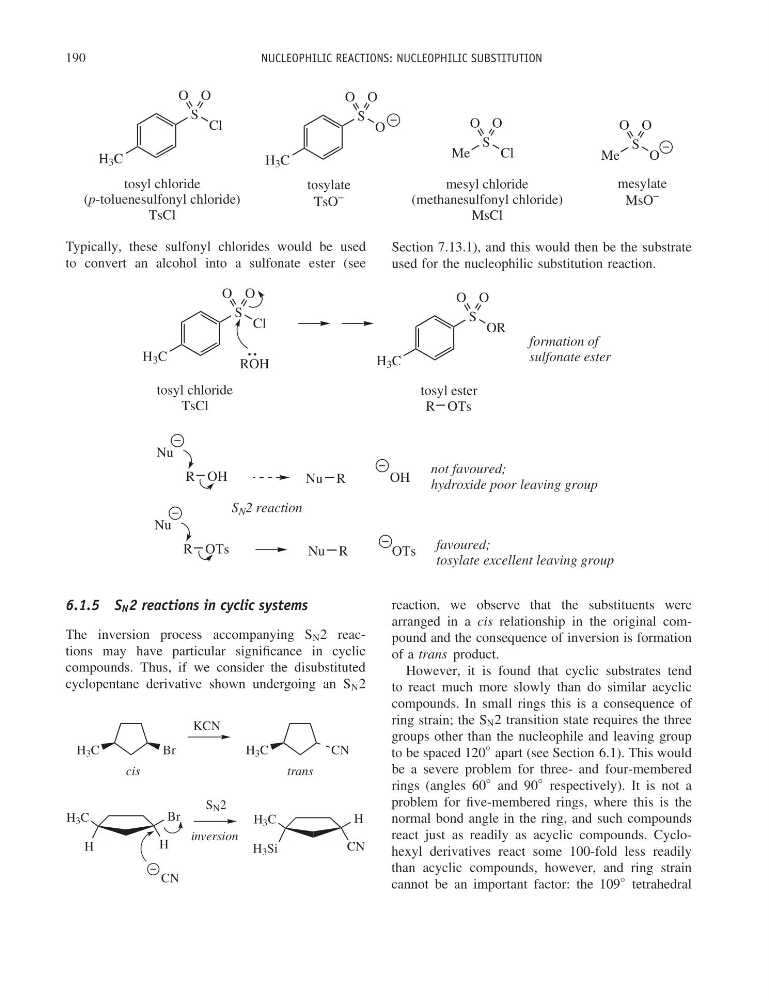
Typically, these sulfonyl chlorides would be used
to convert an alcohol into a sulfonate ester (see
Section 7.13.1), and this would then be the substrate
used for the nucleophilic substitution reaction.
R OH
R OTs
Nu R
S N 2 reaction
Nu R
Nu
Nu
not favoured;
hydroxide poor leaving group
favoured;
tosylate excellent leaving group
formation of
sulfonate ester
R OTs
tosyl ester
tosyl chloride
TsCl
S
Cl
O
O
H 3 C
S
OR
O
O
H 3 C
OH
OTs
ROH
6.1.5 S N 2 reactions in cyclic systems
The inversion process accompanying S N 2 reactions may have particular significance in cyclic
compounds. Thus, if we consider the disubstituted
cyclopentane derivative shown undergoing an S N 2
H 3 C
S N 2
H 3 C
KCN
Br
CN
H 3 C
H 3 Si
CN
H
H 3 C
H
H
Br
CN
cis
trans
inversion
reaction, we observe that the substituents were
arranged in a cis relationship in the original compound and the consequence of inversion is formation
of a trans product.
However, it is found that cyclic substrates tend
to react much more slowly than do similar acyclic
compounds. In small rings this is a consequence of
ring strain; the S N 2 transition state requires the three
groups other than the nucleophile and leaving group
to be spaced 120
◦ apart (see Section 6.1). This would
be a severe problem for three- and four-membered
rings (angles 60
◦ and 90
◦ respectively). It is not a
problem for five-membered rings, where this is the
normal bond angle in the ring, and such compounds
react just as readily as acyclic compounds. Cyclohexyl derivatives react some 100-fold less readily
than acyclic compounds, however, and ring strain
cannot be an important factor: the 109
◦ tetrahedral
NUCLEOPHILIC REACTIONS: NUCLEOPHILIC SUBSTITUTION
tosylate
TsO
−
mesylate
MsO −
mesyl chloride
(methanesulfonyl chloride)
MsCl
tosyl chloride
(p-toluenesulfonyl chloride)
TsCl
S
Cl
O
O
H 3 C
S
O
O
O
H 3 C
S
Me
Cl
O
O
S
Me
O
O
O
Typically, these sulfonyl chlorides would be used
to convert an alcohol into a sulfonate ester (see
Section 7.13.1), and this would then be the substrate
used for the nucleophilic substitution reaction.
R OH
R OTs
Nu R
S N 2 reaction
Nu R
Nu
Nu
not favoured;
hydroxide poor leaving group
favoured;
tosylate excellent leaving group
formation of
sulfonate ester
R OTs
tosyl ester
tosyl chloride
TsCl
S
Cl
O
O
H 3 C
S
OR
O
O
H 3 C
OH
OTs
ROH
6.1.5 S N 2 reactions in cyclic systems
The inversion process accompanying S N 2 reactions may have particular significance in cyclic
compounds. Thus, if we consider the disubstituted
cyclopentane derivative shown undergoing an S N 2
H 3 C
S N 2
H 3 C
KCN
Br
CN
H 3 C
H 3 Si
CN
H
H 3 C
H
H
Br
CN
cis
trans
inversion
reaction, we observe that the substituents were
arranged in a cis relationship in the original compound and the consequence of inversion is formation
of a trans product.
However, it is found that cyclic substrates tend
to react much more slowly than do similar acyclic
compounds. In small rings this is a consequence of
ring strain; the S N 2 transition state requires the three
groups other than the nucleophile and leaving group
to be spaced 120
◦ apart (see Section 6.1). This would
be a severe problem for three- and four-membered
rings (angles 60
◦ and 90
◦ respectively). It is not a
problem for five-membered rings, where this is the
normal bond angle in the ring, and such compounds
react just as readily as acyclic compounds. Cyclohexyl derivatives react some 100-fold less readily
than acyclic compounds, however, and ring strain
cannot be an important factor: the 109
◦ tetrahedral