

THE S N 2 REACTION: BIMOLECULAR NUCLEOPHILIC SUBSTITUTION
189
Table 6.6 Leaving groups and acidity of conjugate acid
Leaving group
pK a of conjugate
acid
Good leaving groups
I
−
−10
Br
−
−9
Cl
−
−7
Me 2 S
−5.4
CH 3 SO 3
− (MsO
− )
−2.6
p-CH 3 (C 6 H 4 )SO 3
− (TsO
− )
−1.3
H 2 O
−1.7
RCO 2
−
4.8
Moderate leaving groups
HS
−
7
CN −
9.1
NH 3
9.2
RNH 2
10.6
RS
−
10.5
Poor leaving groups
F
−
3.2
a
HO
−
15.7
RO
−
16
Very poor leaving groups
NH 2
−
38
R 2 N
−
36
H
−
35
R
−
50
a The C–F bond is one of the strongest, and fluoride is a poor leaving group. On pK a values alone,
this appears out of sequence.
CH 3 OH
H Br
H 3 C O
H
H
Br
Br
H 3 C O
H
H
Br CH 3
H 2 O
methanol acts as base;
protonation of oxygen
conjugate acid
nucleophilic
substitution
weak base and neutral molecule,
good leaving group
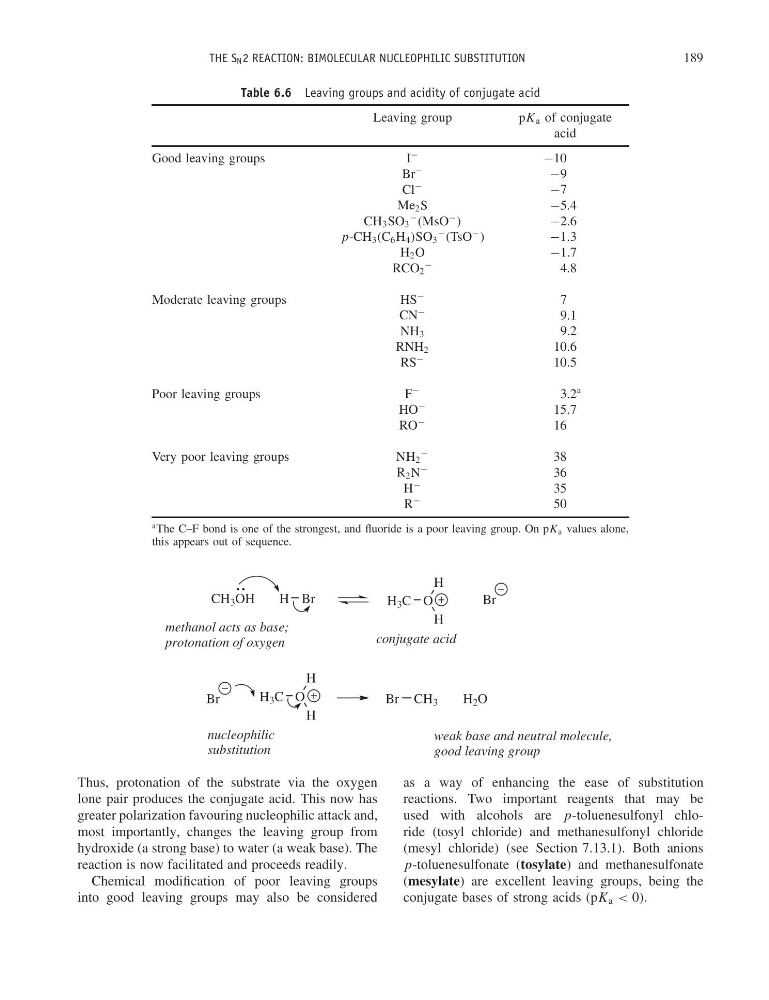
Thus, protonation of the substrate via the oxygen
lone pair produces the conjugate acid. This now has
greater polarization favouring nucleophilic attack and,
most importantly, changes the leaving group from
hydroxide (a strong base) to water (a weak base). The
reaction is now facilitated and proceeds readily.
Chemical modification of poor leaving groups
into good leaving groups may also be considered
as a way of enhancing the ease of substitution
reactions. Two important reagents that may be
used with alcohols are p-toluenesulfonyl chloride (tosyl chloride) and methanesulfonyl chloride
(mesyl chloride) (see Section 7.13.1). Both anions
p-toluenesulfonate (tosylate) and methanesulfonate
(mesylate) are excellent leaving groups, being the
conjugate bases of strong acids (pK a < 0).
189
Table 6.6 Leaving groups and acidity of conjugate acid
Leaving group
pK a of conjugate
acid
Good leaving groups
I
−
−10
Br
−
−9
Cl
−
−7
Me 2 S
−5.4
CH 3 SO 3
− (MsO
− )
−2.6
p-CH 3 (C 6 H 4 )SO 3
− (TsO
− )
−1.3
H 2 O
−1.7
RCO 2
−
4.8
Moderate leaving groups
HS
−
7
CN −
9.1
NH 3
9.2
RNH 2
10.6
RS
−
10.5
Poor leaving groups
F
−
3.2
a
HO
−
15.7
RO
−
16
Very poor leaving groups
NH 2
−
38
R 2 N
−
36
H
−
35
R
−
50
a The C–F bond is one of the strongest, and fluoride is a poor leaving group. On pK a values alone,
this appears out of sequence.
CH 3 OH
H Br
H 3 C O
H
H
Br
Br
H 3 C O
H
H
Br CH 3
H 2 O
methanol acts as base;
protonation of oxygen
conjugate acid
nucleophilic
substitution
weak base and neutral molecule,
good leaving group
Thus, protonation of the substrate via the oxygen
lone pair produces the conjugate acid. This now has
greater polarization favouring nucleophilic attack and,
most importantly, changes the leaving group from
hydroxide (a strong base) to water (a weak base). The
reaction is now facilitated and proceeds readily.
Chemical modification of poor leaving groups
into good leaving groups may also be considered
as a way of enhancing the ease of substitution
reactions. Two important reagents that may be
used with alcohols are p-toluenesulfonyl chloride (tosyl chloride) and methanesulfonyl chloride
(mesyl chloride) (see Section 7.13.1). Both anions
p-toluenesulfonate (tosylate) and methanesulfonate
(mesylate) are excellent leaving groups, being the
conjugate bases of strong acids (pK a < 0).