

188
NUCLEOPHILIC REACTIONS: NUCLEOPHILIC SUBSTITUTION
Table 6.5 Aprotic polar solvents
Name
Formula
Abbreviation
Acetone
Me 2 CO
Acetonitrile
MeCN
Dimethylformamide
HCONMe 2
DMF
Dimethylsulfoxide
Me 2 SO
DMSO
Hexamethylphosphoric
triamide
(Me 2 N) 3 PO
HMPT
times faster in dimethylformamide (DMF) than in
methanol. This is because there is no hydrogen bonding possible in DMF. In sharp contrast, reaction in
the structurally similar solvent N -methylformamide
(HCONHMe), which still contains an N–H that can
participate in hydrogen bonding, is only 45 times
as fast as in methanol. Chloride ions actually form
stronger hydrogen bonds with methanol than with N -
methylformamide, so there is an increase in reactivity, but hardly as dramatic as with the aprotic solvent
DMF.
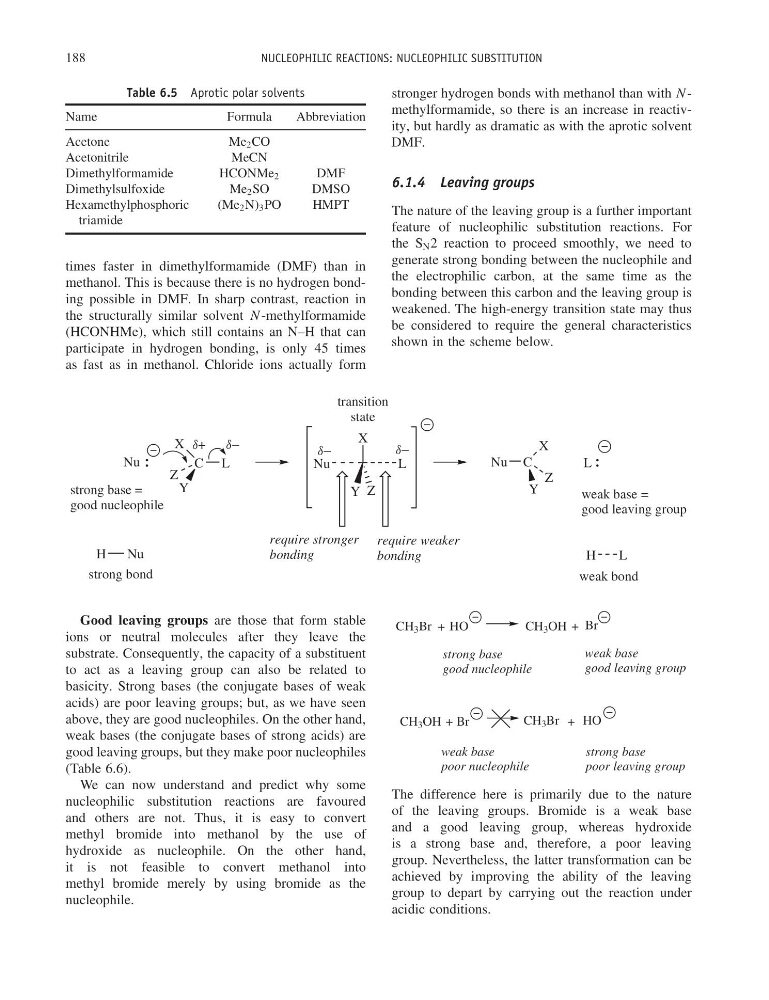
6.1.4 Leaving groups
The nature of the leaving group is a further important
feature of nucleophilic substitution reactions. For
the S N 2 reaction to proceed smoothly, we need to
generate strong bonding between the nucleophile and
the electrophilic carbon, at the same time as the
bonding between this carbon and the leaving group is
weakened. The high-energy transition state may thus
be considered to require the general characteristics
shown in the scheme below.
X
C L
Y
C
X
Y
Nu
Nu
L
strong base =
good nucleophile
Z
Z
d+ d−
L
X
Nu
Y Z
d−
d−
transition
state
require stronger
bonding
require weaker
bonding
weak base =
good leaving group
H
Nu
H
L
strong bond
weak bond
Good leaving groups are those that form stable
ions or neutral molecules after they leave the
substrate. Consequently, the capacity of a substituent
to act as a leaving group can also be related to
basicity. Strong bases (the conjugate bases of weak
acids) are poor leaving groups; but, as we have seen
above, they are good nucleophiles. On the other hand,
weak bases (the conjugate bases of strong acids) are
good leaving groups, but they make poor nucleophiles
(Table 6.6).
We can now understand and predict why some
nucleophilic substitution reactions are favoured
and others are not. Thus, it is easy to convert
methyl bromide into methanol by the use of
hydroxide as nucleophile. On the other hand,
it is not feasible to convert methanol into
methyl bromide merely by using bromide as the
nucleophile.
CH 3 Br HO
+
CH 3 OH + Br
CH 3 OH Br
+
CH 3 Br + HO
strong base
good nucleophile
weak base
poor nucleophile
strong base
poor leaving group
weak base
good leaving group
The difference here is primarily due to the nature
of the leaving groups. Bromide is a weak base
and a good leaving group, whereas hydroxide
is a strong base and, therefore, a poor leaving
group. Nevertheless, the latter transformation can be
achieved by improving the ability of the leaving
group to depart by carrying out the reaction under
acidic conditions.
NUCLEOPHILIC REACTIONS: NUCLEOPHILIC SUBSTITUTION
Table 6.5 Aprotic polar solvents
Name
Formula
Abbreviation
Acetone
Me 2 CO
Acetonitrile
MeCN
Dimethylformamide
HCONMe 2
DMF
Dimethylsulfoxide
Me 2 SO
DMSO
Hexamethylphosphoric
triamide
(Me 2 N) 3 PO
HMPT
times faster in dimethylformamide (DMF) than in
methanol. This is because there is no hydrogen bonding possible in DMF. In sharp contrast, reaction in
the structurally similar solvent N -methylformamide
(HCONHMe), which still contains an N–H that can
participate in hydrogen bonding, is only 45 times
as fast as in methanol. Chloride ions actually form
stronger hydrogen bonds with methanol than with N -
methylformamide, so there is an increase in reactivity, but hardly as dramatic as with the aprotic solvent
DMF.
6.1.4 Leaving groups
The nature of the leaving group is a further important
feature of nucleophilic substitution reactions. For
the S N 2 reaction to proceed smoothly, we need to
generate strong bonding between the nucleophile and
the electrophilic carbon, at the same time as the
bonding between this carbon and the leaving group is
weakened. The high-energy transition state may thus
be considered to require the general characteristics
shown in the scheme below.
X
C L
Y
C
X
Y
Nu
Nu
L
strong base =
good nucleophile
Z
Z
d+ d−
L
X
Nu
Y Z
d−
d−
transition
state
require stronger
bonding
require weaker
bonding
weak base =
good leaving group
H
Nu
H
L
strong bond
weak bond
Good leaving groups are those that form stable
ions or neutral molecules after they leave the
substrate. Consequently, the capacity of a substituent
to act as a leaving group can also be related to
basicity. Strong bases (the conjugate bases of weak
acids) are poor leaving groups; but, as we have seen
above, they are good nucleophiles. On the other hand,
weak bases (the conjugate bases of strong acids) are
good leaving groups, but they make poor nucleophiles
(Table 6.6).
We can now understand and predict why some
nucleophilic substitution reactions are favoured
and others are not. Thus, it is easy to convert
methyl bromide into methanol by the use of
hydroxide as nucleophile. On the other hand,
it is not feasible to convert methanol into
methyl bromide merely by using bromide as the
nucleophile.
CH 3 Br HO
+
CH 3 OH + Br
CH 3 OH Br
+
CH 3 Br + HO
strong base
good nucleophile
weak base
poor nucleophile
strong base
poor leaving group
weak base
good leaving group
The difference here is primarily due to the nature
of the leaving groups. Bromide is a weak base
and a good leaving group, whereas hydroxide
is a strong base and, therefore, a poor leaving
group. Nevertheless, the latter transformation can be
achieved by improving the ability of the leaving
group to depart by carrying out the reaction under
acidic conditions.