

THE S N 2 REACTION: BIMOLECULAR NUCLEOPHILIC SUBSTITUTION
187
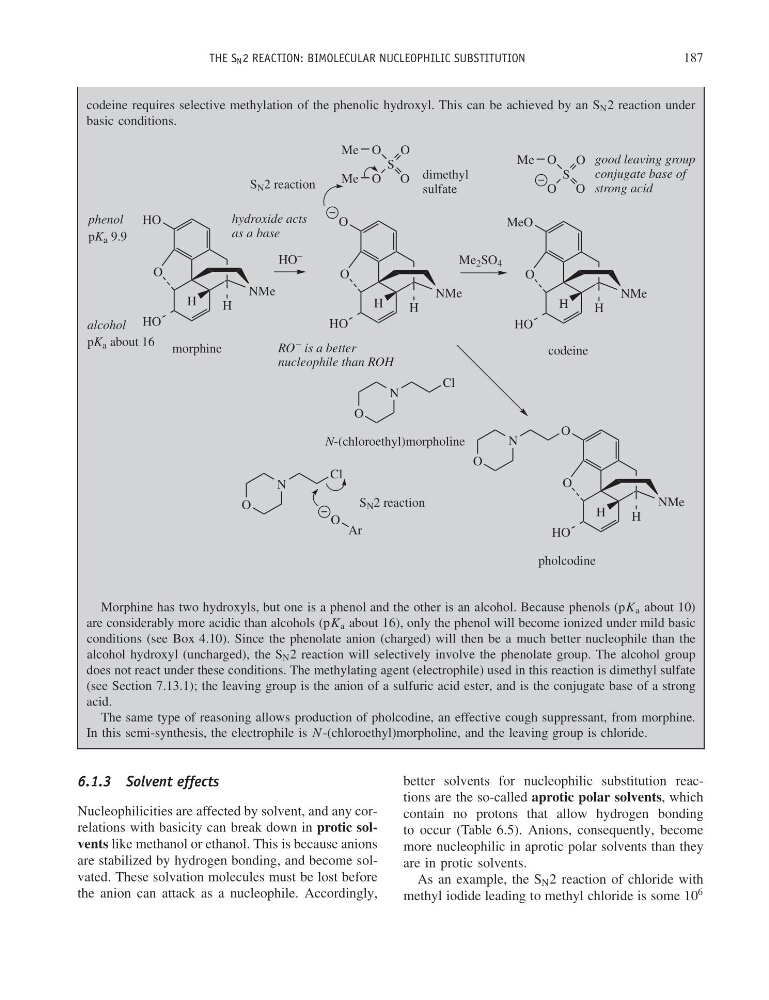
codeine requires selective methylation of the phenolic hydroxyl. This can be achieved by an S N 2 reaction under
basic conditions.
HO
O
HO
H
NMe
MeO
O
HO
H
NMe
O
O
HO
H
NMe
N
O
H
H
H
O
N
Cl
codeine
morphine
pholcodine
phenol
pK a 9.9
alcohol
pK a about 16
HO
−
O
O
HO
H
NMe
H
S
O
O
O
O
Me
Me
S
O
O
O
O
Me
good leaving group
conjugate base of
strong acid
S N 2 reaction
dimethyl
sulfate
RO
nucleophile than ROH
N-(chloroethyl)morpholine
O
N
Cl
Ar
O
hydroxide acts
as a base
S N 2 reaction
Me 2 SO 4
− is a better
Morphine has two hydroxyls, but one is a phenol and the other is an alcohol. Because phenols (pK a about 10)
are considerably more acidic than alcohols (pK a about 16), only the phenol will become ionized under mild basic
conditions (see Box 4.10). Since the phenolate anion (charged) will then be a much better nucleophile than the
alcohol hydroxyl (uncharged), the S N 2 reaction will selectively involve the phenolate group. The alcohol group
does not react under these conditions. The methylating agent (electrophile) used in this reaction is dimethyl sulfate
(see Section 7.13.1); the leaving group is the anion of a sulfuric acid ester, and is the conjugate base of a strong
acid.
The same type of reasoning allows production of pholcodine, an effective cough suppressant, from morphine.
In this semi-synthesis, the electrophile is N-(chloroethyl)morpholine, and the leaving group is chloride.
6.1.3 Solvent effects
Nucleophilicities are affected by solvent, and any correlations with basicity can break down in protic solvents like methanol or ethanol. This is because anions
are stabilized by hydrogen bonding, and become solvated. These solvation molecules must be lost before
the anion can attack as a nucleophile. Accordingly,
better solvents for nucleophilic substitution reactions are the so-called aprotic polar solvents, which
contain no protons that allow hydrogen bonding
to occur (Table 6.5). Anions, consequently, become
more nucleophilic in aprotic polar solvents than they
are in protic solvents.
As an example, the S N 2 reaction of chloride with
methyl iodide leading to methyl chloride is some 10
6
187
codeine requires selective methylation of the phenolic hydroxyl. This can be achieved by an S N 2 reaction under
basic conditions.
HO
O
HO
H
NMe
MeO
O
HO
H
NMe
O
O
HO
H
NMe
N
O
H
H
H
O
N
Cl
codeine
morphine
pholcodine
phenol
pK a 9.9
alcohol
pK a about 16
HO
−
O
O
HO
H
NMe
H
S
O
O
O
O
Me
Me
S
O
O
O
O
Me
good leaving group
conjugate base of
strong acid
S N 2 reaction
dimethyl
sulfate
RO
nucleophile than ROH
N-(chloroethyl)morpholine
O
N
Cl
Ar
O
hydroxide acts
as a base
S N 2 reaction
Me 2 SO 4
− is a better
Morphine has two hydroxyls, but one is a phenol and the other is an alcohol. Because phenols (pK a about 10)
are considerably more acidic than alcohols (pK a about 16), only the phenol will become ionized under mild basic
conditions (see Box 4.10). Since the phenolate anion (charged) will then be a much better nucleophile than the
alcohol hydroxyl (uncharged), the S N 2 reaction will selectively involve the phenolate group. The alcohol group
does not react under these conditions. The methylating agent (electrophile) used in this reaction is dimethyl sulfate
(see Section 7.13.1); the leaving group is the anion of a sulfuric acid ester, and is the conjugate base of a strong
acid.
The same type of reasoning allows production of pholcodine, an effective cough suppressant, from morphine.
In this semi-synthesis, the electrophile is N-(chloroethyl)morpholine, and the leaving group is chloride.
6.1.3 Solvent effects
Nucleophilicities are affected by solvent, and any correlations with basicity can break down in protic solvents like methanol or ethanol. This is because anions
are stabilized by hydrogen bonding, and become solvated. These solvation molecules must be lost before
the anion can attack as a nucleophile. Accordingly,
better solvents for nucleophilic substitution reactions are the so-called aprotic polar solvents, which
contain no protons that allow hydrogen bonding
to occur (Table 6.5). Anions, consequently, become
more nucleophilic in aprotic polar solvents than they
are in protic solvents.
As an example, the S N 2 reaction of chloride with
methyl iodide leading to methyl chloride is some 10
6