

186
NUCLEOPHILIC REACTIONS: NUCLEOPHILIC SUBSTITUTION
Table 6.2 Nucleophilicity and basicity with N and O nucleophiles
Base
(pK a conjugate acid)
Base
(pK a conjugate acid)
H 2 N
− (38)
C 2 H 5 O
− (16)
C 2 H 5 NH 2 (10.6)
HO
− (15.7)
H 3 N (9.2)
PhO
− (10.0)
PhNH 2 (4.6)
CH 3 CO
−
2 (4.8)
H 2 O ( −1.7)
Decreasing basicity
and decreasing
nucleophilicity
←−−−−−−−−−−−−−
Decreasing basicity
and decreasing
nucleophilicity
←−−−−−−−−−−−−−
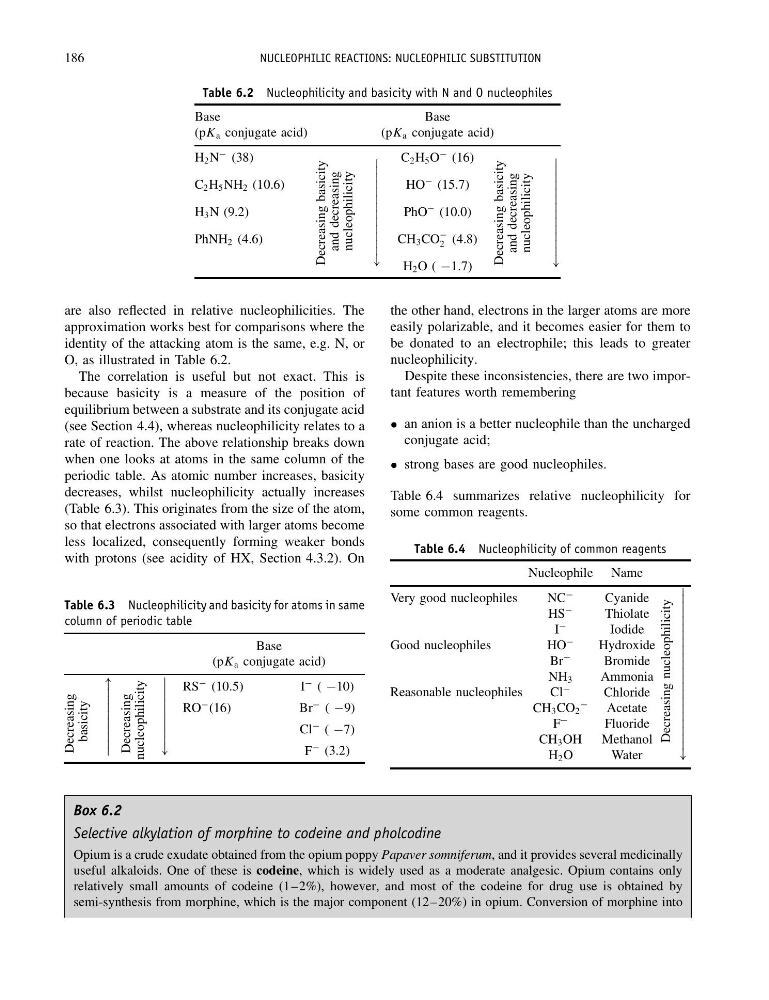
are also reflected in relative nucleophilicities. The
approximation works best for comparisons where the
identity of the attacking atom is the same, e.g. N, or
O, as illustrated in Table 6.2.
The correlation is useful but not exact. This is
because basicity is a measure of the position of
equilibrium between a substrate and its conjugate acid
(see Section 4.4), whereas nucleophilicity relates to a
rate of reaction. The above relationship breaks down
when one looks at atoms in the same column of the
periodic table. As atomic number increases, basicity
decreases, whilst nucleophilicity actually increases
(Table 6.3). This originates from the size of the atom,
so that electrons associated with larger atoms become
less localized, consequently forming weaker bonds
with protons (see acidity of HX, Section 4.3.2). On
Table 6.3 Nucleophilicity and basicity for atoms in same
column of periodic table
Base
(pK a conjugate acid)
RS
− (10.5)
I
− ( −10)
RO
− (16)
Br
− ( −9)
Cl
− ( −7)
F
− (3.2)
Decreasing
basicity
−−−−−−−−−→
Decreasing
nucleophilicity
←−−−−−−−−−
the other hand, electrons in the larger atoms are more
easily polarizable, and it becomes easier for them to
be donated to an electrophile; this leads to greater
nucleophilicity.
Despite these inconsistencies, there are two important features worth remembering
• an anion is a better nucleophile than the uncharged
conjugate acid;
• strong bases are good nucleophiles.
Table 6.4 summarizes relative nucleophilicity for
some common reagents.
Table 6.4 Nucleophilicity of common reagents
Nucleophile Name
Very good nucleophiles
NC
−
Cyanide
HS
−
Thiolate
I
−
Iodide
Good nucleophiles
HO
−
Hydroxide
Br
−
Bromide
NH 3
Ammonia
Reasonable nucleophiles
Cl
−
Chloride
CH 3 CO 2
−
Acetate
F
−
Fluoride
CH 3 OH Methanol
H 2 O
Water
Decreasing nucleophilicity
←−−−−−−−−−−−−−−−−−−−−−−
Box 6.2
Selective alkylation of morphine to codeine and pholcodine
Opium is a crude exudate obtained from the opium poppy Papaver somniferum, and it provides several medicinally
useful alkaloids. One of these is codeine, which is widely used as a moderate analgesic. Opium contains only
relatively small amounts of codeine (1–2%), however, and most of the codeine for drug use is obtained by
semi-synthesis from morphine, which is the major component (12–20%) in opium. Conversion of morphine into
NUCLEOPHILIC REACTIONS: NUCLEOPHILIC SUBSTITUTION
Table 6.2 Nucleophilicity and basicity with N and O nucleophiles
Base
(pK a conjugate acid)
Base
(pK a conjugate acid)
H 2 N
− (38)
C 2 H 5 O
− (16)
C 2 H 5 NH 2 (10.6)
HO
− (15.7)
H 3 N (9.2)
PhO
− (10.0)
PhNH 2 (4.6)
CH 3 CO
−
2 (4.8)
H 2 O ( −1.7)
Decreasing basicity
and decreasing
nucleophilicity
←−−−−−−−−−−−−−
Decreasing basicity
and decreasing
nucleophilicity
←−−−−−−−−−−−−−
are also reflected in relative nucleophilicities. The
approximation works best for comparisons where the
identity of the attacking atom is the same, e.g. N, or
O, as illustrated in Table 6.2.
The correlation is useful but not exact. This is
because basicity is a measure of the position of
equilibrium between a substrate and its conjugate acid
(see Section 4.4), whereas nucleophilicity relates to a
rate of reaction. The above relationship breaks down
when one looks at atoms in the same column of the
periodic table. As atomic number increases, basicity
decreases, whilst nucleophilicity actually increases
(Table 6.3). This originates from the size of the atom,
so that electrons associated with larger atoms become
less localized, consequently forming weaker bonds
with protons (see acidity of HX, Section 4.3.2). On
Table 6.3 Nucleophilicity and basicity for atoms in same
column of periodic table
Base
(pK a conjugate acid)
RS
− (10.5)
I
− ( −10)
RO
− (16)
Br
− ( −9)
Cl
− ( −7)
F
− (3.2)
Decreasing
basicity
−−−−−−−−−→
Decreasing
nucleophilicity
←−−−−−−−−−
the other hand, electrons in the larger atoms are more
easily polarizable, and it becomes easier for them to
be donated to an electrophile; this leads to greater
nucleophilicity.
Despite these inconsistencies, there are two important features worth remembering
• an anion is a better nucleophile than the uncharged
conjugate acid;
• strong bases are good nucleophiles.
Table 6.4 summarizes relative nucleophilicity for
some common reagents.
Table 6.4 Nucleophilicity of common reagents
Nucleophile Name
Very good nucleophiles
NC
−
Cyanide
HS
−
Thiolate
I
−
Iodide
Good nucleophiles
HO
−
Hydroxide
Br
−
Bromide
NH 3
Ammonia
Reasonable nucleophiles
Cl
−
Chloride
CH 3 CO 2
−
Acetate
F
−
Fluoride
CH 3 OH Methanol
H 2 O
Water
Decreasing nucleophilicity
←−−−−−−−−−−−−−−−−−−−−−−
Box 6.2
Selective alkylation of morphine to codeine and pholcodine
Opium is a crude exudate obtained from the opium poppy Papaver somniferum, and it provides several medicinally
useful alkaloids. One of these is codeine, which is widely used as a moderate analgesic. Opium contains only
relatively small amounts of codeine (1–2%), however, and most of the codeine for drug use is obtained by
semi-synthesis from morphine, which is the major component (12–20%) in opium. Conversion of morphine into