

THE S N 2 REACTION: BIMOLECULAR NUCLEOPHILIC SUBSTITUTION
185
Table 6.1 Effect of structure on rates of S N 2
reactions
Halide
Relative rate
of reaction
Class of halide
CH 3 –
30
primary
CH 3 CH 2 –
1
p r i m a r y
(CH 3 ) 2 CH–
0.03
secondary
(CH 3 ) 3 C–
0
tertiary
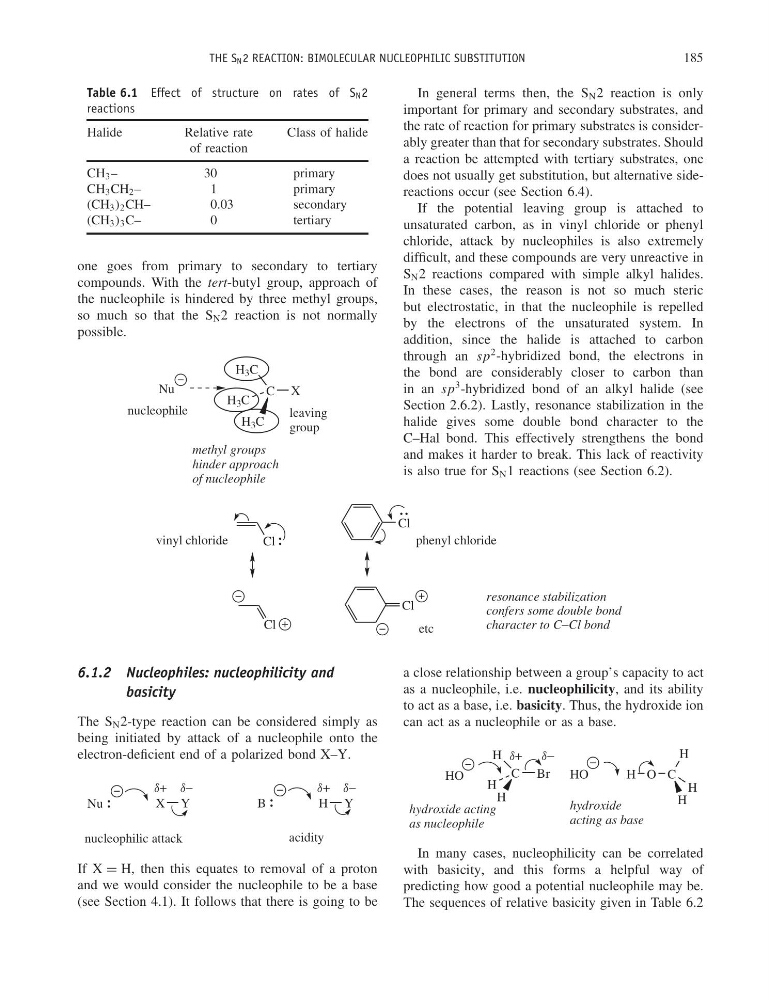
one goes from primary to secondary to tertiary
compounds. With the tert-butyl group, approach of
the nucleophile is hindered by three methyl groups,
so much so that the S N 2 reaction is not normally
possible.
H 3 C
C X
H 3 C
nucleophile
leaving
group
H 3 C
Nu
methyl groups
hinder approach
of nucleophile
In general terms then, the S N 2 reaction is only
important for primary and secondary substrates, and
the rate of reaction for primary substrates is considerably greater than that for secondary substrates. Should
a reaction be attempted with tertiary substrates, one
does not usually get substitution, but alternative sidereactions occur (see Section 6.4).
If the potential leaving group is attached to
unsaturated carbon, as in vinyl chloride or phenyl
chloride, attack by nucleophiles is also extremely
difficult, and these compounds are very unreactive in
S N 2 reactions compared with simple alkyl halides.
In these cases, the reason is not so much steric
but electrostatic, in that the nucleophile is repelled
by the electrons of the unsaturated system. In
addition, since the halide is attached to carbon
through an sp
2 -hybridized bond, the electrons in
the bond are considerably closer to carbon than
in an sp
3 -hybridized bond of an alkyl halide (see
Section 2.6.2). Lastly, resonance stabilization in the
halide gives some double bond character to the
C–Hal bond. This effectively strengthens the bond
and makes it harder to break. This lack of reactivity
is also true for S N 1 reactions (see Section 6.2).
Cl
Cl
Cl
Cl
etc
resonance stabilization
confers some double bond
character to C−Cl bond
vinyl chloride
phenyl chloride
6.1.2 Nucleophiles: nucleophilicity and
basicity
The S N 2-type reaction can be considered simply as
being initiated by attack of a nucleophile onto the
electron-deficient end of a polarized bond X–Y.
X Y
Nu
d+ d−
H Y
d+ d−
nucleophilic attack
acidity
B
If X = H, then this equates to removal of a proton
and we would consider the nucleophile to be a base
(see Section 4.1). It follows that there is going to be
a close relationship between a group’s capacity to act
as a nucleophile, i.e. nucleophilicity, and its ability
to act as a base, i.e. basicity. Thus, the hydroxide ion
can act as a nucleophile or as a base.
H
C Br
H
hydroxide acting
as nucleophile
H
d+ d−
HO
H O C
H
H
H
HO
hydroxide
acting as base
In many cases, nucleophilicity can be correlated
with basicity, and this forms a helpful way of
predicting how good a potential nucleophile may be.
The sequences of relative basicity given in Table 6.2
185
Table 6.1 Effect of structure on rates of S N 2
reactions
Halide
Relative rate
of reaction
Class of halide
CH 3 –
30
primary
CH 3 CH 2 –
1
p r i m a r y
(CH 3 ) 2 CH–
0.03
secondary
(CH 3 ) 3 C–
0
tertiary
one goes from primary to secondary to tertiary
compounds. With the tert-butyl group, approach of
the nucleophile is hindered by three methyl groups,
so much so that the S N 2 reaction is not normally
possible.
H 3 C
C X
H 3 C
nucleophile
leaving
group
H 3 C
Nu
methyl groups
hinder approach
of nucleophile
In general terms then, the S N 2 reaction is only
important for primary and secondary substrates, and
the rate of reaction for primary substrates is considerably greater than that for secondary substrates. Should
a reaction be attempted with tertiary substrates, one
does not usually get substitution, but alternative sidereactions occur (see Section 6.4).
If the potential leaving group is attached to
unsaturated carbon, as in vinyl chloride or phenyl
chloride, attack by nucleophiles is also extremely
difficult, and these compounds are very unreactive in
S N 2 reactions compared with simple alkyl halides.
In these cases, the reason is not so much steric
but electrostatic, in that the nucleophile is repelled
by the electrons of the unsaturated system. In
addition, since the halide is attached to carbon
through an sp
2 -hybridized bond, the electrons in
the bond are considerably closer to carbon than
in an sp
3 -hybridized bond of an alkyl halide (see
Section 2.6.2). Lastly, resonance stabilization in the
halide gives some double bond character to the
C–Hal bond. This effectively strengthens the bond
and makes it harder to break. This lack of reactivity
is also true for S N 1 reactions (see Section 6.2).
Cl
Cl
Cl
Cl
etc
resonance stabilization
confers some double bond
character to C−Cl bond
vinyl chloride
phenyl chloride
6.1.2 Nucleophiles: nucleophilicity and
basicity
The S N 2-type reaction can be considered simply as
being initiated by attack of a nucleophile onto the
electron-deficient end of a polarized bond X–Y.
X Y
Nu
d+ d−
H Y
d+ d−
nucleophilic attack
acidity
B
If X = H, then this equates to removal of a proton
and we would consider the nucleophile to be a base
(see Section 4.1). It follows that there is going to be
a close relationship between a group’s capacity to act
as a nucleophile, i.e. nucleophilicity, and its ability
to act as a base, i.e. basicity. Thus, the hydroxide ion
can act as a nucleophile or as a base.
H
C Br
H
hydroxide acting
as nucleophile
H
d+ d−
HO
H O C
H
H
H
HO
hydroxide
acting as base
In many cases, nucleophilicity can be correlated
with basicity, and this forms a helpful way of
predicting how good a potential nucleophile may be.
The sequences of relative basicity given in Table 6.2