

184
NUCLEOPHILIC REACTIONS: NUCLEOPHILIC SUBSTITUTION
minimize steric interactions if we wish to position
five groups around an atom, and will involve three
sp
2 orbitals and a p orbital as shown. The p orbital is
used for the partial bonding; note that we cannot have
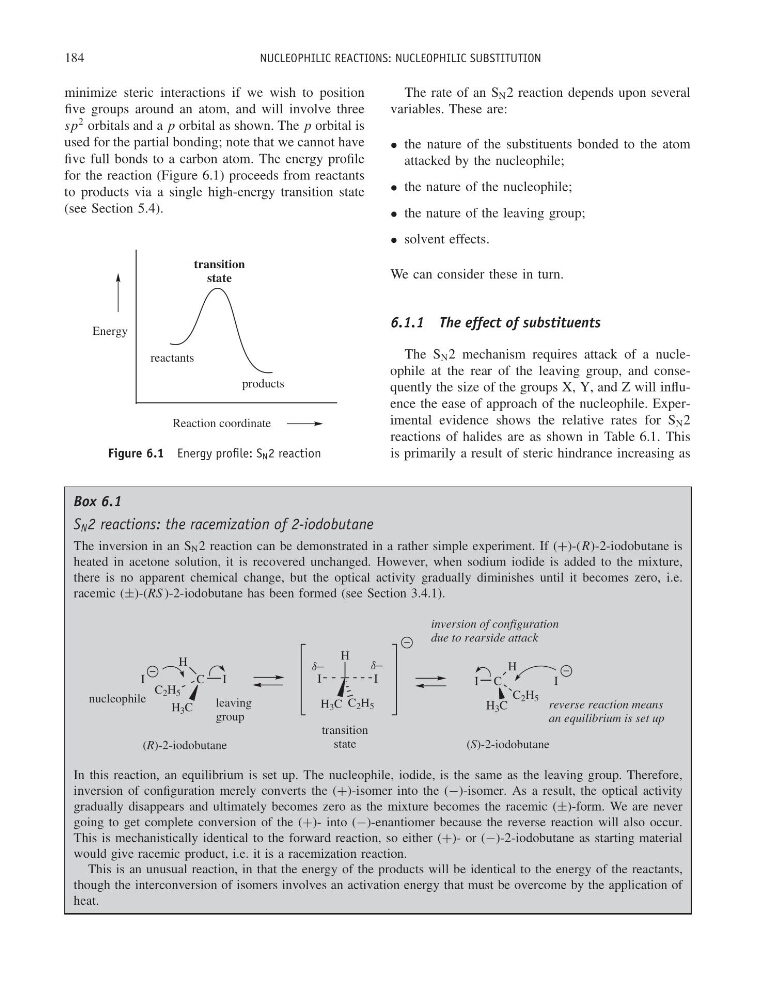
five full bonds to a carbon atom. The energy profile
for the reaction (Figure 6.1) proceeds from reactants
to products via a single high-energy transition state
(see Section 5.4).
transition
state
Energy
Reaction coordinate
reactants
products
Figure 6.1 Energy profile: S N 2 reaction
The rate of an S N 2 reaction depends upon several
variables. These are:
• the nature of the substituents bonded to the atom
attacked by the nucleophile;
• the nature of the nucleophile;
• the nature of the leaving group;
• solvent effects.
We can consider these in turn.
6.1.1 The effect of substituents
The S N 2 mechanism requires attack of a nucleophile at the rear of the leaving group, and consequently the size of the groups X, Y, and Z will influence the ease of approach of the nucleophile. Experimental evidence shows the relative rates for S N 2
reactions of halides are as shown in Table 6.1. This
is primarily a result of steric hindrance increasing as
Box 6.1
S N 2 reactions: the racemization of 2-iodobutane
The inversion in an S N 2 reaction can be demonstrated in a rather simple experiment. If (+)-(R)-2-iodobutane is
heated in acetone solution, it is recovered unchanged. However, when sodium iodide is added to the mixture,
there is no apparent chemical change, but the optical activity gradually diminishes until it becomes zero, i.e.
racemic (±)-(RS )-2-iodobutane has been formed (see Section 3.4.1).
H
C I
H 3 C
C
H
H 3 C
I
nucleophile
leaving
group
inversion of configuration
due to rearside attack
C 2 H 5
C 2 H 5
I
H
I
H 3 C C 2 H 5
d−
d−
transition
state
I
I
(R)-2-iodobutane
(S)-2-iodobutane
reverse reaction means
an equilibrium is set up
In this reaction, an equilibrium is set up. The nucleophile, iodide, is the same as the leaving group. Therefore,
inversion of configuration merely converts the (+)-isomer into the (−)-isomer. As a result, the optical activity
gradually disappears and ultimately becomes zero as the mixture becomes the racemic (±)-form. We are never
going to get complete conversion of the (+)- into (−)-enantiomer because the reverse reaction will also occur.
This is mechanistically identical to the forward reaction, so either (+)- or (−)-2-iodobutane as starting material
would give racemic product, i.e. it is a racemization reaction.
This is an unusual reaction, in that the energy of the products will be identical to the energy of the reactants,
though the interconversion of isomers involves an activation energy that must be overcome by the application of
heat.
NUCLEOPHILIC REACTIONS: NUCLEOPHILIC SUBSTITUTION
minimize steric interactions if we wish to position
five groups around an atom, and will involve three
sp
2 orbitals and a p orbital as shown. The p orbital is
used for the partial bonding; note that we cannot have
five full bonds to a carbon atom. The energy profile
for the reaction (Figure 6.1) proceeds from reactants
to products via a single high-energy transition state
(see Section 5.4).
transition
state
Energy
Reaction coordinate
reactants
products
Figure 6.1 Energy profile: S N 2 reaction
The rate of an S N 2 reaction depends upon several
variables. These are:
• the nature of the substituents bonded to the atom
attacked by the nucleophile;
• the nature of the nucleophile;
• the nature of the leaving group;
• solvent effects.
We can consider these in turn.
6.1.1 The effect of substituents
The S N 2 mechanism requires attack of a nucleophile at the rear of the leaving group, and consequently the size of the groups X, Y, and Z will influence the ease of approach of the nucleophile. Experimental evidence shows the relative rates for S N 2
reactions of halides are as shown in Table 6.1. This
is primarily a result of steric hindrance increasing as
Box 6.1
S N 2 reactions: the racemization of 2-iodobutane
The inversion in an S N 2 reaction can be demonstrated in a rather simple experiment. If (+)-(R)-2-iodobutane is
heated in acetone solution, it is recovered unchanged. However, when sodium iodide is added to the mixture,
there is no apparent chemical change, but the optical activity gradually diminishes until it becomes zero, i.e.
racemic (±)-(RS )-2-iodobutane has been formed (see Section 3.4.1).
H
C I
H 3 C
C
H
H 3 C
I
nucleophile
leaving
group
inversion of configuration
due to rearside attack
C 2 H 5
C 2 H 5
I
H
I
H 3 C C 2 H 5
d−
d−
transition
state
I
I
(R)-2-iodobutane
(S)-2-iodobutane
reverse reaction means
an equilibrium is set up
In this reaction, an equilibrium is set up. The nucleophile, iodide, is the same as the leaving group. Therefore,
inversion of configuration merely converts the (+)-isomer into the (−)-isomer. As a result, the optical activity
gradually disappears and ultimately becomes zero as the mixture becomes the racemic (±)-form. We are never
going to get complete conversion of the (+)- into (−)-enantiomer because the reverse reaction will also occur.
This is mechanistically identical to the forward reaction, so either (+)- or (−)-2-iodobutane as starting material
would give racemic product, i.e. it is a racemization reaction.
This is an unusual reaction, in that the energy of the products will be identical to the energy of the reactants,
though the interconversion of isomers involves an activation energy that must be overcome by the application of
heat.