

6
Nucleophilic reactions: nucleophilic
substitution
As the term suggests, a substitution reaction is one
in which one group is substituted for another. For
nucleophilic substitution, the reagent is a suitable
nucleophile and it displaces a leaving group. As we
study the reactions further, we shall see that mechanistically related competing reactions, eliminations
and rearrangements, also need to be considered.
6.1 The S N 2 reaction: bimolecular
nucleophilic substitution
The abbreviation S N 2 conveys the information ‘substitution–nucleophilic–bimolecular’. The reaction is
essentially the displacement of one group, a leaving group, by another group, a nucleophile. It is a
bimolecular reaction, since kinetic data indicate that
two species are involved in the rate-determining step:
Rate = k[RL][Nu]
where Nu is the nucleophile, RL the substrate containing the leaving group L, and k is the rate constant.
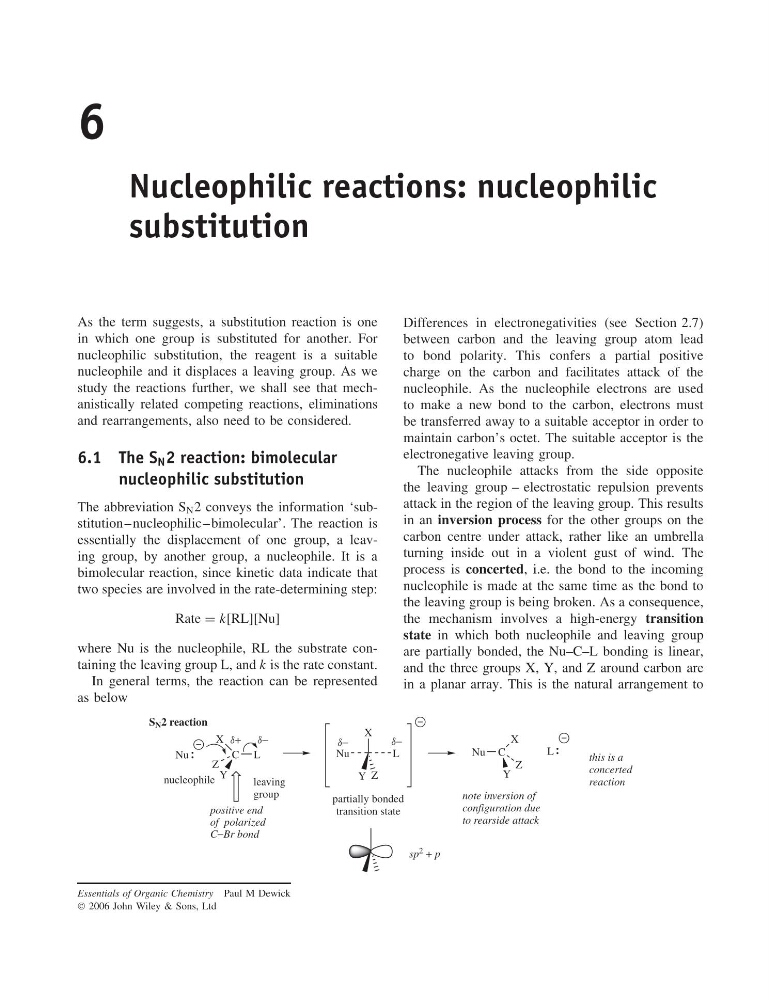
In general terms, the reaction can be represented
as below
Differences in electronegativities (see Section 2.7)
between carbon and the leaving group atom lead
to bond polarity. This confers a partial positive
charge on the carbon and facilitates attack of the
nucleophile. As the nucleophile electrons are used
to make a new bond to the carbon, electrons must
be transferred away to a suitable acceptor in order to
maintain carbon’s octet. The suitable acceptor is the
electronegative leaving group.
The nucleophile attacks from the side opposite
the leaving group – electrostatic repulsion prevents
attack in the region of the leaving group. This results
in an inversion process for the other groups on the
carbon centre under attack, rather like an umbrella
turning inside out in a violent gust of wind. The
process is concerted, i.e. the bond to the incoming
nucleophile is made at the same time as the bond to
the leaving group is being broken. As a consequence,
the mechanism involves a high-energy transition
state in which both nucleophile and leaving group
are partially bonded, the Nu–C–L bonding is linear,
and the three groups X, Y, and Z around carbon are
in a planar array. This is the natural arrangement to
X
C L
Y
C
X
Y
Nu
Nu
L
nucleophile
leaving
group
note inversion of
configuration due
to rearside attack
positive end
of polarized
C−Br bond
this is a
concerted
reaction
Z
Z
d+ d−
L
X
Nu
Y Z
d−
d−
partially bonded
transition state
sp 2 + p
S N 2 reaction
Essentials of Organic Chemistry Paul M Dewick
2006 John Wiley & Sons, Ltd
Nucleophilic reactions: nucleophilic
substitution
As the term suggests, a substitution reaction is one
in which one group is substituted for another. For
nucleophilic substitution, the reagent is a suitable
nucleophile and it displaces a leaving group. As we
study the reactions further, we shall see that mechanistically related competing reactions, eliminations
and rearrangements, also need to be considered.
6.1 The S N 2 reaction: bimolecular
nucleophilic substitution
The abbreviation S N 2 conveys the information ‘substitution–nucleophilic–bimolecular’. The reaction is
essentially the displacement of one group, a leaving group, by another group, a nucleophile. It is a
bimolecular reaction, since kinetic data indicate that
two species are involved in the rate-determining step:
Rate = k[RL][Nu]
where Nu is the nucleophile, RL the substrate containing the leaving group L, and k is the rate constant.
In general terms, the reaction can be represented
as below
Differences in electronegativities (see Section 2.7)
between carbon and the leaving group atom lead
to bond polarity. This confers a partial positive
charge on the carbon and facilitates attack of the
nucleophile. As the nucleophile electrons are used
to make a new bond to the carbon, electrons must
be transferred away to a suitable acceptor in order to
maintain carbon’s octet. The suitable acceptor is the
electronegative leaving group.
The nucleophile attacks from the side opposite
the leaving group – electrostatic repulsion prevents
attack in the region of the leaving group. This results
in an inversion process for the other groups on the
carbon centre under attack, rather like an umbrella
turning inside out in a violent gust of wind. The
process is concerted, i.e. the bond to the incoming
nucleophile is made at the same time as the bond to
the leaving group is being broken. As a consequence,
the mechanism involves a high-energy transition
state in which both nucleophile and leaving group
are partially bonded, the Nu–C–L bonding is linear,
and the three groups X, Y, and Z around carbon are
in a planar array. This is the natural arrangement to
X
C L
Y
C
X
Y
Nu
Nu
L
nucleophile
leaving
group
note inversion of
configuration due
to rearside attack
positive end
of polarized
C−Br bond
this is a
concerted
reaction
Z
Z
d+ d−
L
X
Nu
Y Z
d−
d−
partially bonded
transition state
sp 2 + p
S N 2 reaction
Essentials of Organic Chemistry Paul M Dewick
2006 John Wiley & Sons, Ltd