

180
REACTION MECHANISMS
Box 5.1 (continued)
C O
H
R
H OR
C O
H
R
H
OR
H
R CH
OR
OH
student
version
correct
mechanism
C OH
H
R
ROH
R C H
OH
O
R
H
R CH
OR
OH
under acid conditions,
the lone pair is the
nucleophile
loss of proton,
regeneration of catalyst
H
C O
H
R
H
alcohols are very weak acids; they
require a strong base for ionization
reaction is carried out
under acidic conditions
using strong base as nucleophile
under acidic conditions
require protonation before
nucleophilic attack
protonation via lone pair on
oxygen; the acid catalyst
initiates the reaction
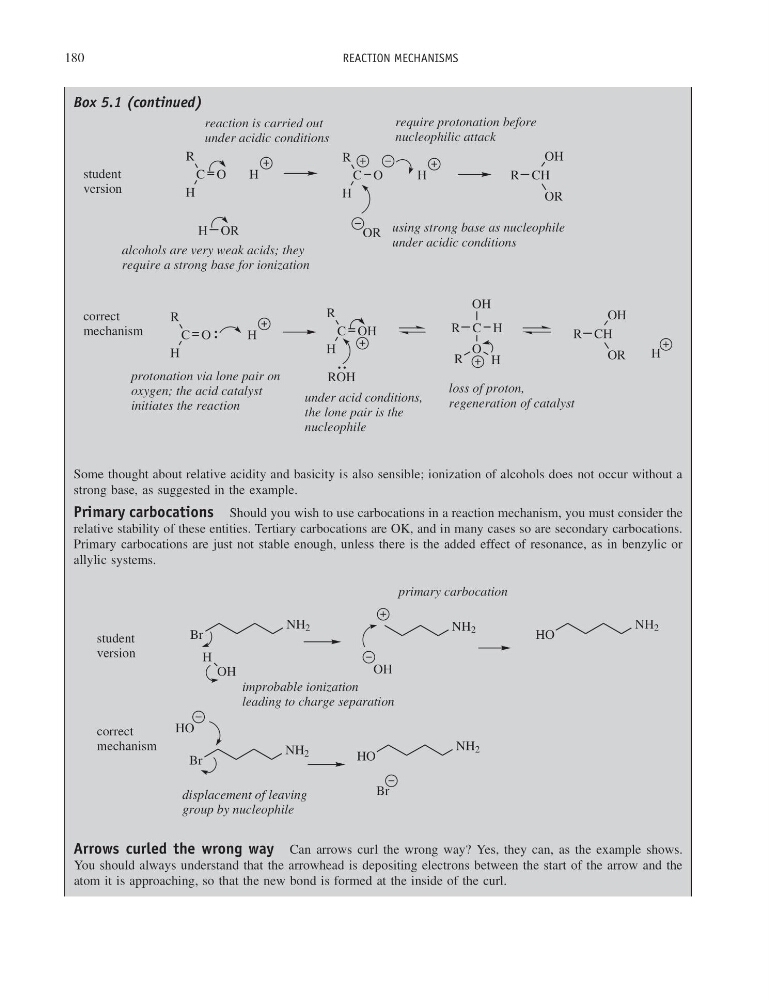
Some thought about relative acidity and basicity is also sensible; ionization of alcohols does not occur without a
strong base, as suggested in the example.
Primary carbocations Should you wish to use carbocations in a reaction mechanism, you must consider the
relative stability of these entities. Tertiary carbocations are OK, and in many cases so are secondary carbocations.
Primary carbocations are just not stable enough, unless there is the added effect of resonance, as in benzylic or
allylic systems.
Br
NH 2
H
OH
NH 2
OH
HO
NH 2
Br
NH 2
HO
HO
NH 2
Br
improbable ionization
leading to charge separation
primary carbocation
student
version
correct
mechanism
displacement of leaving
group by nucleophile
Arrows curled the wrong way Can arrows curl the wrong way? Yes, they can, as the example shows.
You should always understand that the arrowhead is depositing electrons between the start of the arrow and the
atom it is approaching, so that the new bond is formed at the inside of the curl.
REACTION MECHANISMS
Box 5.1 (continued)
C O
H
R
H OR
C O
H
R
H
OR
H
R CH
OR
OH
student
version
correct
mechanism
C OH
H
R
ROH
R C H
OH
O
R
H
R CH
OR
OH
under acid conditions,
the lone pair is the
nucleophile
loss of proton,
regeneration of catalyst
H
C O
H
R
H
alcohols are very weak acids; they
require a strong base for ionization
reaction is carried out
under acidic conditions
using strong base as nucleophile
under acidic conditions
require protonation before
nucleophilic attack
protonation via lone pair on
oxygen; the acid catalyst
initiates the reaction
Some thought about relative acidity and basicity is also sensible; ionization of alcohols does not occur without a
strong base, as suggested in the example.
Primary carbocations Should you wish to use carbocations in a reaction mechanism, you must consider the
relative stability of these entities. Tertiary carbocations are OK, and in many cases so are secondary carbocations.
Primary carbocations are just not stable enough, unless there is the added effect of resonance, as in benzylic or
allylic systems.
Br
NH 2
H
OH
NH 2
OH
HO
NH 2
Br
NH 2
HO
HO
NH 2
Br
improbable ionization
leading to charge separation
primary carbocation
student
version
correct
mechanism
displacement of leaving
group by nucleophile
Arrows curled the wrong way Can arrows curl the wrong way? Yes, they can, as the example shows.
You should always understand that the arrowhead is depositing electrons between the start of the arrow and the
atom it is approaching, so that the new bond is formed at the inside of the curl.