

REACTION MECHANISMS
181
H
H
H
H
H
this means using electrons from double
bond to make new bond to H + as shown
student
version
correct
mechanism
H
H
curly arrow
implies this
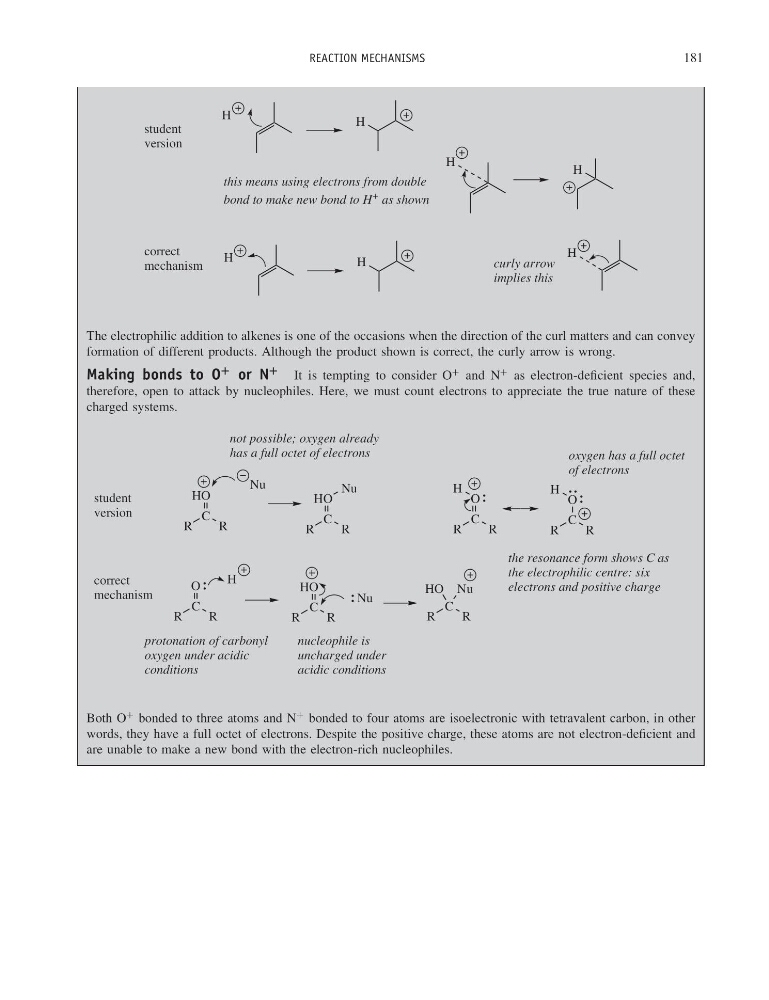
The electrophilic addition to alkenes is one of the occasions when the direction of the curl matters and can convey
formation of different products. Although the product shown is correct, the curly arrow is wrong.
Making bonds to O
+ or N
+
It is tempting to consider O
+ and N
+ as electron-deficient species and,
therefore, open to attack by nucleophiles. Here, we must count electrons to appreciate the true nature of these
charged systems.
HO
C
R
R
Nu
student
version
correct
mechanism
HO
C
R
R
Nu
C
R
R
HO Nu
O
C
R
R
H
O
C
R
R
H
not possible; oxygen already
has a full octet of electrons
HO
C
R
R
Nu
the resonance form shows C as
the electrophilic centre: six
electrons and positive charge
oxygen has a full octet
of electrons
O
C
R
R
H
protonation of carbonyl
oxygen under acidic
conditions
nucleophile is
uncharged under
acidic conditions
Both O
+ bonded to three atoms and N
+ bonded to four atoms are isoelectronic with tetravalent carbon, in other
words, they have a full octet of electrons. Despite the positive charge, these atoms are not electron-deficient and
are unable to make a new bond with the electron-rich nucleophiles.
181
H
H
H
H
H
this means using electrons from double
bond to make new bond to H + as shown
student
version
correct
mechanism
H
H
curly arrow
implies this
The electrophilic addition to alkenes is one of the occasions when the direction of the curl matters and can convey
formation of different products. Although the product shown is correct, the curly arrow is wrong.
Making bonds to O
+ or N
+
It is tempting to consider O
+ and N
+ as electron-deficient species and,
therefore, open to attack by nucleophiles. Here, we must count electrons to appreciate the true nature of these
charged systems.
HO
C
R
R
Nu
student
version
correct
mechanism
HO
C
R
R
Nu
C
R
R
HO Nu
O
C
R
R
H
O
C
R
R
H
not possible; oxygen already
has a full octet of electrons
HO
C
R
R
Nu
the resonance form shows C as
the electrophilic centre: six
electrons and positive charge
oxygen has a full octet
of electrons
O
C
R
R
H
protonation of carbonyl
oxygen under acidic
conditions
nucleophile is
uncharged under
acidic conditions
Both O
+ bonded to three atoms and N
+ bonded to four atoms are isoelectronic with tetravalent carbon, in other
words, they have a full octet of electrons. Despite the positive charge, these atoms are not electron-deficient and
are unable to make a new bond with the electron-rich nucleophiles.