

REACTION MECHANISMS
179
O
H
H 3 C I
O
OH
O
H 3 C I
H
OCH 3 I
HO
−
arrows do not convey
sequence of events
base removing
proton is first step
second step is
nucleophilic attack
base not used
in mechanism
student
version
correct
mechanism
OCH 3 I
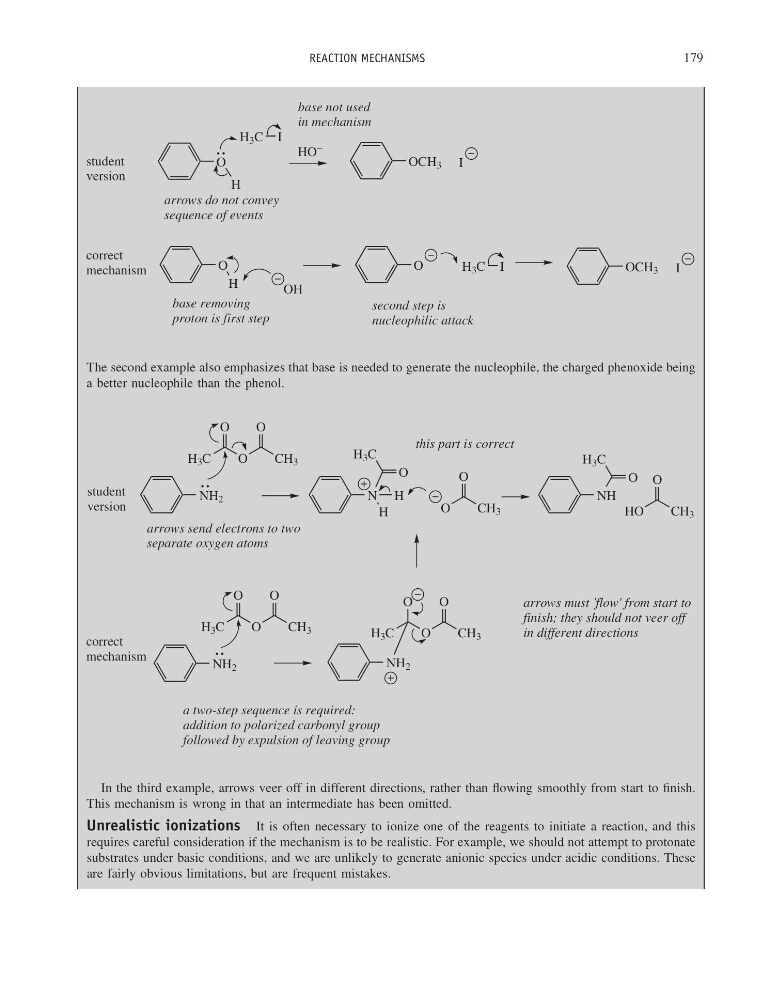
The second example also emphasizes that base is needed to generate the nucleophile, the charged phenoxide being
a better nucleophile than the phenol.
NH 2
H 3 C
O
CH 3
O
O
N
O
H 3 C
O
CH 3
O
student
version
correct
mechanism
H
H
NH
O
H 3 C
HO
CH 3
O
NH 2
H 3 C
O
CH 3
O
O
NH 2
H 3 C
O
CH 3
O
O
arrows send electrons to two
separate oxygen atoms
this part is correct
a two-step sequence is required:
addition to polarized carbonyl group
followed by expulsion of leaving group
arrows must 'flow' from start to
finish; they should not veer off
in different directions
In the third example, arrows veer off in different directions, rather than flowing smoothly from start to finish.
This mechanism is wrong in that an intermediate has been omitted.
Unrealistic ionizations It is often necessary to ionize one of the reagents to initiate a reaction, and this
requires careful consideration if the mechanism is to be realistic. For example, we should not attempt to protonate
substrates under basic conditions, and we are unlikely to generate anionic species under acidic conditions. These
are fairly obvious limitations, but are frequent mistakes.
179
O
H
H 3 C I
O
OH
O
H 3 C I
H
OCH 3 I
HO
−
arrows do not convey
sequence of events
base removing
proton is first step
second step is
nucleophilic attack
base not used
in mechanism
student
version
correct
mechanism
OCH 3 I
The second example also emphasizes that base is needed to generate the nucleophile, the charged phenoxide being
a better nucleophile than the phenol.
NH 2
H 3 C
O
CH 3
O
O
N
O
H 3 C
O
CH 3
O
student
version
correct
mechanism
H
H
NH
O
H 3 C
HO
CH 3
O
NH 2
H 3 C
O
CH 3
O
O
NH 2
H 3 C
O
CH 3
O
O
arrows send electrons to two
separate oxygen atoms
this part is correct
a two-step sequence is required:
addition to polarized carbonyl group
followed by expulsion of leaving group
arrows must 'flow' from start to
finish; they should not veer off
in different directions
In the third example, arrows veer off in different directions, rather than flowing smoothly from start to finish.
This mechanism is wrong in that an intermediate has been omitted.
Unrealistic ionizations It is often necessary to ionize one of the reagents to initiate a reaction, and this
requires careful consideration if the mechanism is to be realistic. For example, we should not attempt to protonate
substrates under basic conditions, and we are unlikely to generate anionic species under acidic conditions. These
are fairly obvious limitations, but are frequent mistakes.