

178
REACTION MECHANISMS
Box 5.1 (continued)
C OH
H
R
ROH
R C H
OH
O
R
H
R CH
OR
OH
student
version
correct
mechanism
C OH
H
R
ROH
R C H
OH
O
R
H
R CH
OR
OH
charge missing;
vague arrow
charge missing;
source of electrons?
arrow from oxygen
lone pair
arrow from bond, neutralizes
positive charge
source of electrons?
arrow from bond,
neutralizes positive charge
H
redundant arrow
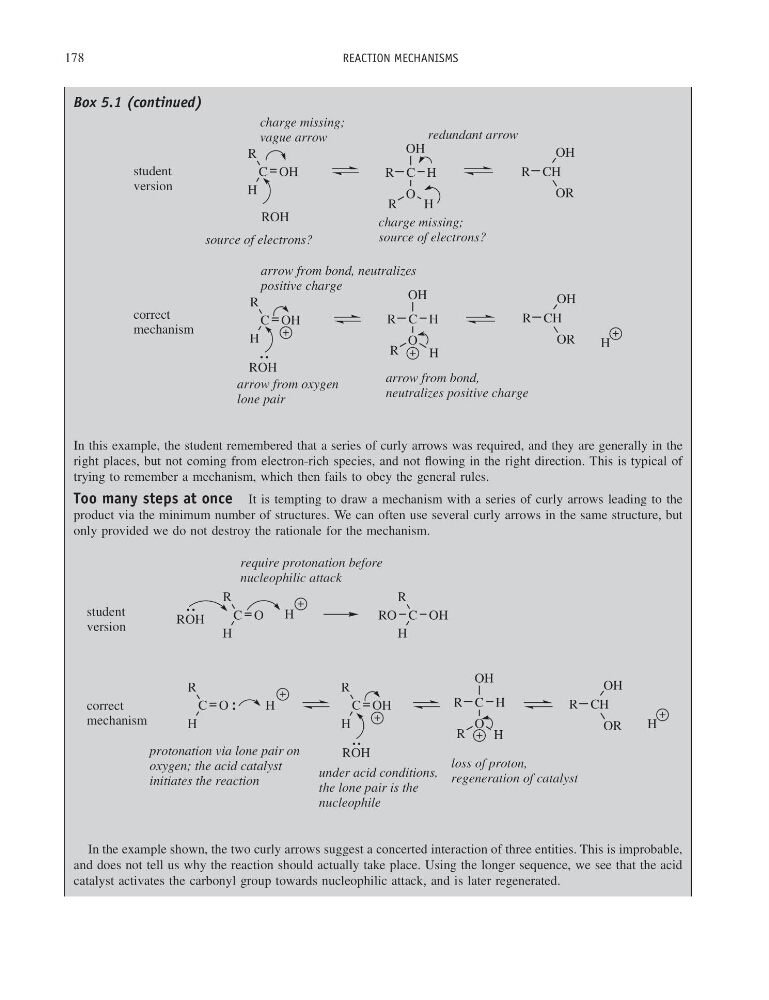
In this example, the student remembered that a series of curly arrows was required, and they are generally in the
right places, but not coming from electron-rich species, and not flowing in the right direction. This is typical of
trying to remember a mechanism, which then fails to obey the general rules.
Too many steps at once It is tempting to draw a mechanism with a series of curly arrows leading to the
product via the minimum number of structures. We can often use several curly arrows in the same structure, but
only provided we do not destroy the rationale for the mechanism.
C O
H
R
ROH
H
C OH
H
R
RO
C OH
H
R
ROH
R C H
OH
O
R
H
R CH
OR
OH
under acid conditions,
the lone pair is the
nucleophile
loss of proton,
regeneration of catalyst
H
C O
H
R
H
protonation via lone pair on
oxygen; the acid catalyst
initiates the reaction
student
version
correct
mechanism
require protonation before
nucleophilic attack
In the example shown, the two curly arrows suggest a concerted interaction of three entities. This is improbable,
and does not tell us why the reaction should actually take place. Using the longer sequence, we see that the acid
catalyst activates the carbonyl group towards nucleophilic attack, and is later regenerated.
REACTION MECHANISMS
Box 5.1 (continued)
C OH
H
R
ROH
R C H
OH
O
R
H
R CH
OR
OH
student
version
correct
mechanism
C OH
H
R
ROH
R C H
OH
O
R
H
R CH
OR
OH
charge missing;
vague arrow
charge missing;
source of electrons?
arrow from oxygen
lone pair
arrow from bond, neutralizes
positive charge
source of electrons?
arrow from bond,
neutralizes positive charge
H
redundant arrow
In this example, the student remembered that a series of curly arrows was required, and they are generally in the
right places, but not coming from electron-rich species, and not flowing in the right direction. This is typical of
trying to remember a mechanism, which then fails to obey the general rules.
Too many steps at once It is tempting to draw a mechanism with a series of curly arrows leading to the
product via the minimum number of structures. We can often use several curly arrows in the same structure, but
only provided we do not destroy the rationale for the mechanism.
C O
H
R
ROH
H
C OH
H
R
RO
C OH
H
R
ROH
R C H
OH
O
R
H
R CH
OR
OH
under acid conditions,
the lone pair is the
nucleophile
loss of proton,
regeneration of catalyst
H
C O
H
R
H
protonation via lone pair on
oxygen; the acid catalyst
initiates the reaction
student
version
correct
mechanism
require protonation before
nucleophilic attack
In the example shown, the two curly arrows suggest a concerted interaction of three entities. This is improbable,
and does not tell us why the reaction should actually take place. Using the longer sequence, we see that the acid
catalyst activates the carbonyl group towards nucleophilic attack, and is later regenerated.