

REACTION MECHANISMS
177
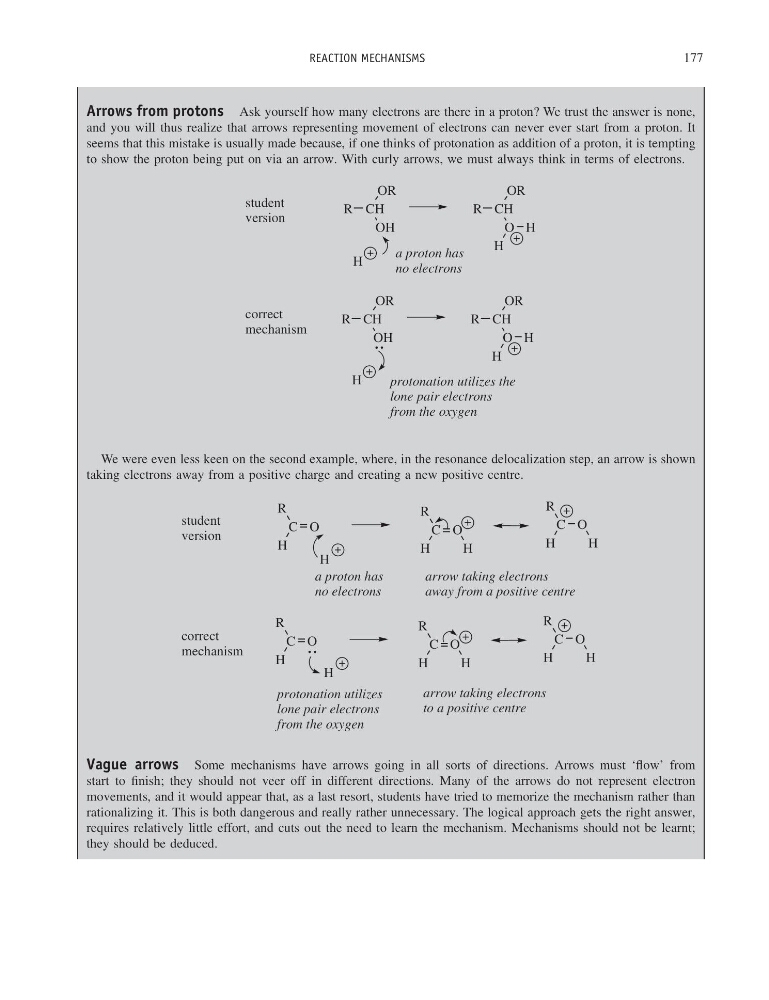
Arrows from protons Ask yourself how many electrons are there in a proton? We trust the answer is none,
and you will thus realize that arrows representing movement of electrons can never ever start from a proton. It
seems that this mistake is usually made because, if one thinks of protonation as addition of a proton, it is tempting
to show the proton being put on via an arrow. With curly arrows, we must always think in terms of electrons.
R CH
OH
OR
H
R CH
O
OR
H
H
student
version
correct
mechanism
R CH
OH
OR
H
R CH
O
OR
H
H
a proton has
no electrons
protonation utilizes the
lone pair electrons
from the oxygen
We were even less keen on the second example, where, in the resonance delocalization step, an arrow is shown
taking electrons away from a positive charge and creating a new positive centre.
student
version
C O
H
R
H
C O
H
R
H
C O
H
R
H
C O
H
R
H
C O
H
R
H
C O
H
R
H
correct
mechanism
arrow taking electrons
away from a positive centre
protonation utilizes
lone pair electrons
from the oxygen
arrow taking electrons
to a positive centre
a proton has
no electrons
Vague arrows Some mechanisms have arrows going in all sorts of directions. Arrows must ‘flow’ from
start to finish; they should not veer off in different directions. Many of the arrows do not represent electron
movements, and it would appear that, as a last resort, students have tried to memorize the mechanism rather than
rationalizing it. This is both dangerous and really rather unnecessary. The logical approach gets the right answer,
requires relatively little effort, and cuts out the need to learn the mechanism. Mechanisms should not be learnt;
they should be deduced.
177
Arrows from protons Ask yourself how many electrons are there in a proton? We trust the answer is none,
and you will thus realize that arrows representing movement of electrons can never ever start from a proton. It
seems that this mistake is usually made because, if one thinks of protonation as addition of a proton, it is tempting
to show the proton being put on via an arrow. With curly arrows, we must always think in terms of electrons.
R CH
OH
OR
H
R CH
O
OR
H
H
student
version
correct
mechanism
R CH
OH
OR
H
R CH
O
OR
H
H
a proton has
no electrons
protonation utilizes the
lone pair electrons
from the oxygen
We were even less keen on the second example, where, in the resonance delocalization step, an arrow is shown
taking electrons away from a positive charge and creating a new positive centre.
student
version
C O
H
R
H
C O
H
R
H
C O
H
R
H
C O
H
R
H
C O
H
R
H
C O
H
R
H
correct
mechanism
arrow taking electrons
away from a positive centre
protonation utilizes
lone pair electrons
from the oxygen
arrow taking electrons
to a positive centre
a proton has
no electrons
Vague arrows Some mechanisms have arrows going in all sorts of directions. Arrows must ‘flow’ from
start to finish; they should not veer off in different directions. Many of the arrows do not represent electron
movements, and it would appear that, as a last resort, students have tried to memorize the mechanism rather than
rationalizing it. This is both dangerous and really rather unnecessary. The logical approach gets the right answer,
requires relatively little effort, and cuts out the need to learn the mechanism. Mechanisms should not be learnt;
they should be deduced.