

176
REACTION MECHANISMS
Box 5.1
Some common mistakes in drawing mechanisms
Experience tells us that whilst many students find mechanisms easy and logical, others despair and are completely
bewildered. We cannot guarantee success for all, but we hope that by showing a few of the common mistakes
we may help some of the latter group join the former. In order to make the examples chosen as real as possible,
these have all been selected from students’ examination answers. The mechanisms relate to reactions we have yet
to meet, but this is not important. At this stage, it is the manipulation of curly arrows that is under consideration.
You may wish to return to this section later.
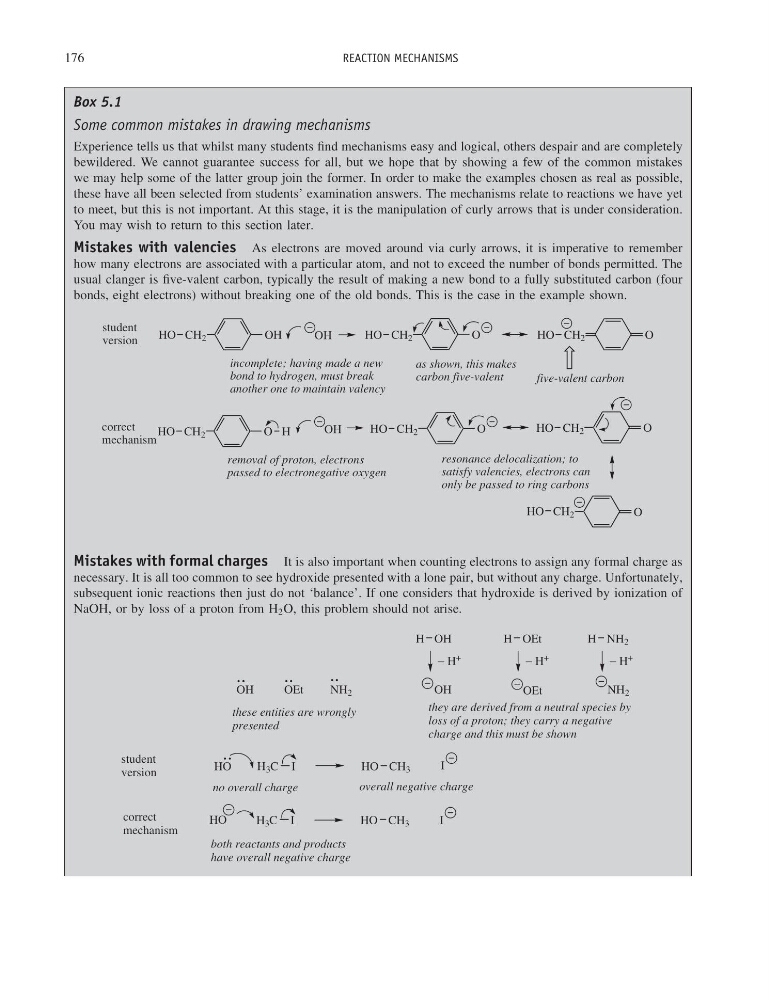
Mistakes with valencies As electrons are moved around via curly arrows, it is imperative to remember
how many electrons are associated with a particular atom, and not to exceed the number of bonds permitted. The
usual clanger is five-valent carbon, typically the result of making a new bond to a fully substituted carbon (four
bonds, eight electrons) without breaking one of the old bonds. This is the case in the example shown.
OH
CH 2
OH
student
version
O
CH 2
O
CH 2
HO
HO
HO
correct
mechanism
incomplete; having made a new
bond to hydrogen, must break
another one to maintain valency
as shown, this makes
carbon five-valent
O
CH 2
HO
H
OH
O
CH 2
HO
O
CH 2
HO
O
CH 2
HO
removal of proton, electrons
passed to electronegative oxygen
resonance delocalization; to
satisfy valencies, electrons can
only be passed to ring carbons
five-valent carbon
Mistakes with formal charges It is also important when counting electrons to assign any formal charge as
necessary. It is all too common to see hydroxide presented with a lone pair, but without any charge. Unfortunately,
subsequent ionic reactions then just do not ‘balance’. If one considers that hydroxide is derived by ionization of
NaOH, or by loss of a proton from H 2 O, this problem should not arise.
OH
OEt
NH 2
OH
OEt
NH 2
these entities are wrongly
presented
they are derived from a neutral species by
loss of a proton; they carry a negative
charge and this must be shown
H 3 C I
HO
HO CH 3
I
student
version
correct
mechanism
H 3 C I
HO
HO CH 3
I
no overall charge
overall negative charge
both reactants and products
have overall negative charge
H OH
H OEt
− H +
− H +
H NH 2
− H +
REACTION MECHANISMS
Box 5.1
Some common mistakes in drawing mechanisms
Experience tells us that whilst many students find mechanisms easy and logical, others despair and are completely
bewildered. We cannot guarantee success for all, but we hope that by showing a few of the common mistakes
we may help some of the latter group join the former. In order to make the examples chosen as real as possible,
these have all been selected from students’ examination answers. The mechanisms relate to reactions we have yet
to meet, but this is not important. At this stage, it is the manipulation of curly arrows that is under consideration.
You may wish to return to this section later.
Mistakes with valencies As electrons are moved around via curly arrows, it is imperative to remember
how many electrons are associated with a particular atom, and not to exceed the number of bonds permitted. The
usual clanger is five-valent carbon, typically the result of making a new bond to a fully substituted carbon (four
bonds, eight electrons) without breaking one of the old bonds. This is the case in the example shown.
OH
CH 2
OH
student
version
O
CH 2
O
CH 2
HO
HO
HO
correct
mechanism
incomplete; having made a new
bond to hydrogen, must break
another one to maintain valency
as shown, this makes
carbon five-valent
O
CH 2
HO
H
OH
O
CH 2
HO
O
CH 2
HO
O
CH 2
HO
removal of proton, electrons
passed to electronegative oxygen
resonance delocalization; to
satisfy valencies, electrons can
only be passed to ring carbons
five-valent carbon
Mistakes with formal charges It is also important when counting electrons to assign any formal charge as
necessary. It is all too common to see hydroxide presented with a lone pair, but without any charge. Unfortunately,
subsequent ionic reactions then just do not ‘balance’. If one considers that hydroxide is derived by ionization of
NaOH, or by loss of a proton from H 2 O, this problem should not arise.
OH
OEt
NH 2
OH
OEt
NH 2
these entities are wrongly
presented
they are derived from a neutral species by
loss of a proton; they carry a negative
charge and this must be shown
H 3 C I
HO
HO CH 3
I
student
version
correct
mechanism
H 3 C I
HO
HO CH 3
I
no overall charge
overall negative charge
both reactants and products
have overall negative charge
H OH
H OEt
− H +
− H +
H NH 2
− H +