

ARROWS
175
mechanism is that it allows us to predict chemical
behaviour without having to remember lots of
chemical reactions. A further reassuring fact is that
virtually all of the chemical reactions can be classified
according to a reaction type, and the number of
distinct reaction types is actually rather few. We only
need to consider reaction types according to what
is achieved in the conversion, namely substitution,
elimination, addition, or rearrangement. In general
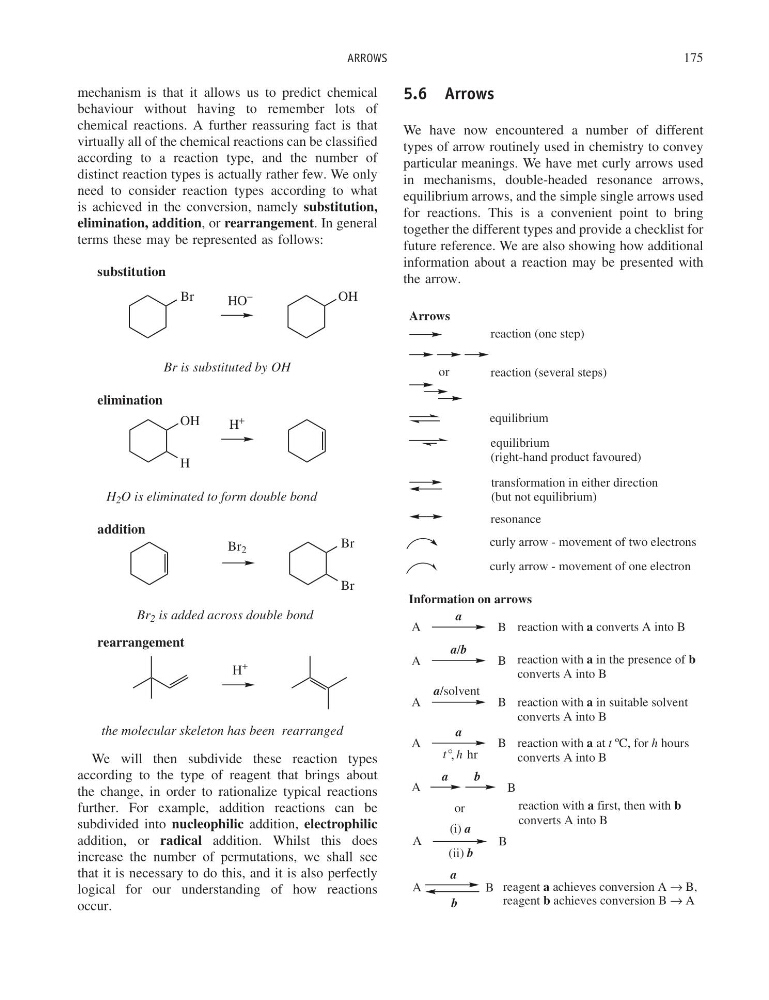
terms these may be represented as follows:
Br
OH
HO
−
substitution
Br is substituted by OH
elimination
OH
H
H +
H 2 O is eliminated to form double bond
addition
Br 2
Br
Br
Br 2 is added across double bond
rearrangement
H +
the molecular skeleton has been rearranged
We will then subdivide these reaction types
according to the type of reagent that brings about
the change, in order to rationalize typical reactions
further. For example, addition reactions can be
subdivided into nucleophilic addition, electrophilic
addition, or radical addition. Whilst this does
increase the number of permutations, we shall see
that it is necessary to do this, and it is also perfectly
logical for our understanding of how reactions
occur.
5.6 Arrows
We have now encountered a number of different
types of arrow routinely used in chemistry to convey
particular meanings. We have met curly arrows used
in mechanisms, double-headed resonance arrows,
equilibrium arrows, and the simple single arrows used
for reactions. This is a convenient point to bring
together the different types and provide a checklist for
future reference. We are also showing how additional
information about a reaction may be presented with
the arrow.
reaction (one step)
reaction (several steps)
or
equilibrium
equilibrium
(right-hand product favoured)
resonance
Arrows
Information on arrows
a
a/b
a/solvent
(i) a
(ii) b
reaction with a converts A into B
reaction with a in the presence of b
converts A into B
reaction with a in suitable solvent
converts A into B
reaction with a first, then with b
converts A into B
curly arrow - movement of two electrons
curly arrow - movement of one electron
B
B
B
B
transformation in either direction
(but not equilibrium)
B
a
b
reagent a achieves conversion A → B,
reagent b achieves conversion B → A
B
a
b
or
a
reaction with a at t ºC, for h hours
converts A into B
B
t
A
A
A
A
A
A
A
hr
° h
,
175
mechanism is that it allows us to predict chemical
behaviour without having to remember lots of
chemical reactions. A further reassuring fact is that
virtually all of the chemical reactions can be classified
according to a reaction type, and the number of
distinct reaction types is actually rather few. We only
need to consider reaction types according to what
is achieved in the conversion, namely substitution,
elimination, addition, or rearrangement. In general
terms these may be represented as follows:
Br
OH
HO
−
substitution
Br is substituted by OH
elimination
OH
H
H +
H 2 O is eliminated to form double bond
addition
Br 2
Br
Br
Br 2 is added across double bond
rearrangement
H +
the molecular skeleton has been rearranged
We will then subdivide these reaction types
according to the type of reagent that brings about
the change, in order to rationalize typical reactions
further. For example, addition reactions can be
subdivided into nucleophilic addition, electrophilic
addition, or radical addition. Whilst this does
increase the number of permutations, we shall see
that it is necessary to do this, and it is also perfectly
logical for our understanding of how reactions
occur.
5.6 Arrows
We have now encountered a number of different
types of arrow routinely used in chemistry to convey
particular meanings. We have met curly arrows used
in mechanisms, double-headed resonance arrows,
equilibrium arrows, and the simple single arrows used
for reactions. This is a convenient point to bring
together the different types and provide a checklist for
future reference. We are also showing how additional
information about a reaction may be presented with
the arrow.
reaction (one step)
reaction (several steps)
or
equilibrium
equilibrium
(right-hand product favoured)
resonance
Arrows
Information on arrows
a
a/b
a/solvent
(i) a
(ii) b
reaction with a converts A into B
reaction with a in the presence of b
converts A into B
reaction with a in suitable solvent
converts A into B
reaction with a first, then with b
converts A into B
curly arrow - movement of two electrons
curly arrow - movement of one electron
B
B
B
B
transformation in either direction
(but not equilibrium)
B
a
b
reagent a achieves conversion A → B,
reagent b achieves conversion B → A
B
a
b
or
a
reaction with a at t ºC, for h hours
converts A into B
B
t
A
A
A
A
A
A
A
hr
° h
,