

4
MOLECULAR REPRESENTATIONS AND NOMENCLATURE
C C
CH 2
H 3 C
CH 3
CH 2 CH 3
C C
H 3 C
CH 3
CH 3
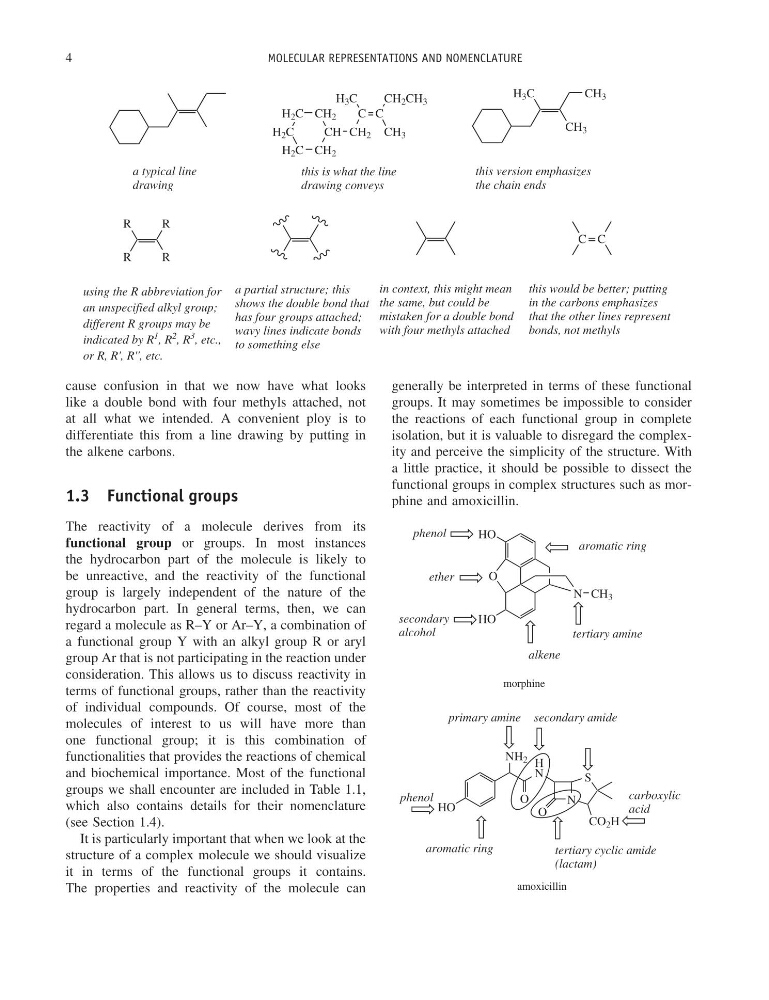
a typical line
drawing
this version emphasizes
the chain ends
a partial structure; this
shows the double bond that
has four groups attached;
wavy lines indicate bonds
to something else
in context, this might mean
the same, but could be
mistaken for a double bond
with four methyls attached
this would be better; putting
in the carbons emphasizes
that the other lines represent
bonds, not methyls
H 2 C CH 2
CH 2
H 2 C
H 2 C
CH
this is what the line
drawing conveys
R
R
R
R
using the R abbreviation for
an unspecified alkyl group;
different R groups may be
indicated by R 1 , R 2 , R 3 , etc.,
or R, R', R'', etc.
cause confusion in that we now have what looks
like a double bond with four methyls attached, not
at all what we intended. A convenient ploy is to
differentiate this from a line drawing by putting in
the alkene carbons.
1.3 Functional groups
The reactivity of a molecule derives from its
functional group or groups. In most instances
the hydrocarbon part of the molecule is likely to
be unreactive, and the reactivity of the functional
group is largely independent of the nature of the
hydrocarbon part. In general terms, then, we can
regard a molecule as R–Y or Ar–Y, a combination of
a functional group Y with an alkyl group R or aryl
group Ar that is not participating in the reaction under
consideration. This allows us to discuss reactivity in
terms of functional groups, rather than the reactivity
of individual compounds. Of course, most of the
molecules of interest to us will have more than
one functional group; it is this combination of
functionalities that provides the reactions of chemical
and biochemical importance. Most of the functional
groups we shall encounter are included in Table 1.1,
which also contains details for their nomenclature
(see Section 1.4).
It is particularly important that when we look at the
structure of a complex molecule we should visualize
it in terms of the functional groups it contains.
The properties and reactivity of the molecule can
generally be interpreted in terms of these functional
groups. It may sometimes be impossible to consider
the reactions of each functional group in complete
isolation, but it is valuable to disregard the complexity and perceive the simplicity of the structure. With
a little practice, it should be possible to dissect the
functional groups in complex structures such as morphine and amoxicillin.
N
S
H
N
CO 2 H
O
O
NH 2
HO
amoxicillin
O
HO
N CH 3
HO
morphine
tertiary amine
phenol
secondary
alcohol
ether
aromatic ring
alkene
phenol
primary amine secondary amide
tertiary cyclic amide
(lactam)
carboxylic
acid
aromatic ring
MOLECULAR REPRESENTATIONS AND NOMENCLATURE
C C
CH 2
H 3 C
CH 3
CH 2 CH 3
C C
H 3 C
CH 3
CH 3
a typical line
drawing
this version emphasizes
the chain ends
a partial structure; this
shows the double bond that
has four groups attached;
wavy lines indicate bonds
to something else
in context, this might mean
the same, but could be
mistaken for a double bond
with four methyls attached
this would be better; putting
in the carbons emphasizes
that the other lines represent
bonds, not methyls
H 2 C CH 2
CH 2
H 2 C
H 2 C
CH
this is what the line
drawing conveys
R
R
R
R
using the R abbreviation for
an unspecified alkyl group;
different R groups may be
indicated by R 1 , R 2 , R 3 , etc.,
or R, R', R'', etc.
cause confusion in that we now have what looks
like a double bond with four methyls attached, not
at all what we intended. A convenient ploy is to
differentiate this from a line drawing by putting in
the alkene carbons.
1.3 Functional groups
The reactivity of a molecule derives from its
functional group or groups. In most instances
the hydrocarbon part of the molecule is likely to
be unreactive, and the reactivity of the functional
group is largely independent of the nature of the
hydrocarbon part. In general terms, then, we can
regard a molecule as R–Y or Ar–Y, a combination of
a functional group Y with an alkyl group R or aryl
group Ar that is not participating in the reaction under
consideration. This allows us to discuss reactivity in
terms of functional groups, rather than the reactivity
of individual compounds. Of course, most of the
molecules of interest to us will have more than
one functional group; it is this combination of
functionalities that provides the reactions of chemical
and biochemical importance. Most of the functional
groups we shall encounter are included in Table 1.1,
which also contains details for their nomenclature
(see Section 1.4).
It is particularly important that when we look at the
structure of a complex molecule we should visualize
it in terms of the functional groups it contains.
The properties and reactivity of the molecule can
generally be interpreted in terms of these functional
groups. It may sometimes be impossible to consider
the reactions of each functional group in complete
isolation, but it is valuable to disregard the complexity and perceive the simplicity of the structure. With
a little practice, it should be possible to dissect the
functional groups in complex structures such as morphine and amoxicillin.
N
S
H
N
CO 2 H
O
O
NH 2
HO
amoxicillin
O
HO
N CH 3
HO
morphine
tertiary amine
phenol
secondary
alcohol
ether
aromatic ring
alkene
phenol
primary amine secondary amide
tertiary cyclic amide
(lactam)
carboxylic
acid
aromatic ring