

PARTIAL STRUCTURES
3
(see Section 2.9.4). To represent this, a circle may be
drawn within the hexagon. Unfortunately, this version
of benzene becomes quite useless when we start to
draw reaction mechanisms, and most people continue
to draw benzene rings in the Kekul´ e form. In some
cases, such as fused rings, it is actually incorrect to
show the circles.
this is strictly incorrect!
two Kekulé versions of naphthalene
each circle must represent six
aromatic p electrons
Thus, naphthalene has only 10 π electrons, one from
each carbon, whereas the incorrect two-circle version
suggests it has 12 π electrons.
We find that, in the early stages, students are usually happier to put in all the atoms when drawing
structures, following earlier practices. However, you
are urged to adopt the shorthand representations as
soon as possible. This saves time and cleans up the
structures of larger molecules. Even a relatively simple molecule such as 2-methylcyclohexanecarboxylic
acid, a cyclohexane ring carrying two substituents,
looks a mess when all the atoms are put in. By contrast, the line drawing looks neat and tidy, and takes
much less time to draw.
CO 2 H
CH 3
C
C
C
C
C
C
H
H
H
H
H
H
H
C
H
H
C O
O
H
H
H
H
2-methylcyclohexanecarboxylic acid
H
Do appreciate that there is no strict convention for
how you orientate the structure on paper. In fact, we
will turn structures around, as appropriate, to suit our
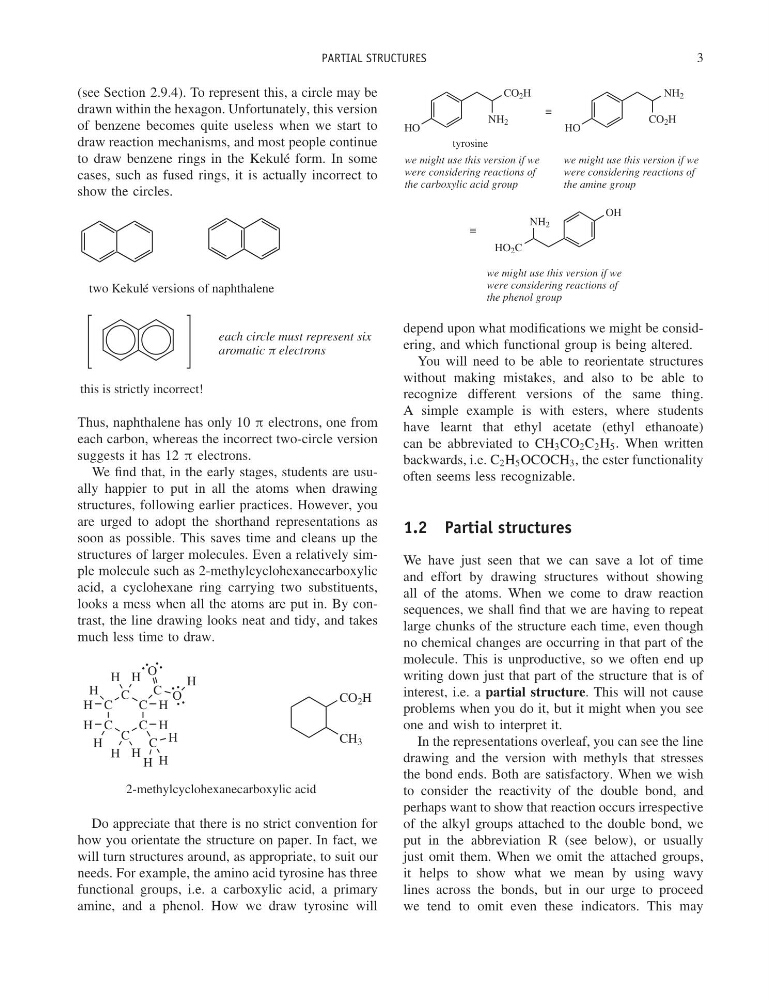
needs. For example, the amino acid tyrosine has three
functional groups, i.e. a carboxylic acid, a primary
amine, and a phenol. How we draw tyrosine will
CO 2 H
NH 2
HO
tyrosine
NH 2
CO 2 H
HO
HO 2 C
NH 2
OH
≡
≡
we might use this version if we
were considering reactions of
the amine group
we might use this version if we
were considering reactions of
the carboxylic acid group
we might use this version if we
were considering reactions of
the phenol group
depend upon what modifications we might be considering, and which functional group is being altered.
You will need to be able to reorientate structures
without making mistakes, and also to be able to
recognize different versions of the same thing.
A simple example is with esters, where students
have learnt that ethyl acetate (ethyl ethanoate)
can be abbreviated to CH 3 CO 2 C 2 H 5 . When written
backwards, i.e. C 2 H 5 OCOCH 3 , the ester functionality
often seems less recognizable.
1.2 Partial structures
We have just seen that we can save a lot of time
and effort by drawing structures without showing
all of the atoms. When we come to draw reaction
sequences, we shall find that we are having to repeat
large chunks of the structure each time, even though
no chemical changes are occurring in that part of the
molecule. This is unproductive, so we often end up
writing down just that part of the structure that is of
interest, i.e. a partial structure. This will not cause
problems when you do it, but it might when you see
one and wish to interpret it.
In the representations overleaf, you can see the line
drawing and the version with methyls that stresses
the bond ends. Both are satisfactory. When we wish
to consider the reactivity of the double bond, and
perhaps want to show that reaction occurs irrespective
of the alkyl groups attached to the double bond, we
put in the abbreviation R (see below), or usually
just omit them. When we omit the attached groups,
it helps to show what we mean by using wavy
lines across the bonds, but in our urge to proceed
we tend to omit even these indicators. This may
3
(see Section 2.9.4). To represent this, a circle may be
drawn within the hexagon. Unfortunately, this version
of benzene becomes quite useless when we start to
draw reaction mechanisms, and most people continue
to draw benzene rings in the Kekul´ e form. In some
cases, such as fused rings, it is actually incorrect to
show the circles.
this is strictly incorrect!
two Kekulé versions of naphthalene
each circle must represent six
aromatic p electrons
Thus, naphthalene has only 10 π electrons, one from
each carbon, whereas the incorrect two-circle version
suggests it has 12 π electrons.
We find that, in the early stages, students are usually happier to put in all the atoms when drawing
structures, following earlier practices. However, you
are urged to adopt the shorthand representations as
soon as possible. This saves time and cleans up the
structures of larger molecules. Even a relatively simple molecule such as 2-methylcyclohexanecarboxylic
acid, a cyclohexane ring carrying two substituents,
looks a mess when all the atoms are put in. By contrast, the line drawing looks neat and tidy, and takes
much less time to draw.
CO 2 H
CH 3
C
C
C
C
C
C
H
H
H
H
H
H
H
C
H
H
C O
O
H
H
H
H
2-methylcyclohexanecarboxylic acid
H
Do appreciate that there is no strict convention for
how you orientate the structure on paper. In fact, we
will turn structures around, as appropriate, to suit our
needs. For example, the amino acid tyrosine has three
functional groups, i.e. a carboxylic acid, a primary
amine, and a phenol. How we draw tyrosine will
CO 2 H
NH 2
HO
tyrosine
NH 2
CO 2 H
HO
HO 2 C
NH 2
OH
≡
≡
we might use this version if we
were considering reactions of
the amine group
we might use this version if we
were considering reactions of
the carboxylic acid group
we might use this version if we
were considering reactions of
the phenol group
depend upon what modifications we might be considering, and which functional group is being altered.
You will need to be able to reorientate structures
without making mistakes, and also to be able to
recognize different versions of the same thing.
A simple example is with esters, where students
have learnt that ethyl acetate (ethyl ethanoate)
can be abbreviated to CH 3 CO 2 C 2 H 5 . When written
backwards, i.e. C 2 H 5 OCOCH 3 , the ester functionality
often seems less recognizable.
1.2 Partial structures
We have just seen that we can save a lot of time
and effort by drawing structures without showing
all of the atoms. When we come to draw reaction
sequences, we shall find that we are having to repeat
large chunks of the structure each time, even though
no chemical changes are occurring in that part of the
molecule. This is unproductive, so we often end up
writing down just that part of the structure that is of
interest, i.e. a partial structure. This will not cause
problems when you do it, but it might when you see
one and wish to interpret it.
In the representations overleaf, you can see the line
drawing and the version with methyls that stresses
the bond ends. Both are satisfactory. When we wish
to consider the reactivity of the double bond, and
perhaps want to show that reaction occurs irrespective
of the alkyl groups attached to the double bond, we
put in the abbreviation R (see below), or usually
just omit them. When we omit the attached groups,
it helps to show what we mean by using wavy
lines across the bonds, but in our urge to proceed
we tend to omit even these indicators. This may