

2
MOLECULAR REPRESENTATIONS AND NOMENCLATURE
bonds, or it can be one showing just the principal
bonds, those of the carbon chain.
However, for many complex structures, even these
approaches become too tedious, and we usually resort
to a shorthand version that omits most, if not all,
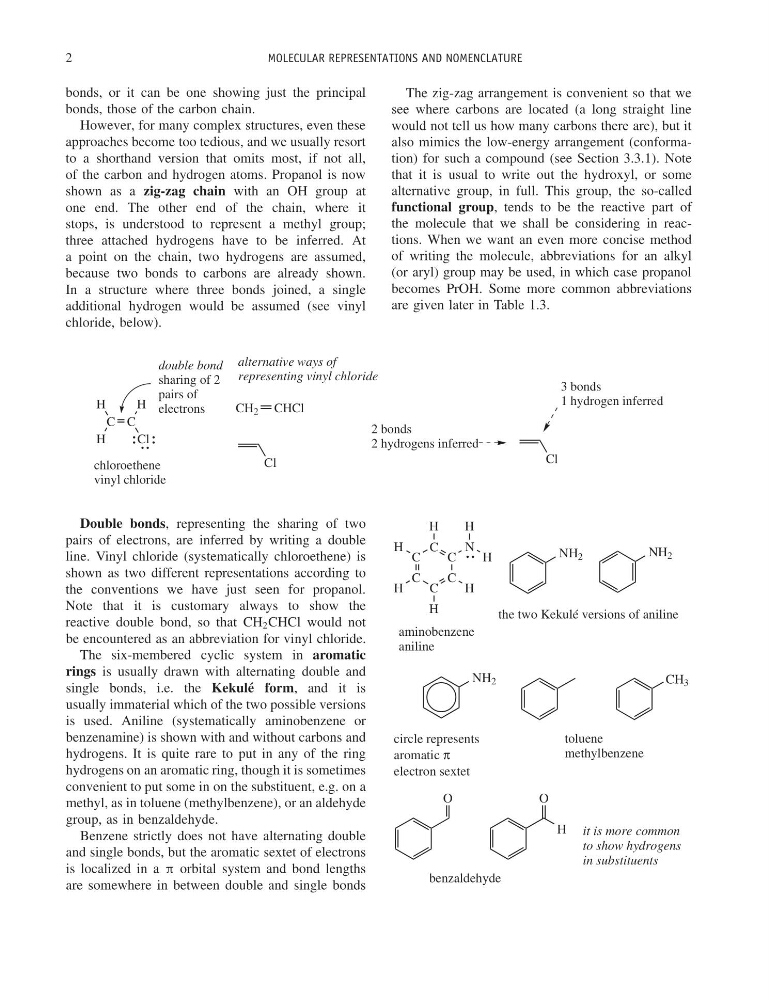
of the carbon and hydrogen atoms. Propanol is now
shown as a zig-zag chain with an OH group at
one end. The other end of the chain, where it
stops, is understood to represent a methyl group;
three attached hydrogens have to be inferred. At
a point on the chain, two hydrogens are assumed,
because two bonds to carbons are already shown.
In a structure where three bonds joined, a single
additional hydrogen would be assumed (see vinyl
chloride, below).
The zig-zag arrangement is convenient so that we
see where carbons are located (a long straight line
would not tell us how many carbons there are), but it
also mimics the low-energy arrangement (conformation) for such a compound (see Section 3.3.1). Note
that it is usual to write out the hydroxyl, or some
alternative group, in full. This group, the so-called
functional group, tends to be the reactive part of
the molecule that we shall be considering in reactions. When we want an even more concise method
of writing the molecule, abbreviations for an alkyl
(or aryl) group may be used, in which case propanol
becomes PrOH. Some more common abbreviations
are given later in Table 1.3.
C C
H
H
H
Cl
chloroethene
vinyl chloride
double bond
sharing of 2
pairs of
electrons
Cl
alternative ways of
representing vinyl chloride
Cl
2 bonds
2 hydrogens inferred
3 bonds
1 hydrogen inferred
CH 2 CHCl
Double bonds, representing the sharing of two
pairs of electrons, are inferred by writing a double
line. Vinyl chloride (systematically chloroethene) is
shown as two different representations according to
the conventions we have just seen for propanol.
Note that it is customary always to show the
reactive double bond, so that CH 2 CHCl would not
be encountered as an abbreviation for vinyl chloride.
The six-membered cyclic system in aromatic
rings is usually drawn with alternating double and
single bonds, i.e. the Kekul´ e form, and it is
usually immaterial which of the two possible versions
is used. Aniline (systematically aminobenzene or
benzenamine) is shown with and without carbons and
hydrogens. It is quite rare to put in any of the ring
hydrogens on an aromatic ring, though it is sometimes
convenient to put some in on the substituent, e.g. on a
methyl, as in toluene (methylbenzene), or an aldehyde
group, as in benzaldehyde.
Benzene strictly does not have alternating double
and single bonds, but the aromatic sextet of electrons
is localized in a π orbital system and bond lengths
are somewhere in between double and single bonds
NH 2
NH 2
C
C
C
C
C
C
H
N
H
H
H
H
H
H
aminobenzene
aniline
NH 2
CH 3
H
O
toluene
methylbenzene
benzaldehyde
the two Kekulé versions of aniline
circle represents
aromatic π
electron sextet
it is more common
to show hydrogens
in substituents
O
MOLECULAR REPRESENTATIONS AND NOMENCLATURE
bonds, or it can be one showing just the principal
bonds, those of the carbon chain.
However, for many complex structures, even these
approaches become too tedious, and we usually resort
to a shorthand version that omits most, if not all,
of the carbon and hydrogen atoms. Propanol is now
shown as a zig-zag chain with an OH group at
one end. The other end of the chain, where it
stops, is understood to represent a methyl group;
three attached hydrogens have to be inferred. At
a point on the chain, two hydrogens are assumed,
because two bonds to carbons are already shown.
In a structure where three bonds joined, a single
additional hydrogen would be assumed (see vinyl
chloride, below).
The zig-zag arrangement is convenient so that we
see where carbons are located (a long straight line
would not tell us how many carbons there are), but it
also mimics the low-energy arrangement (conformation) for such a compound (see Section 3.3.1). Note
that it is usual to write out the hydroxyl, or some
alternative group, in full. This group, the so-called
functional group, tends to be the reactive part of
the molecule that we shall be considering in reactions. When we want an even more concise method
of writing the molecule, abbreviations for an alkyl
(or aryl) group may be used, in which case propanol
becomes PrOH. Some more common abbreviations
are given later in Table 1.3.
C C
H
H
H
Cl
chloroethene
vinyl chloride
double bond
sharing of 2
pairs of
electrons
Cl
alternative ways of
representing vinyl chloride
Cl
2 bonds
2 hydrogens inferred
3 bonds
1 hydrogen inferred
CH 2 CHCl
Double bonds, representing the sharing of two
pairs of electrons, are inferred by writing a double
line. Vinyl chloride (systematically chloroethene) is
shown as two different representations according to
the conventions we have just seen for propanol.
Note that it is customary always to show the
reactive double bond, so that CH 2 CHCl would not
be encountered as an abbreviation for vinyl chloride.
The six-membered cyclic system in aromatic
rings is usually drawn with alternating double and
single bonds, i.e. the Kekul´ e form, and it is
usually immaterial which of the two possible versions
is used. Aniline (systematically aminobenzene or
benzenamine) is shown with and without carbons and
hydrogens. It is quite rare to put in any of the ring
hydrogens on an aromatic ring, though it is sometimes
convenient to put some in on the substituent, e.g. on a
methyl, as in toluene (methylbenzene), or an aldehyde
group, as in benzaldehyde.
Benzene strictly does not have alternating double
and single bonds, but the aromatic sextet of electrons
is localized in a π orbital system and bond lengths
are somewhere in between double and single bonds
NH 2
NH 2
C
C
C
C
C
C
H
N
H
H
H
H
H
H
aminobenzene
aniline
NH 2
CH 3
H
O
toluene
methylbenzene
benzaldehyde
the two Kekulé versions of aniline
circle represents
aromatic π
electron sextet
it is more common
to show hydrogens
in substituents
O