

1
Molecular representations
and nomenclature
1.1 Molecular representations
From the beginnings of chemistry, scientists have
devised means of representing the materials they are
discussing, and have gradually developed a comprehensive range of shorthand notations. These cover
the elements themselves, bonding between atoms,
the arrangement of atoms in molecules, and, of
course, a systematic way of naming compounds that
is accepted and understood throughout the scientific world.
The study of carbon compounds provides us with
the subdivision ‘organic chemistry’, and a few simple
organic compounds can exemplify this shorthand
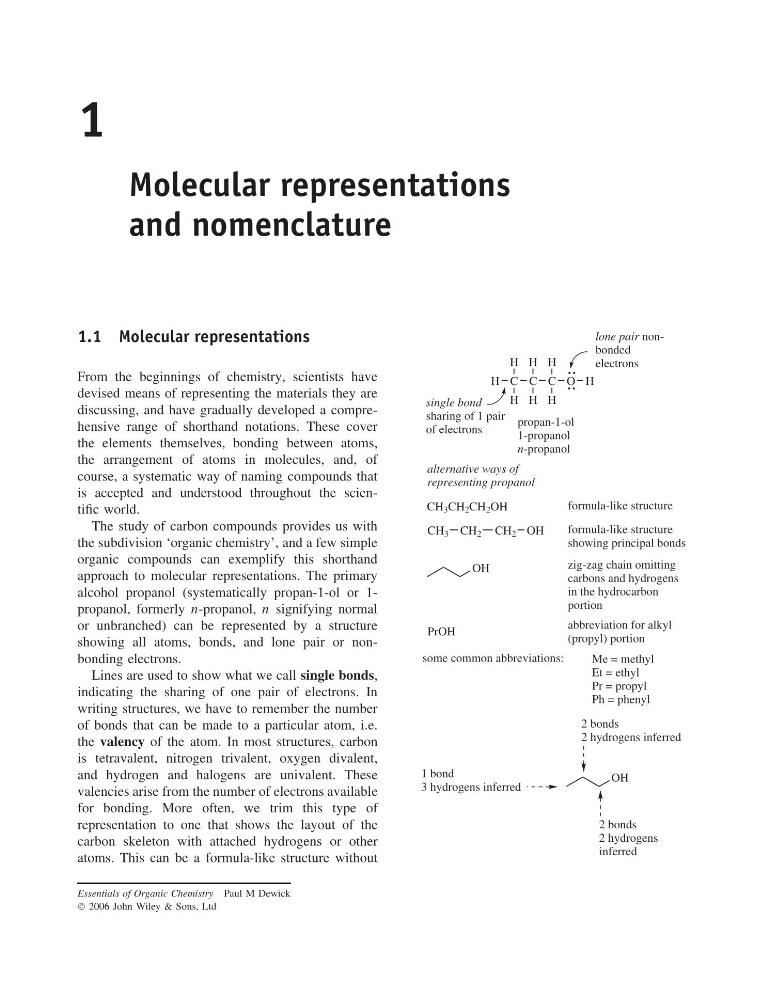
approach to molecular representations. The primary
alcohol propanol (systematically propan-1-ol or 1propanol, formerly n-propanol, n signifying normal
or unbranched) can be represented by a structure
showing all atoms, bonds, and lone pair or nonbonding electrons.
Lines are used to show what we call single bonds,
indicating the sharing of one pair of electrons. In
writing structures, we have to remember the number
of bonds that can be made to a particular atom, i.e.
the valency of the atom. In most structures, carbon
is tetravalent, nitrogen trivalent, oxygen divalent,
and hydrogen and halogens are univalent. These
valencies arise from the number of electrons available
for bonding. More often, we trim this type of
representation to one that shows the layout of the
carbon skeleton with attached hydrogens or other
atoms. This can be a formula-like structure without
H C C
H
H
H
H
C
H
H
O H
Me = methyl
Et = ethyl
Pr = propyl
Ph = phenyl
propan-1-ol
1-propanol
n-propanol
OH
single bond
sharing of 1 pair
of electrons
lone pair nonbonded
electrons
CH 3 CH 2 CH 2 OH
alternative ways of
representing propanol
CH 3 CH 2 CH 2 OH
zig-zag chain omitting
carbons and hydrogens
in the hydrocarbon
portion
formula-like structure
formula-like structure
showing principal bonds
abbreviation for alkyl
(propyl) portion
some common abbreviations:
OH
1 bond
3 hydrogens inferred
2 bonds
2 hydrogens
inferred
2 bonds
2 hydrogens inferred
PrOH
Essentials of Organic Chemistry Paul M Dewick
2006 John Wiley & Sons, Ltd
Molecular representations
and nomenclature
1.1 Molecular representations
From the beginnings of chemistry, scientists have
devised means of representing the materials they are
discussing, and have gradually developed a comprehensive range of shorthand notations. These cover
the elements themselves, bonding between atoms,
the arrangement of atoms in molecules, and, of
course, a systematic way of naming compounds that
is accepted and understood throughout the scientific world.
The study of carbon compounds provides us with
the subdivision ‘organic chemistry’, and a few simple
organic compounds can exemplify this shorthand
approach to molecular representations. The primary
alcohol propanol (systematically propan-1-ol or 1propanol, formerly n-propanol, n signifying normal
or unbranched) can be represented by a structure
showing all atoms, bonds, and lone pair or nonbonding electrons.
Lines are used to show what we call single bonds,
indicating the sharing of one pair of electrons. In
writing structures, we have to remember the number
of bonds that can be made to a particular atom, i.e.
the valency of the atom. In most structures, carbon
is tetravalent, nitrogen trivalent, oxygen divalent,
and hydrogen and halogens are univalent. These
valencies arise from the number of electrons available
for bonding. More often, we trim this type of
representation to one that shows the layout of the
carbon skeleton with attached hydrogens or other
atoms. This can be a formula-like structure without
H C C
H
H
H
H
C
H
H
O H
Me = methyl
Et = ethyl
Pr = propyl
Ph = phenyl
propan-1-ol
1-propanol
n-propanol
OH
single bond
sharing of 1 pair
of electrons
lone pair nonbonded
electrons
CH 3 CH 2 CH 2 OH
alternative ways of
representing propanol
CH 3 CH 2 CH 2 OH
zig-zag chain omitting
carbons and hydrogens
in the hydrocarbon
portion
formula-like structure
formula-like structure
showing principal bonds
abbreviation for alkyl
(propyl) portion
some common abbreviations:
OH
1 bond
3 hydrogens inferred
2 bonds
2 hydrogens
inferred
2 bonds
2 hydrogens inferred
PrOH
Essentials of Organic Chemistry Paul M Dewick
2006 John Wiley & Sons, Ltd