

170
REACTION MECHANISMS
Counting the number of electrons on a particular
atom becomes even more important when mechanisms become a little more complex and involve the
making and breaking of bonds at the same atom. This
is going to be routine at carbon atoms, and the statement above, that ‘carbon cannot form more than four
bonds’, becomes an important guiding principle. Any
mechanism that adds electrons to a carbon atom that
is already carrying its full octet of electrons will also
require the breaking of a bond and the removal of the
excess electrons.
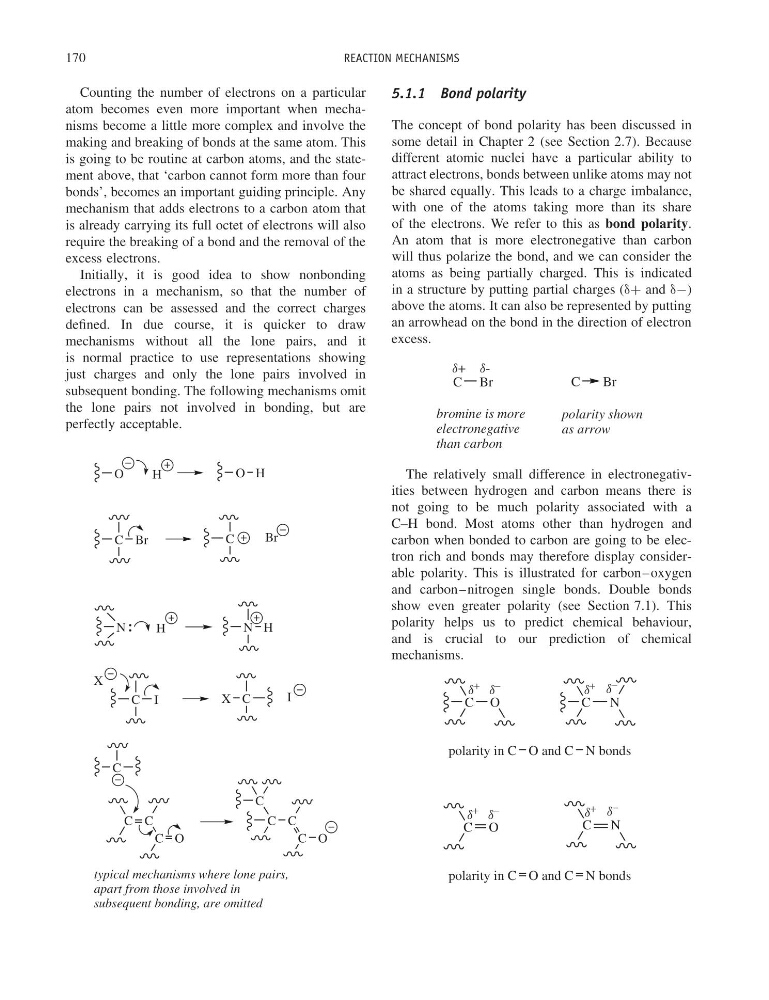
Initially, it is good idea to show nonbonding
electrons in a mechanism, so that the number of
electrons can be assessed and the correct charges
defined. In due course, it is quicker to draw
mechanisms without all the lone pairs, and it
is normal practice to use representations showing
just charges and only the lone pairs involved in
subsequent bonding. The following mechanisms omit
the lone pairs not involved in bonding, but are
perfectly acceptable.
O
C Br
C
N
N H
C I
C
X
C C
C O
C C
C O
C
C
O H
typical mechanisms where lone pairs,
apart from those involved in
subsequent bonding, are omitted
H
Br
H
I
X
5.1.1 Bond polarity
The concept of bond polarity has been discussed in
some detail in Chapter 2 (see Section 2.7). Because
different atomic nuclei have a particular ability to
attract electrons, bonds between unlike atoms may not
be shared equally. This leads to a charge imbalance,
with one of the atoms taking more than its share
of the electrons. We refer to this as bond polarity.
An atom that is more electronegative than carbon
will thus polarize the bond, and we can consider the
atoms as being partially charged. This is indicated
in a structure by putting partial charges (δ+ and δ−)
above the atoms. It can also be represented by putting
an arrowhead on the bond in the direction of electron
excess.
C Br
bromine is more
electronegative
than carbon
d+ dC
Br
polarity shown
as arrow
The relatively small difference in electronegativities between hydrogen and carbon means there is
not going to be much polarity associated with a
C–H bond. Most atoms other than hydrogen and
carbon when bonded to carbon are going to be electron rich and bonds may therefore display considerable polarity. This is illustrated for carbon–oxygen
and carbon–nitrogen single bonds. Double bonds
show even greater polarity (see Section 7.1). This
polarity helps us to predict chemical behaviour,
and is crucial to our prediction of chemical
mechanisms.
C O
C N
d + d −
d + d
−
C O
C N
d
+ d
−
d + d
−
polarity in C O and C N bonds
polarity in C O and C N bonds
REACTION MECHANISMS
Counting the number of electrons on a particular
atom becomes even more important when mechanisms become a little more complex and involve the
making and breaking of bonds at the same atom. This
is going to be routine at carbon atoms, and the statement above, that ‘carbon cannot form more than four
bonds’, becomes an important guiding principle. Any
mechanism that adds electrons to a carbon atom that
is already carrying its full octet of electrons will also
require the breaking of a bond and the removal of the
excess electrons.
Initially, it is good idea to show nonbonding
electrons in a mechanism, so that the number of
electrons can be assessed and the correct charges
defined. In due course, it is quicker to draw
mechanisms without all the lone pairs, and it
is normal practice to use representations showing
just charges and only the lone pairs involved in
subsequent bonding. The following mechanisms omit
the lone pairs not involved in bonding, but are
perfectly acceptable.
O
C Br
C
N
N H
C I
C
X
C C
C O
C C
C O
C
C
O H
typical mechanisms where lone pairs,
apart from those involved in
subsequent bonding, are omitted
H
Br
H
I
X
5.1.1 Bond polarity
The concept of bond polarity has been discussed in
some detail in Chapter 2 (see Section 2.7). Because
different atomic nuclei have a particular ability to
attract electrons, bonds between unlike atoms may not
be shared equally. This leads to a charge imbalance,
with one of the atoms taking more than its share
of the electrons. We refer to this as bond polarity.
An atom that is more electronegative than carbon
will thus polarize the bond, and we can consider the
atoms as being partially charged. This is indicated
in a structure by putting partial charges (δ+ and δ−)
above the atoms. It can also be represented by putting
an arrowhead on the bond in the direction of electron
excess.
C Br
bromine is more
electronegative
than carbon
d+ dC
Br
polarity shown
as arrow
The relatively small difference in electronegativities between hydrogen and carbon means there is
not going to be much polarity associated with a
C–H bond. Most atoms other than hydrogen and
carbon when bonded to carbon are going to be electron rich and bonds may therefore display considerable polarity. This is illustrated for carbon–oxygen
and carbon–nitrogen single bonds. Double bonds
show even greater polarity (see Section 7.1). This
polarity helps us to predict chemical behaviour,
and is crucial to our prediction of chemical
mechanisms.
C O
C N
d + d −
d + d
−
C O
C N
d
+ d
−
d + d
−
polarity in C O and C N bonds
polarity in C O and C N bonds